
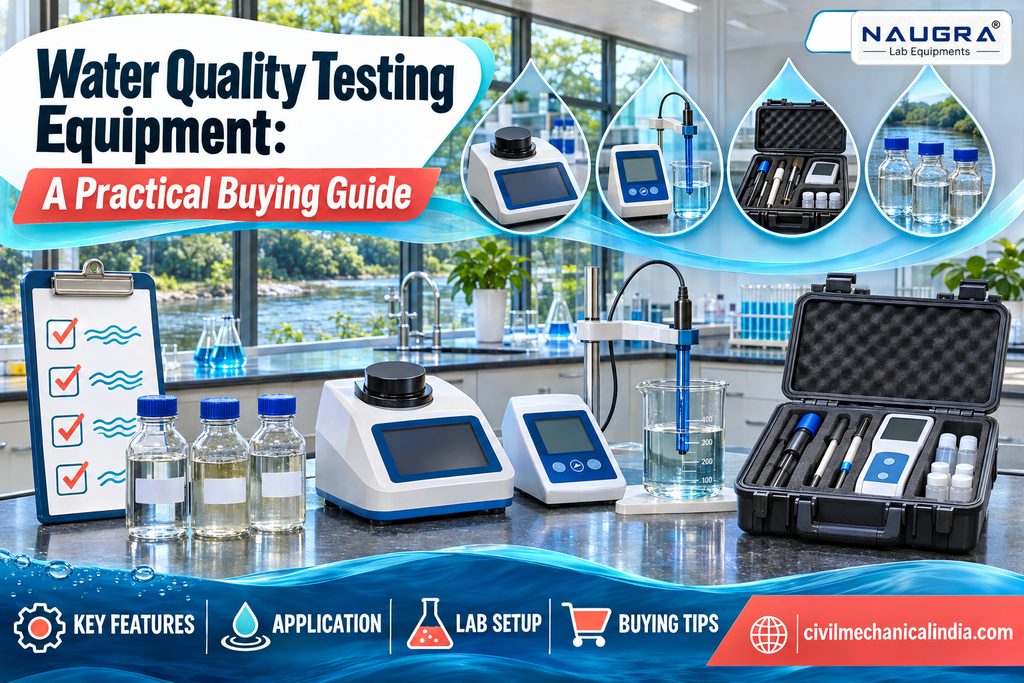
Water quality testing equipment answers three questions about a sample: is it physically acceptable, is it chemically safe, and is it free of harmful bacteria. We manufacture and supply environmental lab instruments from India. This guide helps water utilities, county labs and universities in Kenya, Ethiopia, Ghana, Tanzania and Uganda choose equipment for each question.
What needs to be measured
| Group | Parameters | Instrument |
|---|---|---|
| Physical | Turbidity, colour, temperature, conductivity, dissolved solids | Turbidity meter, conductivity meter, TDS meter |
| Chemical | pH, dissolved oxygen, chlorine, nitrate, fluoride, iron | pH meter, DO meter, colorimeter or spectrophotometer, ion meter |
| Biological | Coliform bacteria, oxygen demand | Incubator, autoclave, BOD incubator |
A small utility lab needs the physical group and pH daily, with chemical and biological tests on a schedule set by the regulator.
Water quality testing equipment in our range
These products are listed in our Environmental Lab Equipment category.
| Product | Code | Measures |
|---|---|---|
| Digital Turbidity Meter | ELE-0007 | Cloudiness of water |
| Digital pH Meter | ELE-0003 | Acidity or alkalinity |
| Conductivity Meter | ELE-0004 | Dissolved salts by conductivity |
| Digital Dissolved Oxygen Meter | ELE-0008 | Oxygen available to aquatic life |
| Digital Water and Soil Testing Kit | ELE-0006 | Several field parameters in one portable kit |
| Digital Photo Colorimeter | ELE-0001 | Concentration by colour reaction |
| BOD Incubator | ELE-0009 | Five-day oxygen demand at controlled temperature |
Our electrochemistry range adds a Digital Ion Meter with Ion Selective Electrodes, described on the site with electrode inputs for fluoride, nitrate, chloride and sodium.
How to choose
- Start from the regulation. Your national drinking water standard lists the parameters and limits.
- Split field and lab work. Portable water quality testing devices go to the source. Bench instruments stay in the lab.
- Check reagent supply. Colour-based tests need reagents you can buy locally and in date.
- Plan microbiology properly. It needs an incubator instrument, an autoclave and a clean bench.
- Do not forget water sampling equipment: bottles, cool boxes and depth samplers decide whether the result means anything.
A digital spectrophotometer costs more than a filter colorimeter but covers more methods and wavelengths.
Think about record keeping as well. Regulators and donors increasingly ask for dated results with the instrument and operator named. Meters with memory or a data output make that easier than handwritten logbooks, and they reduce transcription errors when a team tests dozens of sources in one week.
What drives the price
We quote per specification. Cost depends on:
- Number of parameters.
- Portable or bench format.
- Single or multi-parameter meters.
- Accuracy and detection limit.
- Starter reagents, standards and spare probes.
- Training and installation.
Probes and electrodes are consumables. Price a spare for each meter.
Import and site notes by country
Bench instruments need stable mains power. Portable kits run on batteries.
| Country | Nominal mains supply | Usual port of entry | Note for this equipment |
|---|---|---|---|
| Kenya | 240 V, 50 Hz | Mombasa | Fluoride is high in Rift Valley groundwater. An ion meter with a fluoride electrode is a priority. |
| Ethiopia | 220 V, 50 Hz | Djibouti, then road or rail (landlocked) | Rural schemes are far from labs. Portable kits with built-in incubation serve field teams. |
| Ghana | 230 V, 50 Hz | Tema | Small-scale mining raises turbidity and metals in rivers. Turbidity meters work hard here. |
| Tanzania | 230 V, 50 Hz | Dar es Salaam | Lake zone utilities watch algae and dissolved oxygen. Add DO meters with spare membranes. |
| Uganda | 240 V, 50 Hz | Mombasa, then road (landlocked) | District water offices test boreholes after repairs. Rugged pH and conductivity meters suit that work. |
Mistakes to avoid
- Buying instruments without standards for calibration.
- Storing reagents in heat.
- Skipping sample preservation and cooling.
- Running microbiology without sterilisation equipment.
- Using one probe for clean and polluted samples.
Frequently asked questions
Which instrument should a new water lab buy first?
A laboratory pH meter, a turbidity meter and a conductivity meter. Add a colorimeter and an incubator next.
Do you supply air and noise monitoring enviro instruments too?
Yes. Samplers, particle counters and sound level meters are listed in the same Environmental Lab Equipment category.
Is one water instrument enough for a field team?
A multi-parameter kit covers screening. Samples that fail screening still go to the lab for confirmation.
Get a quotation
Send your parameter list and sample numbers through our contact page. We will propose field and lab equipment with a quotation. More instruments are listed under Analytical Lab Instruments.