
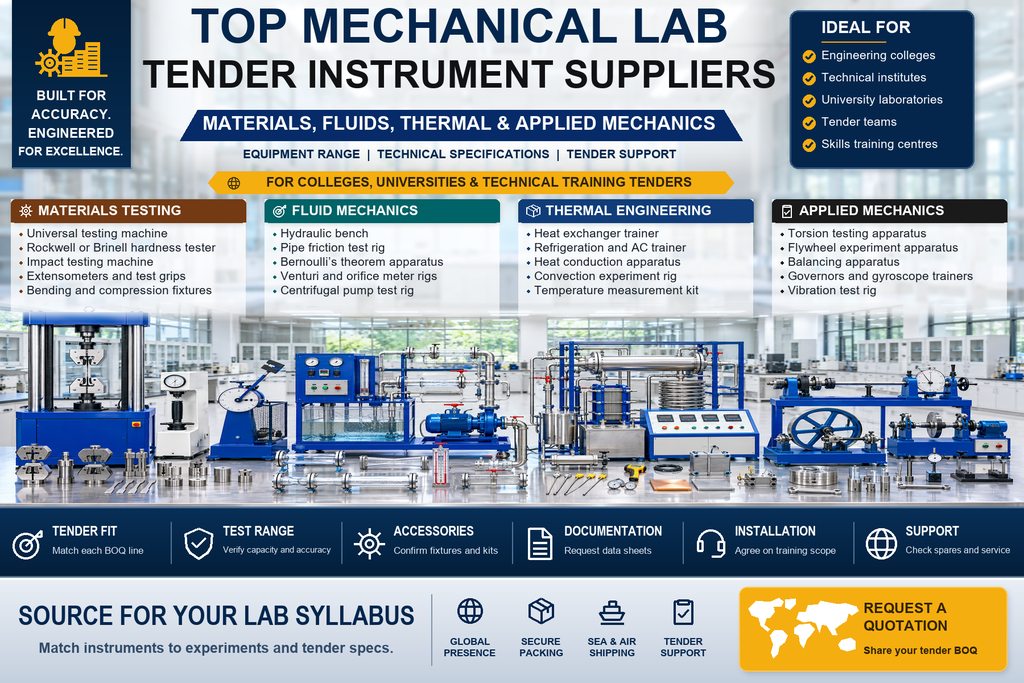
We are mechanical lab tender instruments suppliers and manufacturers based in India, and we equip mechanical engineering laboratories for universities, polytechnics, technical training centres and industrial test rooms in any country. This page sets out our categories and key products with model codes, and explains how we respond to tenders and ship in bulk.
Categories we cover as mechanical lab tender instruments suppliers
A mechanical engineering department is normally equipped laboratory by laboratory. Our website follows the same structure, so a tender schedule can be matched to a category in minutes.
| Laboratory | Category on our website | What it contains |
|---|---|---|
| Strength of materials | Materials Testing Lab Equipment | Universal, torsion, impact, hardness, fatigue and creep machines |
| Fluid mechanics and machinery | Fluid Mechanics Lab Equipment | Flow, pipe friction, pump and turbine rigs |
| Thermal engineering | Thermal Engineering Lab Equipment | Engine test benches, steam and compressor rigs |
| Heat and mass transfer | Heat and Mass Transfer Lab Equipment | Conduction, convection, radiation and heat exchanger rigs |
| Metrology | Measurement Lab Equipment | Gauges, micrometers, projectors and alignment instruments |
| Refrigeration and air conditioning | Refrigeration & Air Conditioning Lab Equipment | Refrigeration, heat pump and air conditioning test rigs |
All of these sit under Mechanical Engineering Lab Equipment, which also lists applied mechanics, dynamics of machines, robotics and fuel testing.
Key products with model codes
The table lists machines and rigs that appear most often in mechanical laboratory tenders. Codes are those shown on our website.
| Product | Model code | Laboratory and use |
|---|---|---|
| Computerised Universal Testing Machine | MTL-0001 | Strength of materials: tensile, compression and bend tests with computer control |
| Digital Torsion Testing Machine | MTL-0002 | Strength of materials: torsion of bars and shafts, digital |
| Impact Testing Machine-Digital | MTL-0004 | Strength of materials: Izod and Charpy impact energy, digital |
| Digital Rockwell Hardness Tester | MTL-0005 | Strength of materials: Rockwell hardness, digital |
| Pelton Wheel Turbine Test Rig | CMI-NP-1503 | Fluid machinery: efficiency and characteristics of an impulse turbine |
| Centrifugal Pump Test Rig | CMI-NP-1500 | Fluid machinery: head, flow and efficiency curves of a centrifugal pump |
| Bernoullis Theorem Demonstration | FMM-0003 | Fluid mechanics: energy conservation along a venturi |
| Single Cylinder Four Stroke Diesel Engine Test Bench | TEE-0012 | Thermal: performance of a single cylinder diesel engine |
| Marcet Boiler Test Setup | TEE-0024 | Thermal: saturation pressure and temperature of steam |
| Shell and Tube Heat Exchanger with Data Acquisition | HET-0015 | Heat transfer: performance of a shell and tube exchanger, with data acquisition |
| Free and Force Convection Apparatus | HET-0009 | Heat transfer: natural and forced convection |
| Slip Gauge Block Set | CMI-NP-1570 | Metrology: gauge blocks for building exact lengths |
| Profile Projector Bench Type | CMI-NP-1569 | Metrology: optical comparator for small parts |
Our product pages show names and codes for most of these, with capacities and ratings confirmed in the quotation against your specification.
How we respond to a tender
Tender documents differ from country to country, but the work is the same. We follow five steps.
- We read the technical specification and the schedule of requirements line by line.
- We match each line to a product and state its model code.
- We note the standard the item meets and any deviation from the specification.
- We list accessories, spares and consumables as separate lines, so nothing is hidden in a lump sum.
- We state delivery period, packing, and installation and training options.
Buyers who are still drafting a tender can send us the syllabus or the list of experiments instead. We return a schedule of equipment that can be pasted into the tender documents.
What decides the specification
Mechanical laboratory equipment is not bought from a fixed price list, because the same rig can be built at several levels. These are the points to settle early.
- Capacity. A universal testing machine is sized by the largest specimen. A pump or turbine rig is sized by the room and the services available.
- Measurement. Dial gauges and manometers teach principles. Sensors with data acquisition save time and suit research.
- Control. Manual, digital or computerised operation changes both price and training needs.
- Services. Three-phase power, water, drainage, compressed air and exhaust must exist in the room before rigs arrive.
- Class size. One rig per student group for common experiments, with larger rigs shared in rotation.
Supplying tenders in any country
We export worldwide. Electrical supply, documentation language and delivery route change with the destination, so we confirm them for every order.
| Region | Typical mains supply | Points we confirm with the buyer |
|---|---|---|
| Africa | 220 to 240 V, 50 Hz in most countries | Port or inland delivery point, French or Portuguese documents where needed |
| Middle East | 220 to 240 V, 50 or 60 Hz | Legalised documents, heat and dust at site |
| South and Southeast Asia | 220 to 240 V, 50 Hz in most countries | Local standards alongside ISO and ASTM |
| Latin America and the Caribbean | 110 to 127 V or 220 V, 50 or 60 Hz | Voltage and frequency by country and even by state, Spanish or Portuguese documents |
| Europe and Central Asia | 230 V, 50 Hz | EN standards and conformity documents |
| Pacific and island states | Varies | Consolidated sea shipment and long transit times |
These supply figures are general reference values. We ask every buyer to confirm voltage, frequency and phase in writing before manufacture, because motors, heaters and pumps are built to suit.
Packing, shipping and installation
Heavy machines travel bolted into wooden cases with lifting points marked. Rigs with glass tubes, gauges and sensors are braced internally and packed with spares for fragile parts. Each case carries a packing list that matches the tender line numbers, which makes checking at the store quick.
A complete department usually ships as one consolidated consignment. That reduces freight, simplifies customs clearance and means the laboratory can be commissioned in one visit. Installation, commissioning and training are available on request and are quoted as separate lines.
Frequently asked questions
Can you supply a complete mechanical engineering department in one order?
Yes. We quote all laboratories in one offer, grouped by laboratory, with model codes against each tender line.
Which standards do you manufacture to?
Testing machines are made to IS, BS, EN, ASTM or AASHTO as applicable. Teaching rigs are built to the experiment list in your syllabus. We state the basis for each line in the offer.
Do you supply manuals and experiment procedures?
Rigs are supplied with instruction manuals. Tell us if your tender requires procedures in a particular format or language.
Send us your tender requirements
Whichever country you are buying for, send us your tender requirements as they stand: the technical specification, the schedule of quantities and any compliance forms. We will reply with an itemised offer that names the product, model code and standard for every line, and we will point out anything that needs clarification before you evaluate.
We can supply the complete mechanical laboratory list from India, in single units or in bulk for several campuses: materials testing machines, fluid mechanics and hydraulic machinery rigs, engine and steam test benches, heat transfer apparatus, refrigeration rigs and metrology instruments. One supplier means one set of documents, one shipment and one team responsible for commissioning.
Tell us the destination, the electrical supply and the delivery date you must meet. Use our contact page to send the documents. We do not publish prices, since every tender differs in scope, but every enquiry receives a clear quotation with each item priced separately.