
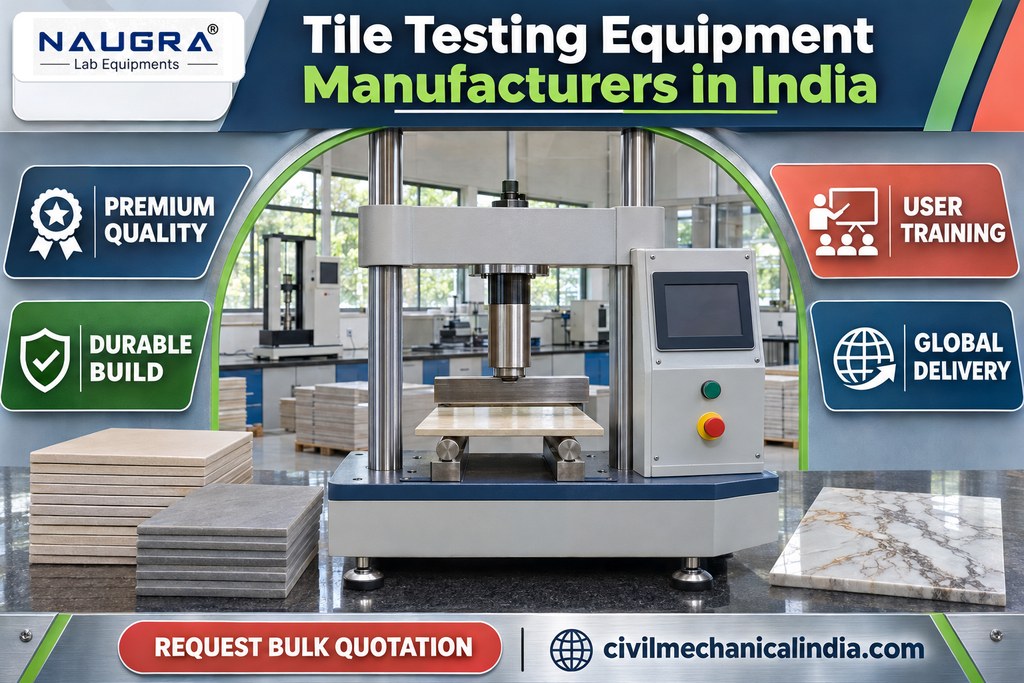
We manufacture tile testing equipment in India for ceramic tile factories, marble and granite processors, importers and standards bodies. Floor and wall tiles are sold to a standard that defines strength, wear, slip and stain resistance. The model codes below are for tender buyers in Africa and South America.
Our tile testing equipment range
| Product | Model code | Use |
|---|---|---|
| Ceramic Tile Breaking Strength and Modulus of Rupture Tester | CMI-IND-0441 | Breaking strength and modulus of rupture of tiles |
| Deep Abrasion Resistance Tester for Unglazed Tiles | CMI-IND-0442 | Deep abrasion resistance of unglazed tiles |
| Dynamic Coefficient of Friction Tester for Floor Tiles | CMI-IND-0443 | Dynamic coefficient of friction of floor tiles |
| Tile Chemical Resistance and Stain Resistance Test Cabinet | CMI-IND-0446 | Resistance to chemicals and stains |
| Marble and Stone Flexural and Compressive Strength Test Machine | CMI-IND-0444 | Flexural and compressive strength of marble and stone |
| Rotary Platform Stone Wear Abrasion Tester for Marble Flooring | CMI-IND-0445 | Wear of marble flooring on a rotary platform |
Ten instruments are shown on our Marble and Floor Tiles Testing Instruments page.
Tests and applications
| Property | Test | Applies to |
|---|---|---|
| Strength | Breaking strength, modulus of rupture | All tiles |
| Porosity | Water absorption | Classification of tile type |
| Wear | Deep abrasion, surface abrasion | Floor tiles |
| Safety | Slip resistance | Floors, wet areas |
| Cleanability | Stain and chemical resistance | Kitchens, hospitals |
| Size | Dimensions, flatness | Installation quality |
Water absorption sorts tiles into groups, from dense porcelain to porous wall tile, and each group has its own strength limits. Breaking strength confirms the tile will carry loads once laid.
Abrasion tests decide where a tile can be used: a home bathroom, a shop or an airport. Slip resistance has become a specification item for public buildings and wet areas.
Natural stone is tested for compressive and flexural strength, absorption and wear before it is specified for flooring or cladding. Importers test tiles and stone at the port, and many countries apply mandatory standards.
What to specify in a tender
- Tile sizes, including the largest format.
- Standards followed, usually ISO 10545 or national equivalents.
- Load range and support spans for strength tests.
- Abrasive type and wheel for abrasion tests.
- Chemicals and staining agents specified.
Quality control in a tile plant
Test at each stage. Check raw material fineness and moisture, pressed tile density and dried strength, then fired properties. Fired tiles are sampled from each kiln car or time interval for dimensions, flatness, absorption and breaking strength.
Large-format tiles need wider supports and careful handling. Tell us your largest size so that the strength tester and flatness gauges can accommodate it.
Water absorption by boiling or vacuum needs a dedicated station with a balance and drying oven. Abrasion and slip tests are run less often, at product approval and periodically. Keep tested tiles with their kiln and shade codes for traceability, as complaints usually arrive after tiles have been laid.
Markets we supply in Africa and South America
Housing growth has made tile production one of the faster-growing building material industries in both regions.
| Country | Nominal mains supply | Usual port of entry | Note for buyers |
|---|---|---|---|
| Senegal | 230 V, 50 Hz | Dakar | Construction growth supports tile imports and new local production. |
| Egypt | 220 V, 50 Hz | Alexandria | A major producer of ceramic tiles and marble with extensive testing needs. |
| Tanzania | 230 V, 50 Hz | Dar es Salaam | New tile factories supply East African markets and test to regional standards. |
| Angola | 220 V, 50 Hz | Luanda | Imported tiles are checked for conformity as local production develops. |
| Argentina | 220 V, 50 Hz | Buenos Aires | Established ceramic producers and stone quarries test to national standards. |
| Colombia | 110 V, 60 Hz | Cartagena or Buenaventura | Supply is 110 V at 60 Hz. Motorised testers are built to suit. |
Why source from us
- Strength, wear, slip and chemical testers for tile and stone from one manufacturer.
- Supports and fixtures for your tile formats.
- Raw material and ceramic body testers on the same order.
- Installation and training available.
Frequently asked questions
Can the strength tester take large-format tiles?
Tell us the largest dimensions. We confirm support span and capacity in the offer.
Do you supply water absorption apparatus?
Yes. Boiling and vacuum apparatus are listed in the same category.
Are ceramic body tests covered?
Yes. See our Porcelains and Ceramics Testing Instruments range.
Send us your tender requirements
Tile factories, stone processors and standards bodies usually specify a laboratory against the tile standard. Send us your tender requirements and we will answer each line with the instrument we offer, its model code and the method it follows.
We can supply the tile and stone laboratory from India: breaking strength testers, water absorption apparatus, deep and surface abrasion testers, slip resistance testers, chemical and stain resistance cabinets, stone compression and flexure machines, dimension and flatness gauges, ovens and balances.
Tell us the products you make or inspect, the largest format, the standards and the destination. Use our contact page to send the details. We reply with an itemised quotation and delivery period.
Formats and standards decide the fixtures, so each tender is quoted on its own scope. Port inspection laboratories can ask for a reduced set covering the tests their regulation makes mandatory.