
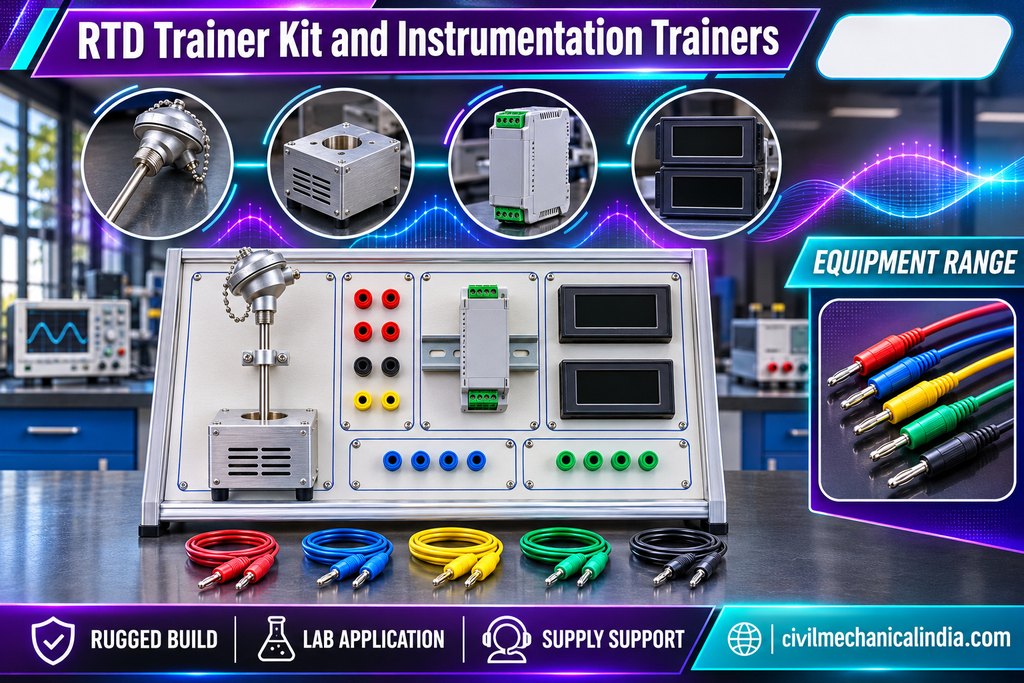
An RTD trainer kit teaches students how a resistance temperature detector turns temperature into a measurable electrical signal, and how that signal is conditioned and displayed. We manufacture instrumentation trainers in India. This page is for instrumentation departments in DR Congo, Botswana, Nigeria, South Africa and Egypt.
Our instrumentation trainers, including RTD trainer kit options
Temperature sensor training is covered by our Temperature and Pressure Measurement Trainer and Sensor Trainer. The products below are from our Instrumentation Trainers category.
| Product | Model code | Teaches |
|---|---|---|
| Linear Variable Differential Transducer Trainer | Instrumentation0001 | Displacement measurement with an LVDT |
| Pressure Transducer Trainer | Instrumentation0002 | Pressure sensing and signal conditioning |
| Mini Process Control Demonstrator | Instrumentation0005 | A small closed control loop |
| PLC Trainer | Instrumentation0003 | Ladder logic and industrial control |
| Digital Control System | Instrumentation0007 | Digital controller behaviour |
| Relay Control Trainer | Instrumentation0008 | Relay logic circuits |
Our website does not show a product page titled RTD trainer kit or thermocouple trainer kit. Name these in your enquiry, and we will confirm the trainer and its specification in the quotation.
What an RTD experiment covers
A platinum resistance thermometer changes resistance with temperature in a nearly straight line. The common Pt100 type has 100 ohms at 0 °C and rises by about 0.385 ohms per degree. Those are the standard values for industrial Pt100 sensors.
Students normally:
- Heat the sensor in steps and record resistance.
- Plot resistance against temperature and find the slope.
- Compare two-wire, three-wire and four-wire connections and see how lead resistance causes error.
- Feed the sensor into a bridge or transmitter and read a 4 to 20 mA output on a current device.
| Sensor | Principle | Strength | Limitation |
|---|---|---|---|
| RTD | Resistance of platinum rises with temperature | Accurate and stable | Slower, narrower range |
| Thermocouple | Two metals generate a small voltage | Wide range, rugged, fast | Needs cold junction compensation |
| Thermistor | Semiconductor resistance changes sharply | Very sensitive | Non-linear |
Applications
- Diploma and degree courses in instrumentation and control.
- Technician training for process plants, breweries, mines and power stations.
- Bridging courses in scientific electronics for mechanical students.
Features
- Sensors, heater, signal conditioning and display on one panel.
- Test points for meters and oscilloscopes.
- Patch leads and manual supplied.
- Related trainers for strain gauges, where students determine the gauge factor, on request.
Building an instrumentation lab
Group trainers by measured quantity: temperature, pressure, level, flow and displacement. Add one or two control trainers so students close the loop from sensor to actuator. Each bench needs a multimeter and access to an oscilloscope. Calibrators for temperature and pressure let advanced students practise the checks they will do in industry.
Linking the lab to industry practice
Ask local employers which sensors and transmitters they use, and include the same signal standards in class exercises. Students who have wired a three-wire RTD into a transmitter, scaled the output and checked it against a reference are ready for plant work. Short calibration exercises with written certificates build the documentation habit that industry expects.
Markets served: import and site notes
| Country | Nominal mains supply | Usual port of entry | Note for this equipment |
|---|---|---|---|
| DR Congo | 220 V, 50 Hz | Matadi (west); Dar es Salaam route for the east and south | Copper and cobalt plants employ many instrument technicians. Training should mirror plant sensors. |
| Botswana | 230 V, 50 Hz | Durban or Walvis Bay, then road (landlocked) | Diamond and power sectors need calibration skills. Add a reference thermometer and calibrator. |
| Nigeria | 230 V, 50 Hz | Lagos (Apapa or Tin Can Island) | Oil, gas and food industries recruit from polytechnics. Process control trainers are core. |
| South Africa | 230 V, 50 Hz | Durban | Colleges align with trade test requirements. Share the test tasks so trainers match. |
| Egypt | 220 V, 50 Hz | Alexandria | Petrochemical and fertiliser plants use RTDs widely. Three-wire and four-wire practice is essential. |
Why buy from us
- Manufacturer of sensor, control and PLC trainers.
- Electrical and electronics lab equipment on the same order.
- Itemised tender offers.
- Installation and training offered.
How to order
- Send the experiment list.
- State bench count, voltage and destination.
- We match trainers to experiments and quote.
Reach us through the contact page. Trainers are priced per configuration.
Frequently asked questions
Is an RTD better than a thermocouple?
Neither is better overall. RTDs are more accurate at moderate temperatures. Thermocouples cover higher temperatures and tolerate rough handling.
Do trainers include a heat source?
Temperature trainers normally include a small heater or bath. We confirm this in the offer.
Do you supply process control rigs as well?
Yes. See Process Control Training System and Temperature Process Control Training System.