
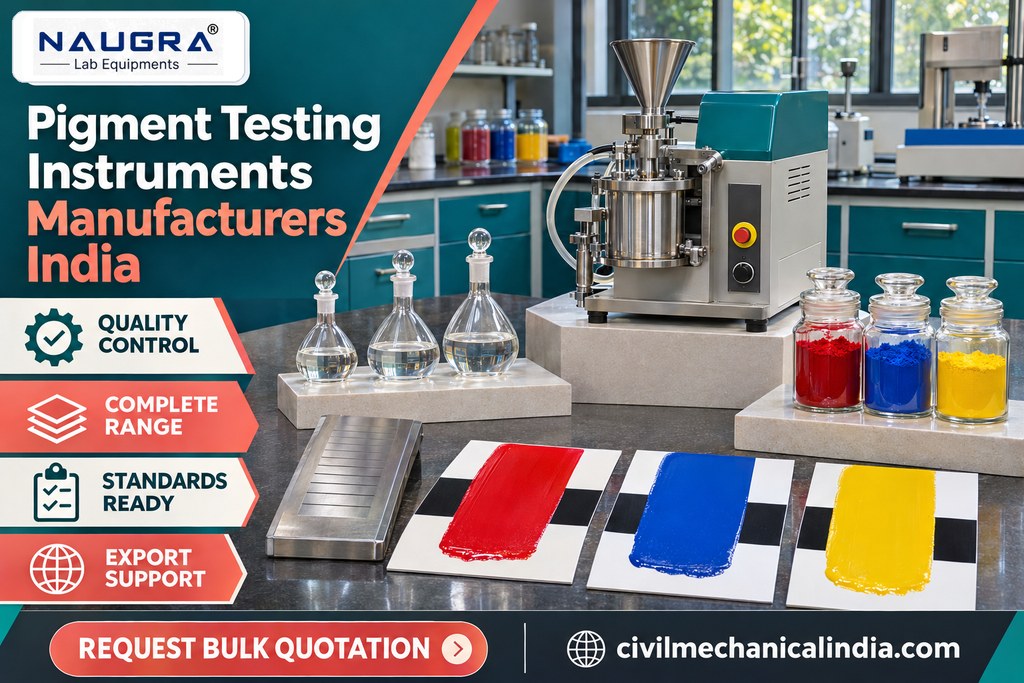
We manufacture pigment testing instruments in India for pigment producers and for the paint, ink and plastics companies that buy pigments. These instruments measure how well a pigment disperses, how much it hides, how it resists light and how consistent each lot is. The model codes below are for tender buyers in Africa and South America.
Our pigment testing instruments range
| Product | Model code | Use |
|---|---|---|
| Laboratory Bead Mill for Pigment Dispersion | CMI-IND-0234 | Dispersing pigment under controlled conditions |
| Dispersion Fineness of Grind Gauge for Pigment Pastes | CMI-IND-0232 | Fineness of dispersion in pastes |
| Hiding Power and Opacity Test Chart Apparatus | CMI-IND-0233 | Hiding power and opacity on contrast charts |
| Lightfastness and Weathering Tester for Pigmented Samples | CMI-IND-0235 | Lightfastness and weathering of coloured samples |
| Density Pycnometer and Specific Gravity Bottle Set for Pigments | CMI-IND-0231 | Density of pigment powders |
| Moisture and Volatile Matter Test Oven for Pigments | CMI-IND-0236 | Moisture and volatile matter |
Ten instruments are shown on our Pigments Testing Instruments page.
Tests and applications
| Property | Test | Effect on the product |
|---|---|---|
| Dispersibility | Milling, then grind gauge | Colour strength, gloss, defects |
| Opacity | Contrast ratio on charts | Coverage per litre |
| Durability | Light and weather exposure | Fading outdoors |
| Density | Pycnometer | Formulation by volume |
| Moisture | Oven loss | Storage stability, reactivity |
| Colour | Comparison with standard | Lot-to-lot consistency |
A pigment is only as good as its dispersion. Tests therefore begin by dispersing the powder in a standard medium under fixed conditions, then measuring fineness, strength and shade against a reference lot.
Hiding power decides how much pigment a paint maker needs, which makes it a direct cost factor. Lightfastness decides where the pigment can be used. A red that is acceptable indoors may fade in months on an exterior wall under tropical sun.
Buyers test every delivery. Small shifts in shade or strength between lots force a paint or ink maker to adjust formulas, so tight incoming control saves rework.
What to specify in a tender
- Pigment types: inorganic, organic, extenders.
- Dispersion medium and milling method used as your standard.
- Grind gauge range.
- Light source and cycle for exposure tests.
- Colour measurement method for strength and shade.
Making pigment tests repeatable
Standardise the dispersion step. Use the same medium, pigment loading, bead charge, speed and time for every test, and run the reference lot alongside each new lot. Without that discipline, differences in milling hide differences in the pigment.
Make drawdowns at a fixed film thickness on the same chart type, and compare them in a standard light. Store the reference pigment sealed and dry, and replace it before it runs out so that a new reference can be checked against the old.
Dry powders pick up moisture in humid climates. Keep samples closed, measure moisture on arrival and record it with the other results. Label every container with the lot number and date opened.
Markets we supply in Africa and South America
Paint, ink and plastics industries in both regions buy pigments in quantity, and some countries produce mineral pigments themselves.
| Country | Nominal mains supply | Usual port of entry | Note for buyers |
|---|---|---|---|
| Benin | 220 V, 50 Hz | Cotonou | Paint makers serving a busy construction market test incoming pigments. |
| Djibouti | 220 V, 50 Hz | Djibouti | A port economy where imported raw materials are inspected for regional buyers. |
| Congo | 230 V, 50 Hz | Pointe-Noire | Humid conditions make moisture control of powders important. |
| Malawi | 230 V, 50 Hz | Beira or Nacala, then road or rail | Small paint producers benefit from basic dispersion and opacity checks. |
| Paraguay | 220 V, 50 Hz | River route to Asunción | Paint and plastics producers import pigments and verify each lot. |
| Venezuela | 120 V, 60 Hz | La Guaira or Puerto Cabello | Supply is 120 V at 60 Hz. Mills and ovens are specified to suit. |
Why source from us
- Dispersion, opacity, durability and physical testers from one manufacturer.
- Paint and ink testers on the same order.
- Consumables such as charts and beads quoted separately.
- Installation and training available.
Frequently asked questions
Do you supply colour measuring instruments?
Yes. Tell us the colour system you report and we will include a suitable instrument.
Which beads does the mill use?
Tell us your pigments and medium. We state bead material and size in the offer.
Are paint film testers available?
Yes. See our Paint Testing Equipment India range.
Send us your tender requirements
Pigment producers and users share one aim, which is lots that match. Send us your tender requirements for pigment testing and we will answer each line with the instrument we offer, its model code and the accessories supplied.
We can supply the pigment laboratory from India: laboratory mills, grind gauges, film applicators and opacity charts, lightfastness and weathering testers, pycnometers, moisture ovens, oil absorption apparatus, sieves, colour meters and balances. For paint and ink makers, viscosity, gloss, adhesion and film testers are added to the same offer.
Tell us the pigments you make or buy, the industries you supply and the destination port. Reach us through the contact page. We reply with an itemised quotation and delivery period. Test media and methods are specific to each company, so every tender is quoted on its own scope. Charts, beads, applicators and other consumables are priced line by line, so you can order the quantities that suit your sample numbers.