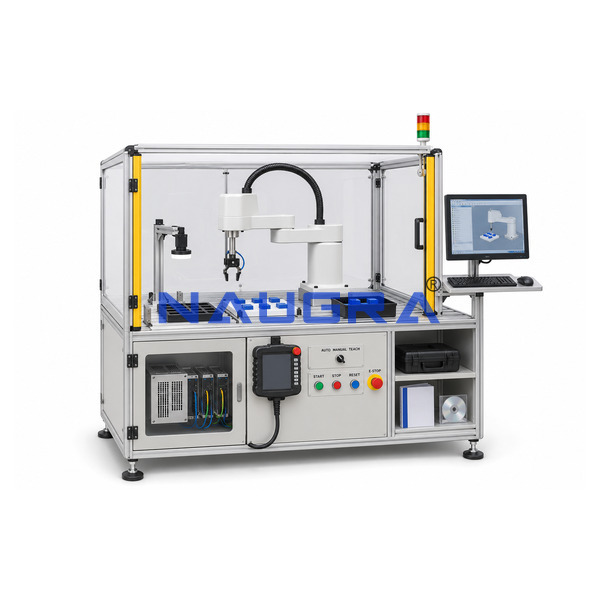
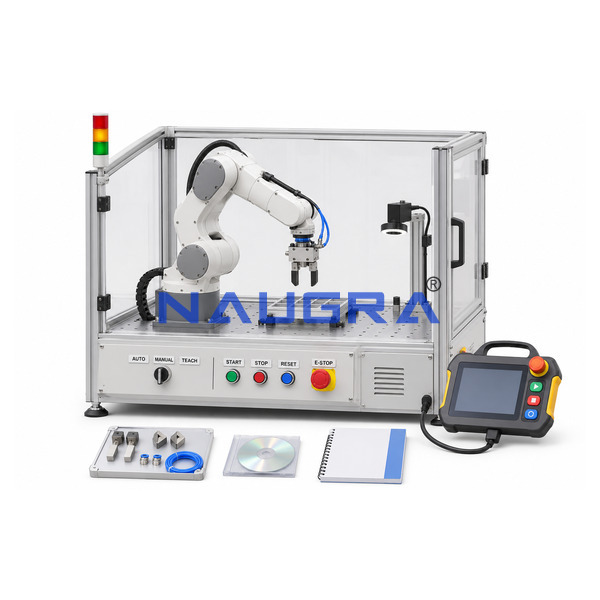
Four Joints Robot Training System Manufacturers and Suppliers in India
Four Joints Robot Training System
Quick answer: Four Joints Robot Training System units are made and supplied in India by Civil Mechanical India, a manufacturer and supplier covering four joints, SCARA, six-axis, gantry, delta and collaborative arms plus palletizing and vision sorting stations. Engineering colleges and robotics labs use them.
Four joints robot training system manufacturers in India are expected to cover more than one arm type, since industry uses SCARA, delta, gantry and six-axis machines. This page groups our robot trainers by arm configuration and application. Among suppliers in India we describe payload, reach and controller so that mechatronics courses can pick the right arm.
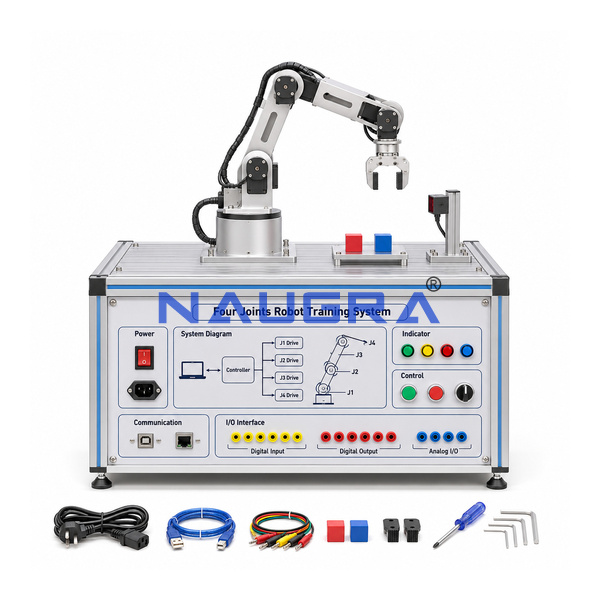
Robot training works best when students meet several kinematic types. The four joints system consists of distribution, transmission and robot modules, while the SCARA station teaches horizontal articulated motion and assembly, and the six-axis system covers kinematics and teach pendant programming. The Cartesian gantry teaches XYZ linear motion, and the delta parallel robot shows high speed pick and place.
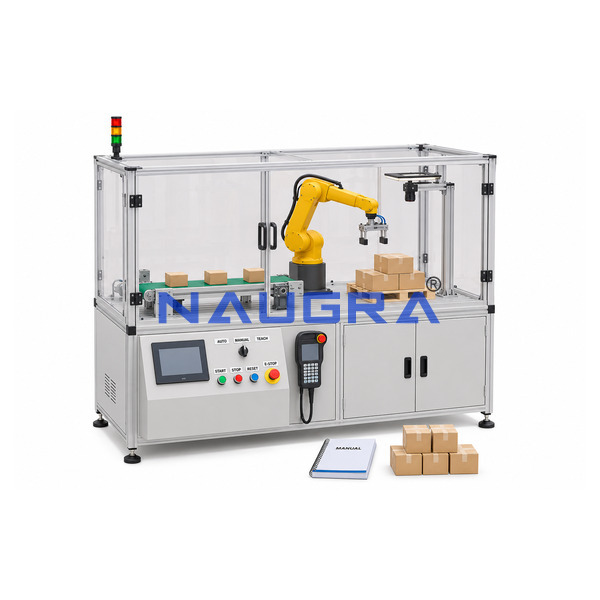
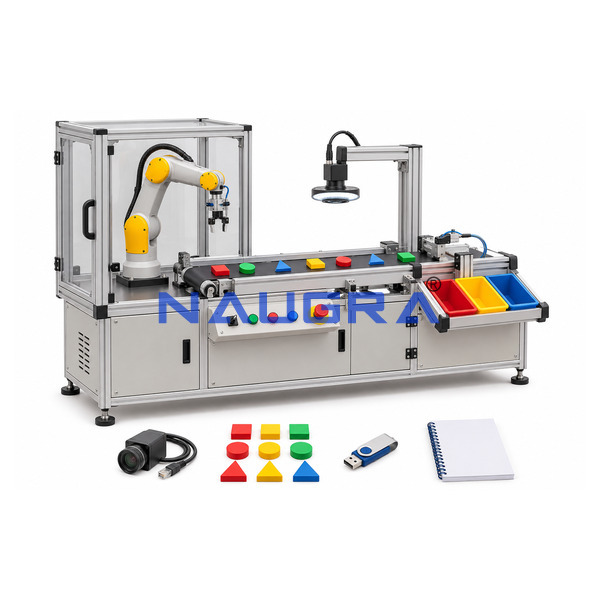
Application stations then turn these arms into working cells: palletizing, vision-based colour and shape sorting, and gripper and end effector exercises. A collaborative arm introduces safe human-robot working, a mobile platform covers line following and obstacle avoidance, and the software station allows offline programming and simulation before using the robot.
Product code: CMI-NP-1329
Buy Robot Programming and Simulation Training Software Station from India
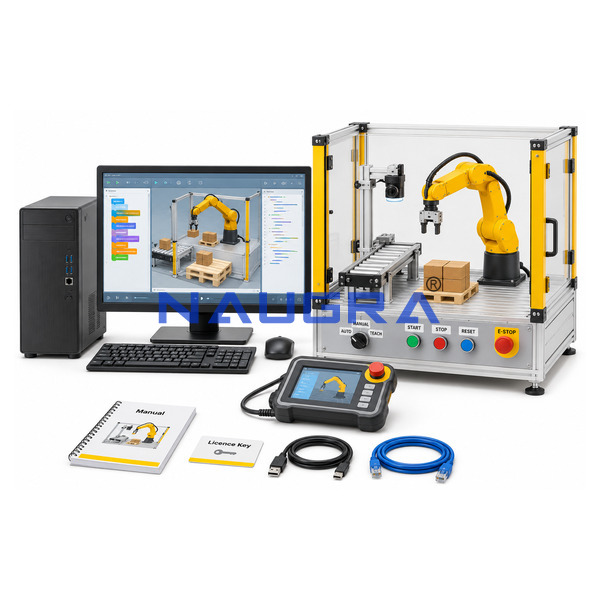
Robot Programming and Simulation Training Software Station is a training station designed for offline programming and simulation of articulated robot cells.
Product code: CMI-NP-1332
Buy Six-Axis Industrial Robot Training System from India
Six-Axis Industrial Robot Training System is a robot training system designed for learning kinematics, teach pendant programming and pick and place tasks.
Four Joints Robot Training System range by function
Camera resolution and lighting, gripper type, conveyor or pallet size, software licence and PC specification
How is this different from Mechatronic Training System?
A mechatronic training system combines mechanics, sensors, pneumatics and PLC control on a station, usually with simple handling devices. A robot training system concentrates on the manipulator itself: its joints, kinematics, teach pendant and programming, and the application cells built around it. Mechatronic stations suit first-year automation courses, and robot trainers belong to a second stage of industrial robotics.
A SCARA or four joints arm is the easiest start, because motion is limited to a plane plus vertical travel and programming is simple. A six-axis arm teaches full kinematics and is the better choice if students will work with industrial robots later. Delta and gantry robots suit packaging and pick and place modules.
What should be checked on the robot and its controller?
Confirm payload (often a few kilograms for teaching arms), reach, repeatability in mm, number of axes and the programming method: teach pendant, text commands or graphical software. Check emergency stop circuits, protective guarding and I/O for sensors and grippers. Include the offline simulation software so that more students can practise without the arm.
Who buys Four Joints Robot Training System?
Polytechnic and engineering mechatronics departments, ITIs offering industrial robotics or automation courses, and skill academies buy these trainers. Technical universities add collaborative arms and vision modules for research projects, and training centres of manufacturing firms use palletizing stations for operator courses.
It is a manipulator with four joints, commonly three rotary axes plus a vertical axis or rotation of the wrist, suited to pick and place and assembly tasks. It is a simple way to teach kinematics and programming.
How is a SCARA robot different from a six-axis arm?
A SCARA arm is stiff vertically and compliant horizontally, ideal for assembly on a flat table. A six-axis arm can reach around objects in any orientation, so it is used for welding, painting and machine tending.
What does the vision sorting module do?
A camera identifies colour and shape of parts and sends position information to the robot controller, which then sorts parts into bins. It teaches how machine vision and robots work together.
Are collaborative robots safe for students?
Collaborative arms limit force and speed and stop on contact, which is why they are used for teaching. Still, risk assessment and a clear workspace are needed, and the training unit includes safety instruction.
Do you export robot trainers to institutes overseas?
Yes, they are shipped with controllers, software licences and manuals. State the destination voltage and the software language needed so that the correct configuration is supplied for your country.
Tender enquiries
Request a tender quotation
As established manufacturers and suppliers for tender requirements from India, we undertake civil laboratory and industrial testing tenders as well as bulk and OEM supply of mechanical engineering and testing laboratory equipment. Please forward your tender specifications and our team will prepare a detailed quotation for Four Joints Robot Training System.