
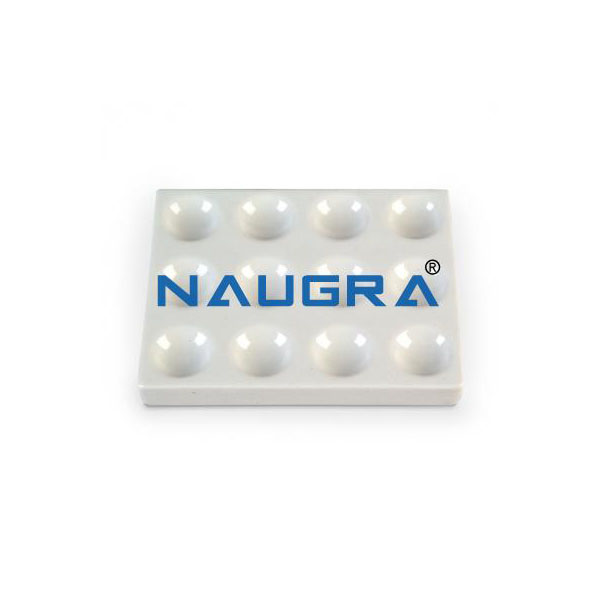
Cavity Reaction Spot Plate Porcelain
Product code: EDU-POC-0001Buy Cavity Reaction Spot Plate Porcelain from India
Cavity Reaction Spot Plate Porcelain
Porcelain ware manufacturers in India are asked mostly for items that must survive a flame or a muffle furnace without cracking. We supply crucibles with lids for ashing and gravimetric work, spouted evaporating dishes, perforated-plate Buchner funnels and unglazed mortars. Suppliers in India often stock only a few sizes, so tell us the capacity you need in ml for each piece.
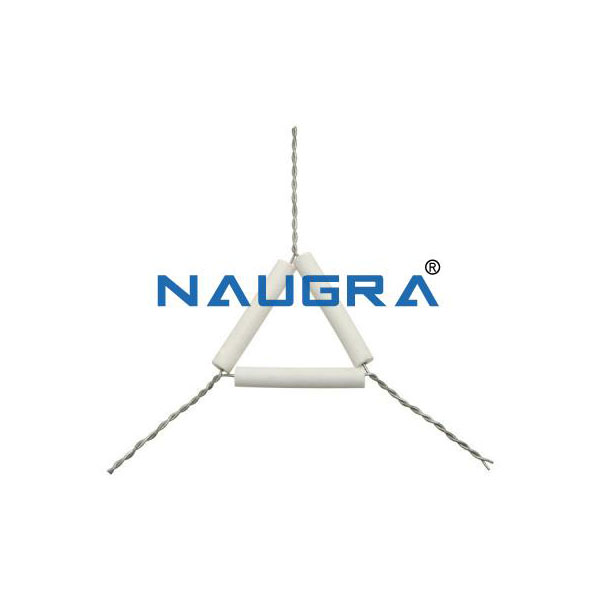
Porcelain is chosen where glass would soften or crack: it tolerates red heat, resists most acids and can be weighed repeatedly after ignition. The range is grouped by what the lab does with it. Crucibles with lids and clay triangles support heating and ashing, while the spouted evaporating dish concentrates solutions over a water bath or hot plate.
The Buchner funnel with a perforated plate sits on a filter flask for vacuum filtration of precipitates. The mortar and pestle has an unglazed grinding surface, because glaze would polish smooth and stop grinding. The 12-cavity spot plate, glazed on top and sides and about 115 x 90 mm, gives white wells for colour reactions on a drop scale.
Last updated: November 2026
Cavity Reaction Spot Plate Porcelain
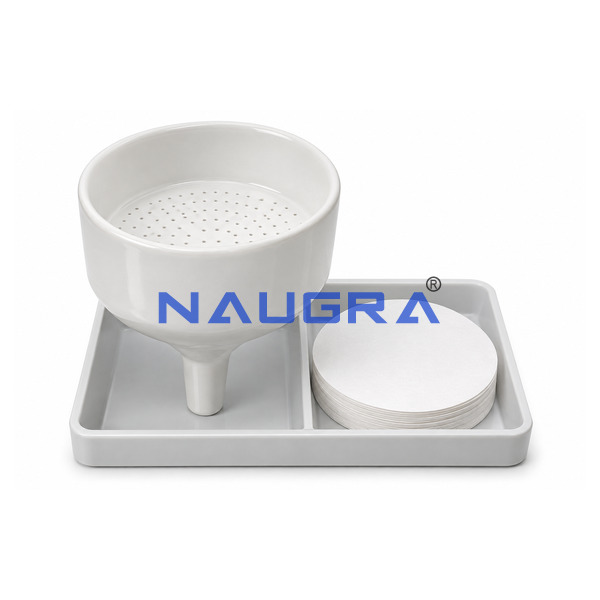
Perforated plate porcelain funnel used with a filter flask and filter paper for vacuum filtration of precipitates in chemistry practicals. Key highlights include perforated filter plate and glazed porcelain.
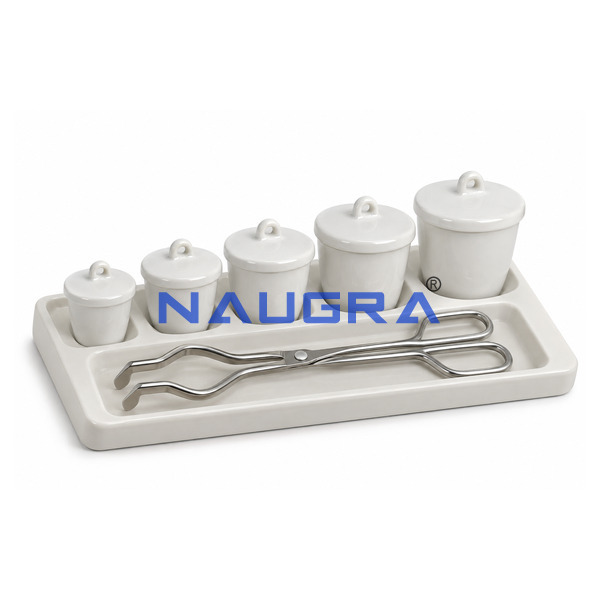
Glazed porcelain crucible with lid for heating, ashing and igniting samples at high temperature in analytical and gravimetric chemistry. Key highlights include glazed inside and outside and heat resistant porcelain.
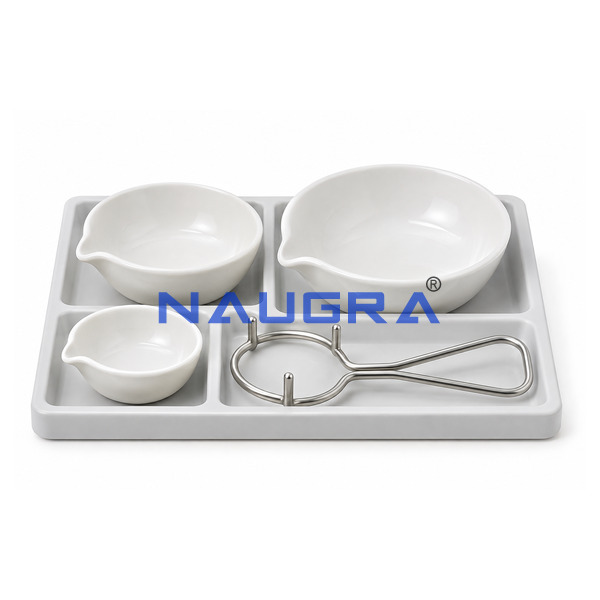
Round bottom porcelain evaporating dish with spout for concentrating solutions by evaporation on a water bath or hot plate in the laboratory. Key highlights include glazed porcelain and pouring spout.
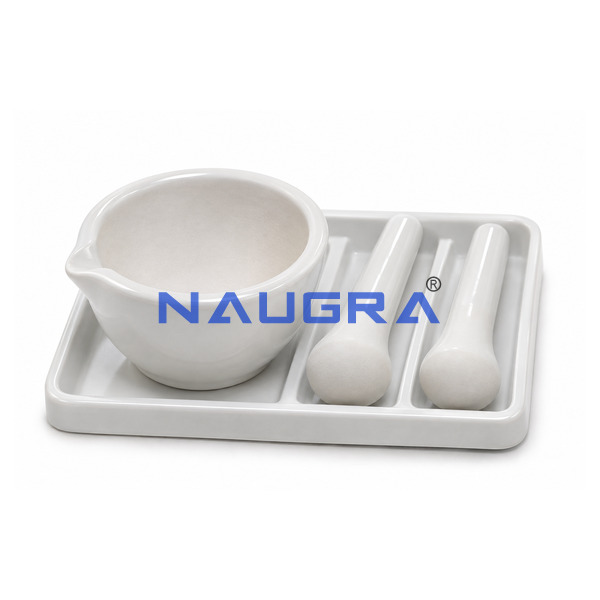
Unglazed grinding surface porcelain mortar with pestle for crushing and grinding solid samples into fine powder in chemistry and pharmacy laboratories. Key highlights include rough inside surface and glazed outer surface.
| Function | Products | What to confirm |
|---|---|---|
| Heating and ignition | Porcelain Crucible with Lid, Porcelain Evaporating Dish, Clay Triangle | Capacity in ml, glaze inside and outside, lid fit, clay triangle side (50 mm) matched to crucible diameter |
| Filtration and grinding | Porcelain Buchner Funnel, Porcelain Mortar and Pestle | Funnel diameter and plate hole pattern, matching filter paper size, mortar diameter and unglazed grinding face |
| Spot testing | Cavity Reaction Spot Plate Porcelain | Number of cavities (12), cavity depth, glazed surface and overall plate size |
Porcelain handles direct flame, muffle furnace temperatures and thermal shock that would crack borosilicate glass, which is why ashing and ignition are done in porcelain crucibles. The trade-off is that you cannot see the contents, and the ware is heavier and chipped by knocks. Glassware is transparent and graduated for measuring volumes; porcelain is bought for heat, grinding and filtering duty.
See also: Laboratory Glassware
The complete Porcelain Ware range (6 products), in alphabetical order:
| Cavity Reaction Spot Plate Porcelain | Clay Triangle | Porcelain Buchner Funnel |
| Porcelain Crucible with Lid | Porcelain Evaporating Dish | Porcelain Mortar and Pestle |
Decide the capacity from the sample mass, commonly 15 to 50 ml for crucibles, and check that the lid sits flat. Confirm that glaze covers the inside and outside and that there are no pinholes or crazing lines, which lead to weight change in gravimetric work. Ask for the maximum working temperature and for matching clay triangles or tongs in the same offer.
A Buchner funnel must match the filter flask rubber bung and take circular filter paper just smaller than the perforated plate, so state the diameter of both. For grinding, pick a mortar with an unglazed inner surface and a pestle that fits the base curve, sized by the batch of sample you crush at a time.
Chemistry departments of schools and colleges buy crucibles, dishes and spot plates for qualitative and gravimetric analysis. Pharmacy colleges favour mortars and pestles for trituration. Cement, fly ash and coal testing labs use crucibles with lids for loss on ignition work. These items normally ride along with glassware, burners and analytical balances in one chemistry lab order.
Yes, glazed porcelain crucibles are made for that duty, but heat and cool them gradually. Placing a cold crucible into a furnace already at 900 deg C or taking a hot one onto a cold bench can cause cracks.
Glaze wears smooth and the pestle then slides instead of crushing. The rough, unglazed biscuit surface grips the solid and breaks it down, which is why only the outside of the mortar is glazed.
The 12-cavity plate is roughly 115 x 90 mm with shallow round depressions that hold a few drops each. The white glazed surface makes colour changes and precipitates easy to see.
The funnel fits into a thick-walled filter flask through a rubber ring, filter paper is wetted on the perforated plate and suction from a water pump or vacuum pump draws the liquid through. Use only vacuum-rated flasks.
Porcelain is fragile, so we pack it in partitioned cartons with cushioning for export. Share piece counts and sizes so that breakage allowance can be considered in the quotation.
Civil Mechanical India is one of the leading manufacturers and suppliers in India for tender requirements, covering civil laboratory and industrial testing tenders and the bulk and OEM supply of mechanical engineering and testing laboratory equipment. Kindly share your tender specifications and we shall submit a complete quotation for Porcelain Ware.
Send us your equipment list or tender specification. We quote against IS, BS, EN, ASTM and AASHTO standards and ship to 90+ countries.