
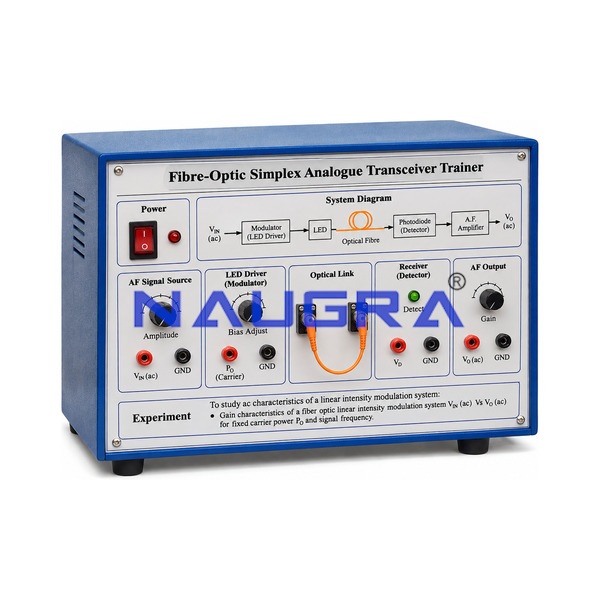
Fibre-Optic Simplex Analogue Transceiver Trainer
Product code: Fiber0001Buy Fibre-Optic Simplex Analogue Transceiver Trainer from India
Fibre-Optic Simplex Analogue Transceiver Trainer
Optical links behave differently from copper, so students need to see light launched, attenuated and received. Civil Mechanical India is among the Fiber Optic Trainer Kits manufacturers in India of LED and laser based optical trainers, and one of the suppliers in India who include plastic fibre patch cords and receiver boards in each kit.
The simplex analogue transceiver trainer studies linear intensity modulation, including the gain characteristics of the link, while the digital transceiver trainer studies digital transmission performance. The advanced analogue trainer carries transmitters at 660 nm and 850 nm, a receiver and one-metre PMMA fibre, so students compare wavelengths and attenuation.
A measurement trainer finds the numerical aperture of the fibre and its loss in dB per metre. The laser diode intensity modulation and demodulation trainer introduces laser diodes, optical fibres and communication, and the WDM trainer sends two wavelengths on one fibre and separates them at the receiver to demonstrate wavelength division multiplexing. All use regulated supplies and need an oscilloscope.
Last updated: November 2026
Fibre-Optic Simplex Analogue Transceiver Trainer
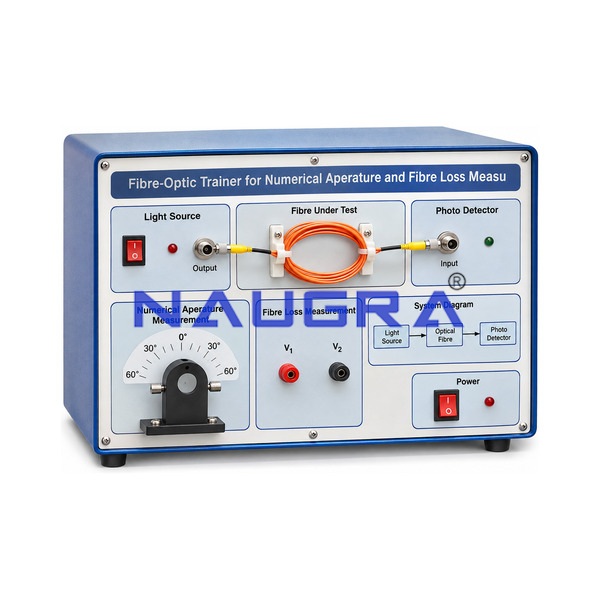
Fibre-Optic Trainer for Numerical Aperature and Fibre Loss Measu
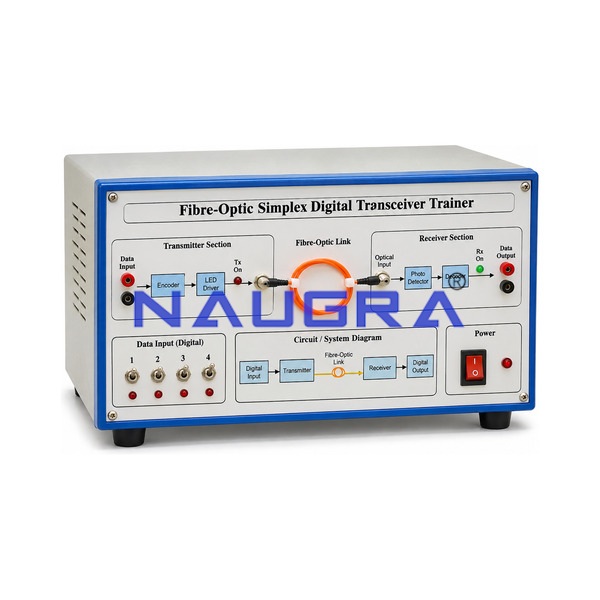
Fibre-Optic Simplex Digital Transceiver Trainer
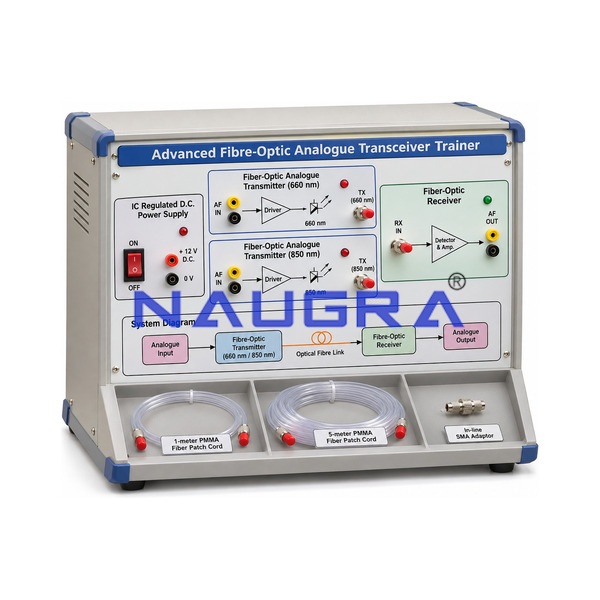
Advanced Fibre-Optic Analogue Transceiver Trainer
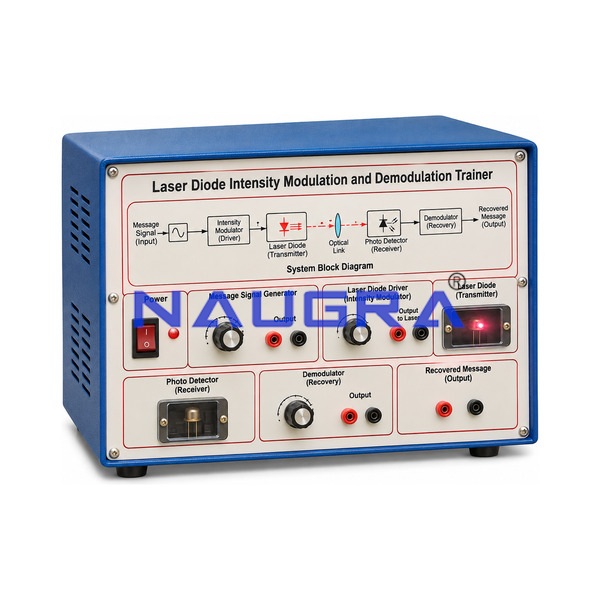
Laser Diode Intensity Modulation and Demodulation Trainer
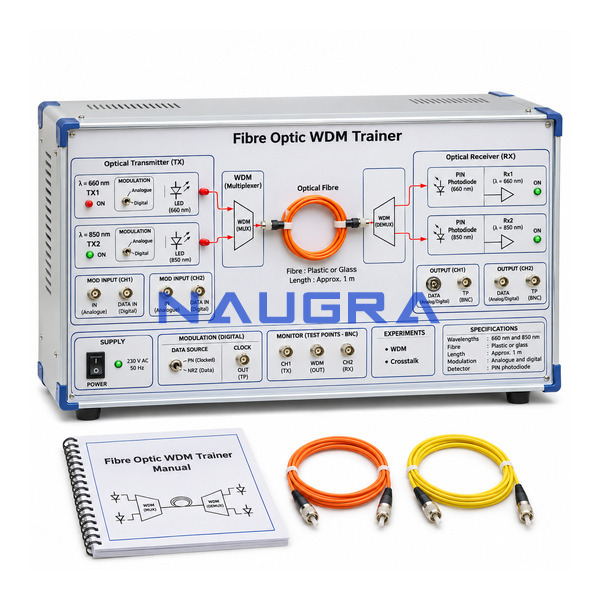
A trainer to study wavelength division multiplexing over a fibre optic link with two wavelengths. Used in optical communication labs. Features include two wavelength sources, WDM coupler and receiver with filters.
| Function | Products | What to confirm |
|---|---|---|
| Analogue and digital links | Fibre-Optic Simplex Analogue Transceiver Trainer, Fibre-Optic Simplex Digital Transceiver Trainer, Advanced Fibre-Optic Analogue Transceiver Trainer | LED wavelength, fibre type and length, signal types and bandwidth, power supply and test points. |
| Loss and aperture measurement | Fibre-Optic Trainer for Numerical Aperature and Fibre Loss Measu | Source wavelength, detector and meter, fibre lengths and connector types, and measurement accuracy. |
| Laser and WDM trainers | Laser Diode Intensity Modulation and Demodulation Trainer, Fibre Optic WDM Trainer | Laser power class and safety rules, wavelengths used, couplers and filters, and modulation options. |
Communication trainer kits process electrical signals, with modulation, multiplexing, microwave and transmission lines. Fiber optic trainers convert the signal to light, send it through a fibre and convert it back, and the main lessons are attenuation, numerical aperture, source wavelength and multiplexing. Most telecom departments buy both so students can compare electrical and optical links.
See also: Communication Trainers Kits
The complete Fiber Optic Trainer Kits range (6 products), in alphabetical order:
Check the wavelengths of the transmitters (660 nm red and 850 nm are common for plastic fibre), the type and length of the fibre supplied, the receiver sensitivity and whether analogue and digital links are both needed. Ask for the experiment list and confirm if an external function generator is required.
It measures the acceptance cone of the fibre by projecting the output onto a graduated screen, from which numerical aperture is calculated, and it measures loss over different fibre lengths. Check the source wavelength and whether lengths of fibre for loss measurement are included.
Choose a laser diode trainer to teach higher bandwidth links and threshold current behaviour. A WDM trainer is for courses that cover multiplexing, where two wavelengths share one fibre. Ask for filter or coupler details, and remember that laser sources need eye safety precautions.
Electronics and telecommunication departments of engineering colleges buy the analogue and digital transceiver trainers for the optical communication lab. Polytechnics buy the simpler LED-based kits, and universities with photonics programmes add the laser and WDM trainers. Training units of telecom companies use them for entry-level fibre training.
PMMA fibre is cheap, easy to cut and safe to handle, and works well at 650 nm for short links in a lab. Glass fibres are used when attenuation and bandwidth at 1310 or 1550 nm are studied.
Laser diodes can damage the eye if viewed directly, so students are told never to look at the open fibre end. The power in training kits is low, but follow the safety instructions in the manual.
Students see how attenuation differs between the two wavelengths in the same fibre, and learn why 850 nm sources are preferred in multimode links while visible red light is easier to see and align.
Yes, a dual-trace oscilloscope and a function generator are normally used to view the modulating signal and the received signal, so check that these are available on the bench.
State the number of trainers and the destination mains voltage, and we will supply them with plastic fibre patch cords, spare LEDs and manuals, packed for sea or air transport.
Civil Mechanical India is an established manufacturer and supplier for tender requirements from India, handling civil laboratory and industrial testing tenders and bulk and OEM orders for mechanical engineering and testing laboratory equipment. On receipt of your tender specifications, we will submit a complete quotation for Fiber Optic Trainer Kits.
Send us your equipment list or tender specification. We quote against IS, BS, EN, ASTM and AASHTO standards and ship to 90+ countries.