
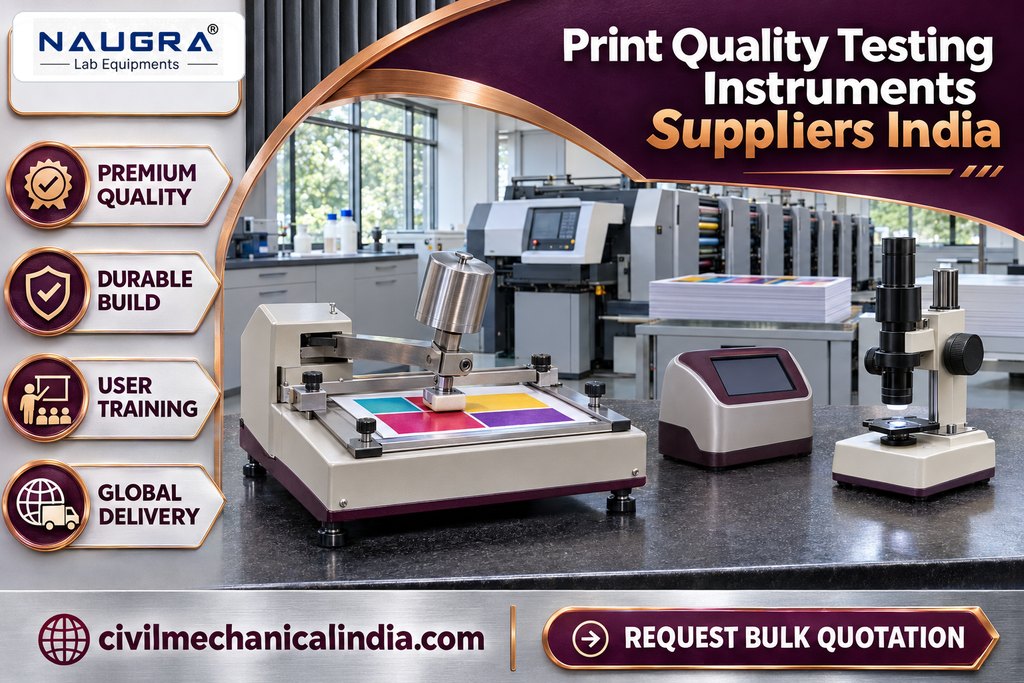
Our print quality testing instruments let a printer measure what a customer will judge: whether the print rubs off, how glossy it is, whether it sticks, fades or registers correctly. Packaging, label and commercial printers use them at the press and in the laboratory. We manufacture them in India. The model codes below are for tender buyers in Africa and South America.
Our print quality testing instruments range
| Product | Model code | Use |
|---|---|---|
| Ink Rub Resistance Tester for Printed Surfaces | CMI-IND-0381 | Rub and scuff resistance of printed surfaces |
| Print Gloss Meter for Coated Paper and Inks | CMI-IND-0384 | Gloss of printed and coated surfaces |
| Print Adhesion Tape Tester for Printed Film | CMI-IND-0383 | Adhesion of print to film by tape test |
| Print Light Fastness Xenon Test Chamber | CMI-IND-0385 | Fading under xenon light |
| Print Registration and Dot Gain Measuring Microscope | CMI-IND-0386 | Register and dot gain under magnification |
| Ink Viscosity Cup Set with Flow Timing Stand | CMI-IND-0382 | Ink viscosity at the press with a timing stand |
Ten instruments are shown on our Printing Testing Instruments page.
Tests and applications
| Customer complaint | Property | Test |
|---|---|---|
| Print scuffed in transit | Rub resistance | Rub tester |
| Dull or uneven finish | Gloss | Gloss meter |
| Ink flakes off film | Adhesion | Tape test |
| Colours faded on the shelf | Light fastness | Xenon exposure |
| Blurred images | Register, dot gain | Measuring microscope |
| Colour varies through the run | Ink viscosity | Flow cup |
Packaging rubs against other packs in every carton and lorry. A rub tester reproduces that wear in a controlled way, so printers can prove durability and compare varnishes.
Adhesion on plastic films depends on surface treatment and ink choice. The tape test is quick and is done at the press on every reel. Light fastness matters for products displayed in shop windows or outdoors, and is assessed when inks are selected.
Dot gain and register describe how accurately the press reproduces the artwork. A measuring microscope gives printers numbers to control them.
What to specify in a tender
- Printing processes: flexo, gravure, offset or digital.
- Substrates printed: paper, board, film or foil.
- Rub test method, load and number of strokes.
- Gloss angle specified by your customers.
- Light source and exposure standard for fastness tests.
Controlling print quality through the run
Set up a small test station at each press. Operators check viscosity and adhesion and compare colour with the approved proof at fixed intervals, recording each check. A problem caught within one reel is a small problem.
Send samples from each job to the laboratory for rub and gloss. Test after the ink has dried fully, since rub resistance improves over the first day.
Agree test methods and limits with each customer in writing, including the number of rub strokes and the tape used for adhesion. Keep a signed reference print for every repeat job, stored away from light so the colours stay true.
Markets we supply in Africa and South America
Printed packaging is produced close to the factories that fill it, so printing capacity is growing across both regions.
| Country | Nominal mains supply | Usual port of entry | Note for buyers |
|---|---|---|---|
| Gabon | 220 V, 50 Hz | Libreville (Owendo) | Printers serve beverage and food producers in a humid climate that tests ink drying. |
| Madagascar | 220 V, 50 Hz | Toamasina | Exporters need printed packs that meet overseas retailers' requirements. |
| Niger | 220 V, 50 Hz | Cotonou, then road | Local printing is developing alongside food packing. |
| Somalia | 220 V, 50 Hz | Mogadishu or Berbera | Small printers supply labels and cartons to local producers. |
| Argentina | 220 V, 50 Hz | Buenos Aires | A mature printing industry serves wine, food and pharmaceutical brands. |
| Colombia | 110 V, 60 Hz | Cartagena or Buenaventura | Supply is 110 V at 60 Hz. Chambers and motorised testers are built to suit. |
Why source from us
- Durability, appearance and press-side instruments from one supplier.
- Methods aligned with common brand owner specifications.
- Ink, film and board testers on the same order.
- Installation and training available.
Frequently asked questions
Do you supply colour measuring instruments?
Yes. Tell us whether you need density, colour difference or both.
Can the rub tester run wet rub tests?
Tell us the methods you follow. We confirm weights and accessories in the offer.
Are ink laboratory instruments available?
Yes. See our Ink and Printing Testing Instruments range.
Send us your tender requirements
Printers are often asked by brand owners to demonstrate in-house testing before they are approved as suppliers. Send us your tender requirements and we will answer each line with the instrument we offer, its model code and what is supplied with it.
We can supply the print laboratory from India: rub testers, gloss meters, adhesion test kits, light fastness chambers, measuring microscopes, flow cups, colour measuring instruments and viewing aids. Substrate testers for film, board and labels are added so one order covers the whole plant.
Tell us the processes you run, the products you print and the destination. Use our contact page to send the details. We reply with an itemised quotation and delivery period.
Customer methods differ, so each tender is quoted on its own list. If you have a brand owner's supplier manual, send the testing section and we will match instruments to each requirement.