
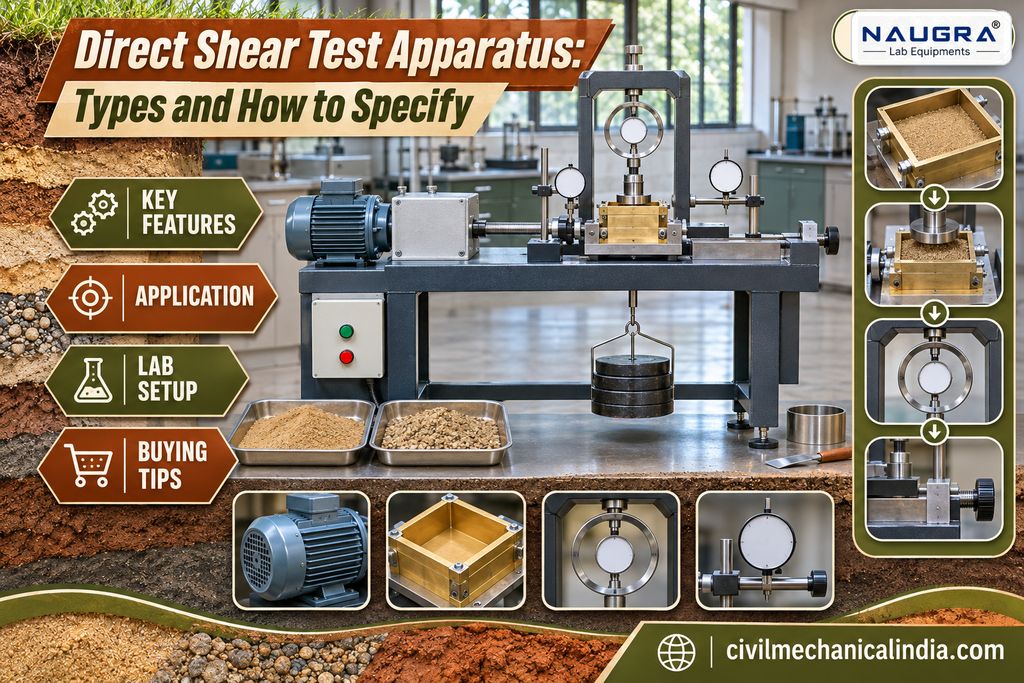
A direct shear test apparatus measures the shear strength of soil by sliding one half of a soil sample over the other under a known vertical load. The results give cohesion and the angle of internal friction, which engineers use for slopes, foundations and retaining walls. We manufacture this equipment in India. This guide helps geotechnical labs in Senegal, Côte d'Ivoire, Cameroon, Mozambique and DR Congo specify it correctly.
How the test works
Soil is placed in a split box. A vertical load is applied through a loading cap. The lower half of the box is then pushed sideways at a steady rate while the upper half is held by a load-measuring device. Shear force, horizontal movement and vertical movement are recorded until the sample fails. The test is repeated at three or more vertical loads to draw the failure line.
Types of direct shear test apparatus
| Feature | Options | Notes |
|---|---|---|
| Shear box size | 60 mm square, 100 mm square, 300 mm square | Small boxes for sand and clay, large boxes for gravelly soil |
| Drive | Hand-operated or motorised | Motorised drives hold a constant strain rate |
| Normal load | Dead weights on a lever, or pneumatic | Lever loading is simple and needs no air supply |
| Force measurement | Proving ring or load cell | Load cells allow data logging |
| Displacement | Dial gauges or electronic transducers | Transducers suit automatic recording |
Box sizes shown are the common industry sizes. Tell us which your standard requires.
Soil strength equipment in our range
These products are listed in our Soil Testing Lab Equipment category.
| Product | Code | Test |
|---|---|---|
| Direct Shear Test Apparatus | TSE-0002 | Shear strength parameters by direct shear |
| Triaxial Test Apparatus | TSE-0003 | Shear strength under controlled drainage |
| Unconfined Compression Testing Apparatus | TSE-0012 | Unconfined compressive strength of cohesive soil |
| Vane Shear Test Apparatus | TSE-0032 | Undrained shear strength of soft clay |
| Consolidation Test Apparatus | TSE-0001 | Settlement behaviour under load |
| DCP - Dynamic Cone Penetrometer | TSE-0010 | In-situ strength profile of subgrade |
Direct shear is quicker and simpler than triaxial testing. A triaxial test apparatus gives more control over drainage and is preferred for design on clays.
How to write the specification
- Standard: IS, BS, ASTM or AASHTO.
- Shear box size and whether spare boxes are needed.
- Strain rate range, especially if slow drained tests are planned.
- Maximum normal stress.
- Measurement: analogue or electronic with data logger.
- Accessories: porous stones, grid plates, sample cutter, weights.
What drives the price
We quote against the specification. The main factors are:
- Box size, with large boxes needing a much heavier frame.
- Number of speeds in the drive.
- Analogue or electronic measurement.
- Data acquisition software.
- Weight set and accessories.
- Freight for the frame and weights.
Import and site notes by country
Motorised units need single-phase power. Confirm voltage before ordering.
| Country | Nominal mains supply | Usual port of entry | Note for this equipment |
|---|---|---|---|
| Senegal | 230 V, 50 Hz | Dakar | Coastal sands dominate near Dakar. The standard 60 mm box suits them well. |
| Côte d'Ivoire | 220 V, 50 Hz | Abidjan | Lateritic gravels need a larger box so that particles are small relative to the sample. |
| Cameroon | 220 V, 50 Hz | Douala | Volcanic and residual soils vary widely. Order extra porous stones and grid plates. |
| Mozambique | 220 V, 50 Hz | Maputo, Beira or Nacala | Soft alluvial clays in river deltas need slow drained tests, so a wide speed range matters. |
| DR Congo | 220 V, 50 Hz | Matadi (west); Dar es Salaam route for the east and south | Tailings dams at mines require routine shear testing. Electronic logging saves technician time. |
Mistakes to avoid
- Testing gravelly soil in a small box.
- Shearing too fast for a drained test.
- Forgetting to separate the box halves before shearing.
- Using an uncalibrated proving ring.
- Ordering without a sample cutter of matching size.
Frequently asked questions
What else does a soils lab need besides shear testing?
Classification and compaction equipment: sieves, plastic limit apparatus, a soil compaction test machine and CBR equipment. These soil testing tools are all in the same category.
Proving ring or load cell?
A proving ring is robust and needs no power. A load cell is needed for automatic recording.
Do you install and train?
We offer installation, commissioning and training. Ask for it in the quotation.
Request a quotation
Send the standard, box size and measurement type through our contact page. We will send a matching offer for these soil analysis instruments. See also our wider Civil Engineering Laboratory Equipment range.