
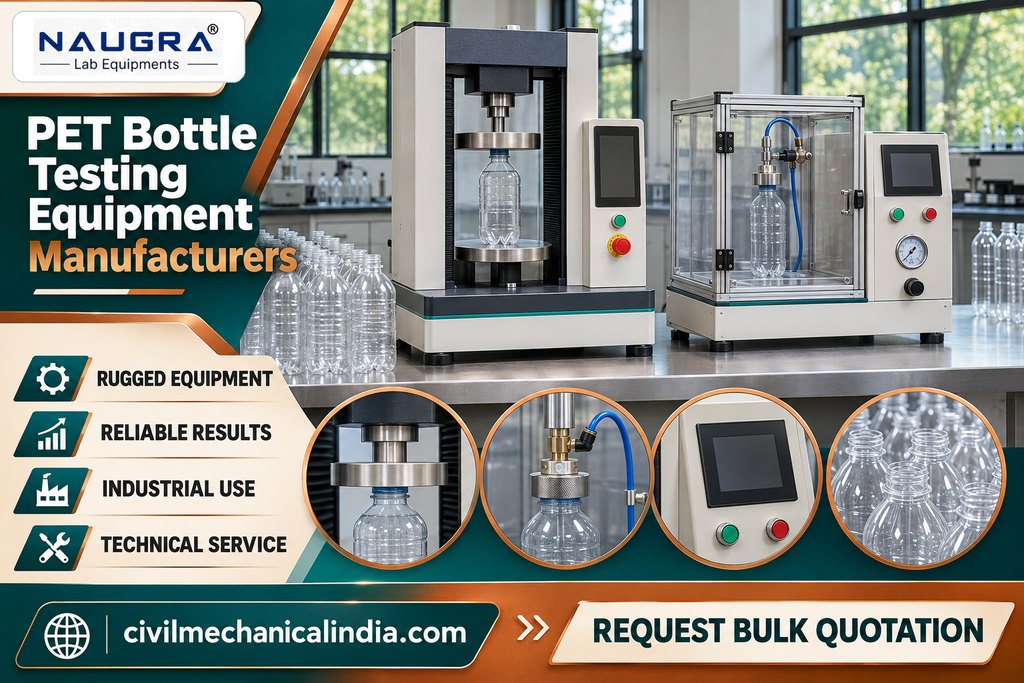
We manufacture PET bottle testing equipment in India for bottle converters and for water, soft drink, juice and edible oil producers. Every bottle design has a specification for strength, pressure, volume and material distribution, and these instruments verify it. The model codes below are for tender buyers in Africa and South America.
Our PET bottle testing equipment range
| Product | Model code | Use |
|---|---|---|
| Digital Top Load Strength Tester for PET Bottles | CMI-IND-0526 | Top load strength |
| Carbonated PET Bottle Burst Pressure Tester | CMI-IND-0522 | Burst pressure of carbonated bottles |
| Bottle Wall Thickness and Material Distribution Tester | CMI-IND-0521 | Wall thickness and material distribution |
| Creep and Volume Expansion Tester for Carbonated PET Bottles | CMI-IND-0523 | Creep and volume expansion under pressure |
| Digital Bottle Dimension and Volume Measuring Station | CMI-IND-0524 | Dimensions and volume |
| Digital Cap Torque Tester for PET Bottle Closures | CMI-IND-0525 | Cap torque on PET closures |
Ten instruments are shown on our PET Bottles Testing Instruments page.
Tests and applications
| Requirement | Test | Failure seen in the market |
|---|---|---|
| Survive capping and stacking | Top load | Buckled bottles on pallets |
| Hold carbonation pressure | Burst | Bottles bursting in warm storage |
| Keep shape over time | Creep, expansion | Rocking bases, low fill appearance |
| Correct contents | Volume | Short or overfilled bottles |
| Even walls | Thickness | Thin spots, panel collapse |
| Seal and open properly | Torque | Leaks or hard-to-open caps |
Top load is the everyday test. Empty bottles must survive the capper, and filled bottles must carry several layers of pallets above them. As bottle weights fall, top load is the first value to approach its limit.
Carbonated drinks stored in a hot warehouse or a parked lorry generate high pressure. Burst and creep tests show the margin a bottle has. Still water bottles face the opposite problem, panels sucking in as the bottle cools, which thickness distribution helps to control.
Volume is a legal matter. Brimful and fill point capacity are checked on each mould cavity.
What to specify in a tender
- Bottle sizes and shapes, including the tallest and widest.
- Products filled: still, carbonated, hot-fill or oil.
- Load and pressure ranges.
- Thickness measurement method.
- Fixtures and neck adaptors for each finish.
Routine checks in a bottle plant
Test at start-up, at each mould or preform lot change and at fixed intervals. Record results by mould cavity so that one faulty cavity does not hide in an average.
Run top load on empty bottles at a fixed speed and note where the bottle fails, at the shoulder, the panel or the base. The failure position tells the process technician which heating zone to adjust.
Burst tests need a safety cabinet, as bottles fail suddenly. Measure base clearance and height after pressure conditioning for carbonated products. Condition bottles for a consistent time after blowing, because PET shrinks slightly in the first hours and volume changes with it.
Keep sample bottles from each production code until the product's shelf life has passed.
Markets we supply in Africa and South America
PET bottles are made in nearly every country of both regions, often in the same plant that fills them.
| Country | Nominal mains supply | Usual port of entry | Note for buyers |
|---|---|---|---|
| Niger | 220 V, 50 Hz | Cotonou, then road | Bottled water is essential in a hot, dry climate, and local bottling is expanding. |
| Somalia | 220 V, 50 Hz | Mogadishu or Berbera | Water bottlers supply cities where piped water is limited. |
| Chad | 220 V, 50 Hz | Douala, then road | Heat in storage and transport tests bottle strength and sealing. |
| Mauritius | 230 V, 50 Hz | Port Louis | Beverage producers serve residents and a large tourism sector. |
| Bolivia | 230 V, 50 Hz | Arica in Chile, then road | Bottling at altitude changes pressure conditions, so burst margins are watched. |
| Uruguay | 220 V, 50 Hz | Montevideo | Beverage and edible oil producers test bottles to established specifications. |
Why source from us
- Strength, pressure, dimensional and closure testers from one manufacturer.
- Adaptors for your neck finishes and bottle shapes.
- Preform and filling line testers on the same order.
- Installation and training available.
Frequently asked questions
Can one tester serve several bottle sizes?
Yes. Tell us all sizes and we supply the adaptors and platens needed.
Is the burst tester safe for operators?
It is used inside a guarded cabinet. We confirm the safety features in the offer.
Are preform tests covered?
Preform instruments are listed in our Preforms Testing Instruments range.
Send us your tender requirements
Converters and bottlers are asked by beverage brands to hold specific instruments before a bottle design is approved. Send us your tender requirements and we will reply to each line with the instrument we offer, its model code, range and fixtures.
We can supply the PET bottle laboratory from India: top load testers, burst and creep testers, wall thickness gauges, dimension and volume stations, cap torque testers, drop testers, stress crack test equipment, section cutters and balances. Preform and filling line testers are added for integrated plants.
Tell us your bottle sizes, products, neck finishes and the destination port. Write to us through the contact page. We reply with an itemised quotation and delivery time.
Fixtures are specific to each bottle, so each tender is quoted on its own list. A small water bottler can ask for a basic set covering top load, volume and torque, which handles most daily checks.