
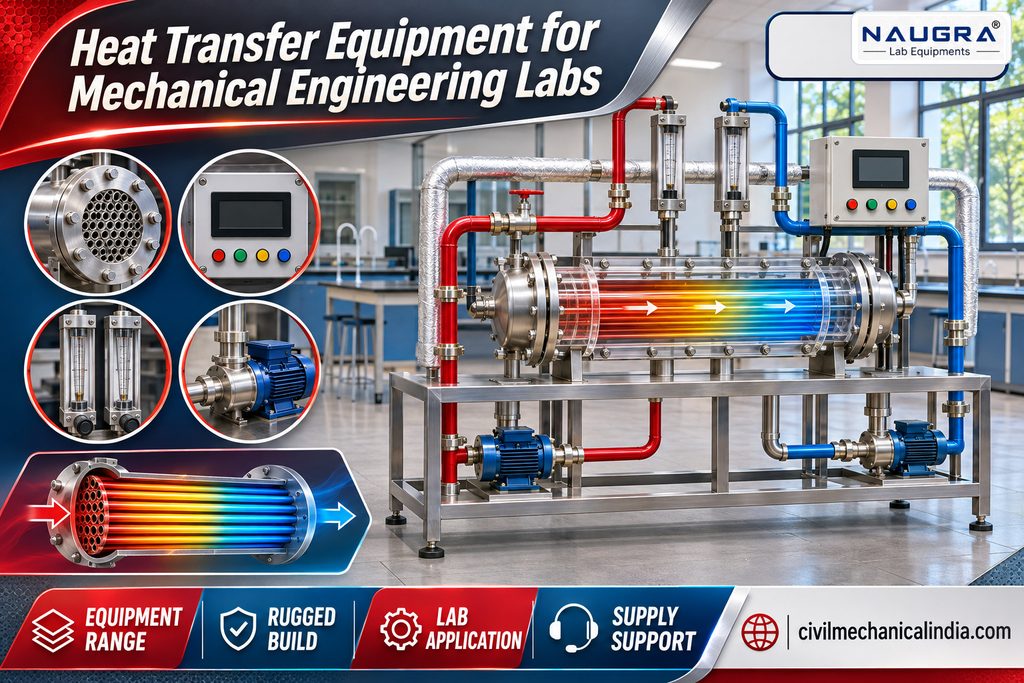
We manufacture heat transfer equipment in India for mechanical and chemical engineering departments, covering conduction, convection, radiation and heat exchangers. This page lists model codes for universities and polytechnics in Ghana, Tanzania, Uganda, Morocco and Algeria.
Our heat transfer equipment range
These products are from our Heat and Mass Transfer Lab Equipment category.
| Product | Model code | Experiment |
|---|---|---|
| Computerized Composite Wall Apparatus | HET-0003 | Conduction through layers of different materials |
| Heat Transfer Through Lagged Pipe with Data Acquisition | HET-0011 | Heat loss through pipe insulation |
| Free and Force Convection Apparatus | HET-0009 | Natural and forced convection from a heated surface |
| Computerized Stefan Boltzman Apparatus | HET-0006 | Radiation law and the Stefan-Boltzmann constant |
| Shell and Tube Heat Exchanger with Data Acquisition | HET-0015 | Performance of a shell and tube exchanger |
| Parallel and Counter Flow Heat Exchanger with Data Acquisition | HET-0013 | Parallel and counter flow compared |
| Plate Type Heat Exchanger with Data Acquisition | HET-0014 | Performance of a plate exchanger |
| Computerized Thermal Conductivity of Liquid | HET-0007 | Thermal conductivity of a liquid |
| Computerized Boiling Heat Transfer Apparatus | HET-0001 | Boiling regimes on a heated wire |
| Computerized Heat Pipe Demonstrator | HET-0004 | Operation of a heat pipe |
Product names that include "computerized" or "with data acquisition" are listed that way on our website.
Applications
| Mode | What students find | Rig |
|---|---|---|
| Conduction | Thermal conductivity, temperature profile | Composite wall, lagged pipe, guarded hot plate |
| Convection | Heat transfer coefficient | Free and forced convection apparatus |
| Radiation | Emissivity, Stefan-Boltzmann constant | Radiation apparatus |
| Heat exchange | Effectiveness, overall coefficient | Shell and tube, plate, concentric tube |
| Phase change | Boiling curve | Boiling apparatus |
The same rigs serve chemical engineering courses, where heat exchangers sit beside other process engineering equipments such as evaporators and distillation columns.
Features
- Electric heaters with variable power input.
- Thermocouples at defined points with a multi-channel indicator.
- Data acquisition on the models named for it, so readings go straight to a computer.
- Bench-mounted frames with insulated test sections.
- Manuals with theory, procedure and sample calculations.
Heater ratings and sensor counts depend on the rig. We state them in the quotation.
Planning the thermal lab
Heat transfer rigs are compact and mostly bench-mounted, so a machine laboratory of modest size can hold a full set. Each needs a power socket. Exchanger rigs also need a cold water supply and drain. Steady-state experiments take time to settle, often 30 minutes or more, which is a typical figure for this kind of rig. Timetable longer sessions or let one group start a rig for the next.
Spares and consumables
Heaters, thermocouples and fuses are the parts that fail first on thermal rigs. Order one spare heater element and a few thermocouples of the right type for each rig, plus insulation material for test sections that students open and close. With those on the shelf, a failed sensor costs a class one session, not one semester.
Markets served: import and site notes
| Country | Nominal mains supply | Usual port of entry | Note for this equipment |
|---|---|---|---|
| Ghana | 230 V, 50 Hz | Tema | Warm ambient conditions reduce the temperature difference in convection tests. Use higher heater settings. |
| Tanzania | 230 V, 50 Hz | Dar es Salaam | Voltage fluctuation changes heater power. A stabiliser gives steadier readings. |
| Uganda | 240 V, 50 Hz | Mombasa, then road (landlocked) | New engineering faculties are building thermal labs. Start with conduction and exchanger rigs. |
| Morocco | 220 V, 50 Hz | Casablanca | Solar thermal industry interest makes radiation and exchanger experiments relevant. |
| Algeria | 230 V, 50 Hz | Algiers | Oil and gas processing relies on heat exchangers. Shell and tube rigs match industry practice. |
Why buy from us
- Manufacturer of heat transfer, thermodynamics and other energy equipment for teaching.
- Model codes for each rig.
- Itemised tender offers.
- Installation, commissioning and training offered.
How to order
- Send the experiments in your syllabus.
- Say whether you want data acquisition.
- Give voltage and destination.
- We reply with rigs matched to each experiment and a quotation.
Contact us through the contact page. Rigs are priced per enquiry.
Frequently asked questions
Can the rigs connect to a computer?
Models listed with data acquisition do. Tell us if all rigs should have it.
Do you supply a calandria evaporator for chemical engineering?
It is not in this category. Ask us and we will check our chemical engineering range for you.
What other test equipment is needed?
A stopwatch, measuring cylinder and thermometers for checks. Related rigs are under Thermal Engineering Lab Equipment and Refrigeration & Air Conditioning Lab Equipment.