
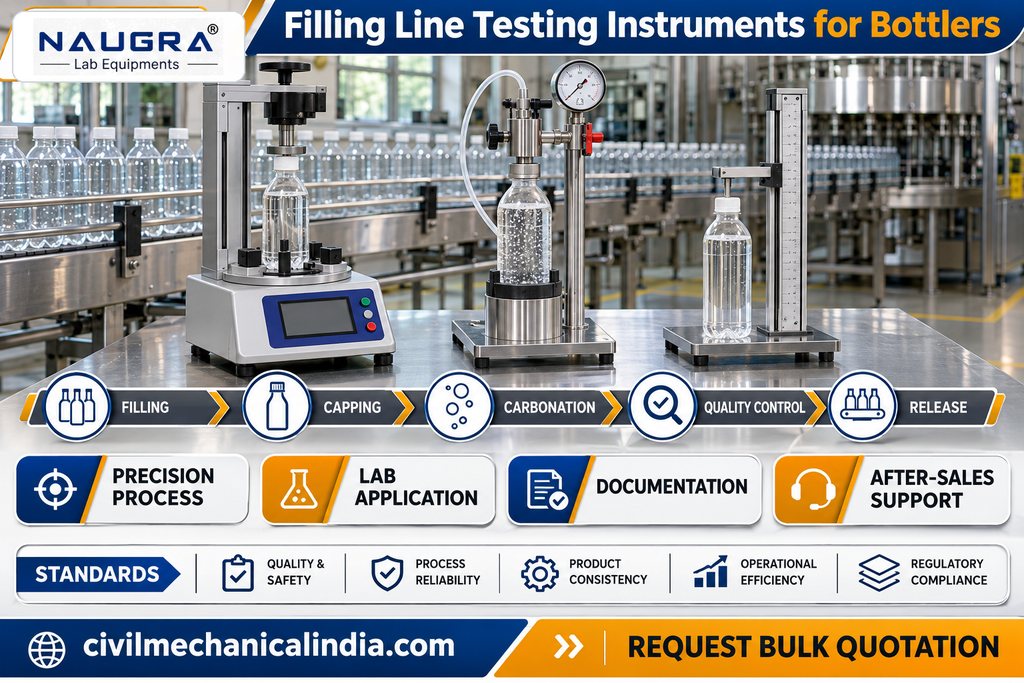
Our filling line testing instruments are the checks a bottler runs every hour: is the bottle full, is the cap tight, is the drink carbonated and will the pack survive handling. Water, soft drink, juice, beer and edible oil producers use them at the line. We manufacture them in India. The model codes below are for tender buyers in Africa and South America.
Our filling line testing instruments range
| Product | Model code | Use |
|---|---|---|
| Bottle Cap Torque Tester Digital for Filling Lines | CMI-IND-0241 | Cap removal torque at the line |
| Fill Level and Headspace Gauge for Filled Containers | CMI-IND-0246 | Fill level and headspace of filled containers |
| Dissolved CO2 and Carbonation Tester for Filled Beverages | CMI-IND-0245 | Dissolved carbon dioxide in beverages |
| Cap Removal Force and Liner Seal Integrity Tester | CMI-IND-0243 | Cap removal force and liner seal integrity |
| Container Burst and Internal Pressure Tester for Bottles | CMI-IND-0244 | Burst and internal pressure resistance of bottles |
| Bottle Drop and Impact Tester for Filling Line Handling | CMI-IND-0242 | Drop and impact resistance in handling |
Ten instruments are shown on our Filling Line Testing Instruments page.
Tests and applications
| Check | Why | Frequency |
|---|---|---|
| Fill level | Legal content, appearance | Every sampling round |
| Cap torque | Sealing and ease of opening | Each capping head, each round |
| Carbonation | Taste and shelf life | Each tank and during the run |
| Seal integrity | Leaks, contamination | Each round |
| Bottle strength | Safety with carbonated products | Each bottle lot |
| Drop resistance | Damage in distribution | Each packaging change |
Short fills break the law, and overfills give product away. A simple gauge on sampled bottles from each filling valve catches a faulty valve before thousands of bottles are affected.
Carbonation is the signature of a soft drink. It depends on temperature and pressure at filling, and it must be measured, since a drink that is slightly flat is noticed by every consumer. Cap torque and seal checks then make sure that the gas stays in.
Returnable glass and lightweight PET both need strength checks. Lightweighting saves resin, but only if burst and top load results stay within limits.
What to specify in a tender
- Products filled: still, carbonated, hot-fill or oil.
- Container materials and sizes.
- Torque and pressure ranges.
- Fixtures for each bottle and cap format.
- Data recording for line quality reports.
Organising checks at the line
Put a quality station beside each line with the instruments operators use hourly. Results should be recorded by valve and by capping head, since most faults belong to one position.
Calibrate torque testers and pressure gauges on a schedule and keep reference weights and gauges on site. A drifting instrument can pass bad product or stop good product, and both are costly.
Train operators to act on results. A check sheet with clear limits and an instruction for each out-of-limit case turns measurements into decisions. Keep retained samples from each production code for the shelf life of the product.
Markets we supply in Africa and South America
Bottled water and soft drinks are produced in nearly every town of both regions, from large plants to small local bottlers.
| Country | Nominal mains supply | Usual port of entry | Note for buyers |
|---|---|---|---|
| Togo | 220 V, 50 Hz | Lomé | Regional beverage producers supply several neighbouring markets. |
| Eritrea | 230 V, 50 Hz | Massawa | Bottled water and soft drinks are produced locally for domestic demand. |
| Gabon | 220 V, 50 Hz | Libreville (Owendo) | Warm, humid conditions make sealing and shelf life checks important. |
| Madagascar | 220 V, 50 Hz | Toamasina | Local bottlers serve a large island market with long distribution routes. |
| Guyana | 120 V or 240 V, 60 Hz (varies by area) | Georgetown | Supply is 60 Hz and voltage varies by area. Confirm before ordering. |
| Suriname | 127 V, 60 Hz | Paramaribo | Beverage producers serve a small market and value compact instruments. |
Why source from us
- Fill, torque, carbonation, seal and strength testers from one manufacturer.
- Robust instruments for use at the line.
- Bottle, preform and closure testers on the same order.
- Installation and operator training available.
Frequently asked questions
Can one torque tester serve several bottle sizes?
Yes, with adjustable holding pegs. List your formats and we confirm the fixtures.
Does the carbonation tester work on PET and glass?
Tell us your containers and closures. We confirm piercing and sealing parts in the offer.
Are bottle wall and top load testers available?
Yes. See our PET Bottles Testing Instruments range.
Send us your tender requirements
New lines and plant upgrades usually come with a list of quality instruments from the beverage brand or the plant engineer. Send us your tender requirements and we will reply to each line with the instrument we offer, its model code, range and fixtures.
We can supply the complete line laboratory from India: cap torque testers, fill level gauges, carbonation testers, seal integrity testers, burst and drop testers, top load and wall thickness testers, refractometers, pH meters and balances. Preform and closure testers are added for plants that blow their own bottles.
Tell us what you fill, the container formats, the line speeds and the destination. Send the list through our contact page. We reply with an itemised quotation and delivery time. Formats and ranges differ on every line, so each tender is quoted on its own requirements, with change parts for each bottle size shown separately.