
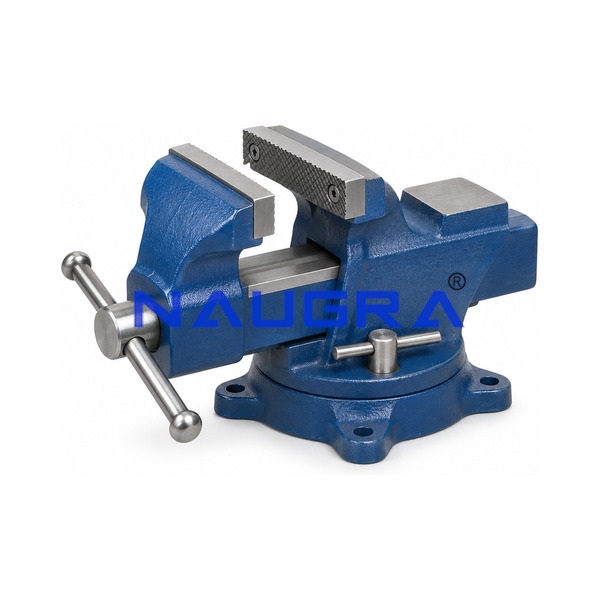
Mechanic s Bench Vice
Product code: Bench Vice0001Buy Mechanic s Bench Vice from India
Mechanic s Bench Vice
Fitting shop managers asking for mechanics bench vice manufacturers in India typically specify jaw width and opening. Civil Mechanical India is among the suppliers in India that supplies fixed, swivel, quick release, pipe and machine vices, with jaw plates and screw details listed for each.
A bench vice is bolted to the edge of a workbench and clamps work between two jaws, one fixed and one moving on a screw. The mechanic's vice and heavy duty cast iron vice have serrated steel jaw plates, which grip firmly but can mark soft metals, so soft jaw covers are used. The parallel jaw type with a quick release lets the screw be disengaged and the jaw slid to the work, saving time during repeated clamping.
The swivel base vice rotates and locks at any angle, which helps with awkward jobs. The pipe vice has V-shaped hardened jaws with a chain or yoke to grip round bar and pipe. The machine vice for a drilling machine is a precision vice with accurate jaws, used to hold work on a drill press table.
Last updated: November 2026
Mechanic s Bench Vice
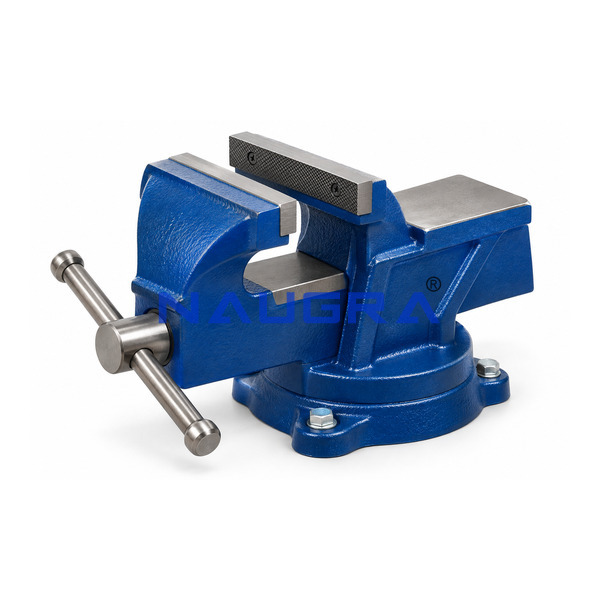
Heavy Duty Cast Iron Bench Vice is a heavy duty cast iron fixed bench vice with serrated steel jaw plates, designed for holding workpieces firmly for filing, sawing, chipping and hand fitting.
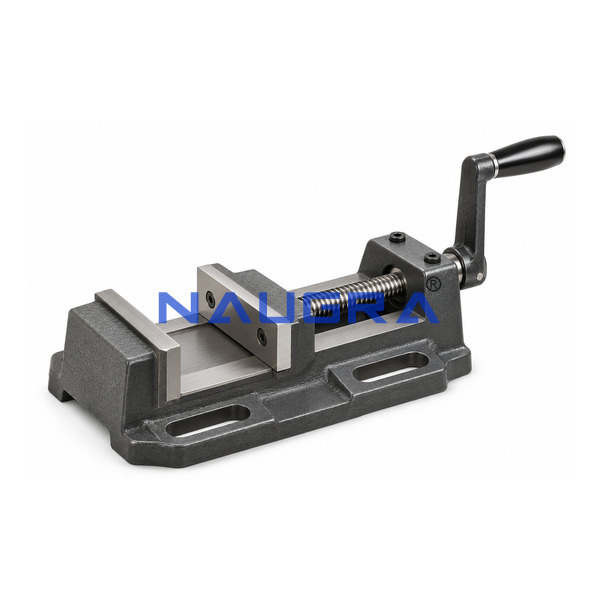
Machine Vice for Drilling Machine is a precision machine vice for clamping workpieces on drill press and milling tables, designed for securely holding parts during drilling and light milling.
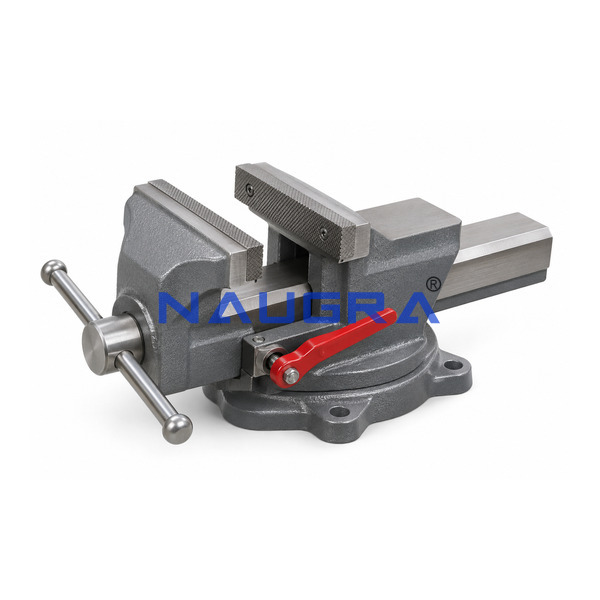
Parallel Jaw Bench Vice with Quick Release is a bench vice with parallel sliding jaw and a quick-release mechanism for fast jaw positioning, designed for fast and repeatable clamping in school and industrial workshops.
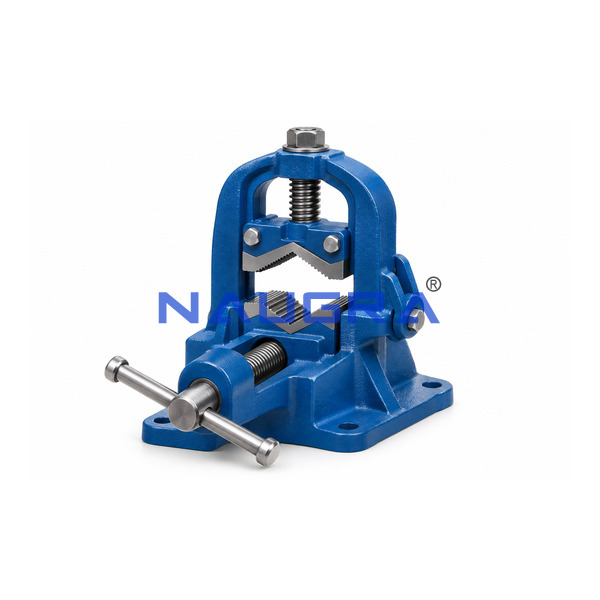
Pipe Bench Vice is a bench vice with V-shaped hardened jaws and chain or yoke for gripping round bar and pipe, designed for holding pipes and round sections for threading, cutting and assembly.
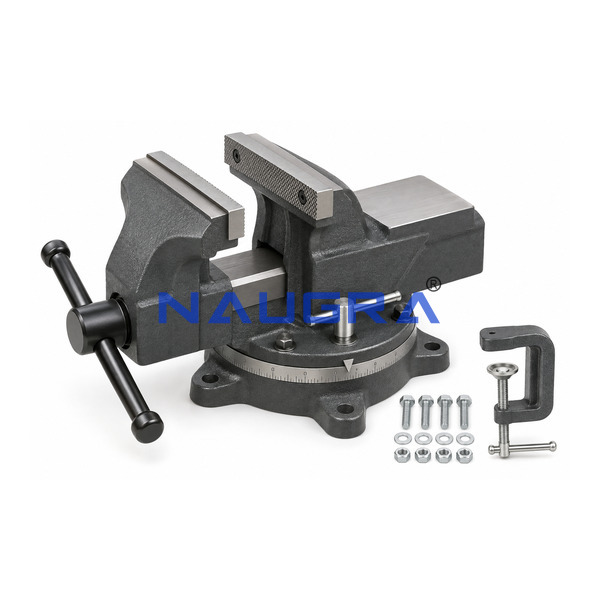
Swivel Base Bench Vice is a bench vice with a rotating base that can be locked at any angle, designed for holding work in different positions during fitting and assembly.
| Function | Products | What to confirm |
|---|---|---|
| General bench vices | Mechanic s Bench Vice, Heavy Duty Cast Iron Bench Vice | Jaw width (100 to 200 mm), jaw opening, throat depth, material of body and anvil |
| Quick release and swivel | Parallel Jaw Bench Vice with Quick Release, Swivel Base Bench Vice | Quick release mechanism, swivel lock, parallel jaw accuracy and base bolt pattern |
| Special vices | Pipe Bench Vice, Machine Vice for Drilling Machine | Pipe size range, V jaw hardness, machine vice jaw width and slot size for clamping |
A bench vice is a work-holding device, not a machine. It has no motor and makes no holes. In a workshop, though, it works with a drill: the machine vice for drilling holds the part while a drill cuts it. Buy a vice to hold, and a heavy duty drill to cut. Fitting benches usually need a row of vices while a workshop needs only a few drills.
See also: Heavy Duty Drill Suppliers
The complete Mechanics Bench Vice range (6 products), in alphabetical order:
| Heavy Duty Cast Iron Bench Vice | Machine Vice for Drilling Machine | Mechanic s Bench Vice |
| Parallel Jaw Bench Vice with Quick Release | Pipe Bench Vice | Swivel Base Bench Vice |
Jaw width of 100 mm suits school benches, 125 to 150 mm is the usual workshop size, and 200 mm is for heavy fitting. Check the jaw opening and depth against the largest part. Wider jaws give more grip but also weigh more and need a stronger bench.
Cast iron bodies are common and strong in compression, while steel jaws are hardened to resist wear. Check that the screw is a robust square or acme thread with a bronze or steel nut. Ask whether jaws are replaceable. Look at the smoothness of screw travel too, because a rough screw wastes time and loosens clamping force in a busy bench.
Use bolts through the bench top with washers, and place the vice so the fixed jaw sits at the bench edge. Ask for bolt size and pattern. A loose vice is unsafe and damages the work. Check that the bench top is thick enough, usually 40 mm or more of hardwood or a steel frame, so that the vice does not flex when hammering.
Typical buyers are ITI fitting shops, polytechnic and school workshops, maintenance departments, garages and plumbing trades. A fitting lab buys a vice per bench, and a drilling or milling lab adds machine vices. Welding shops also use heavy vices to hold plate during chipping, and agricultural repair shops use them in the field.
A bench vice is bolted to a bench for hand work, while a machine vice is accurately ground and clamps to a machine table for drilling or milling.
They help protect finished or soft work from serrations. Soft jaws of aluminium, copper or fibre fit over the steel plates, so a polished component or a thin tube is not marked when clamped.
V-shaped jaws or a yoke hold round pipe without slipping. The pipe vice has hardened V grooves that bite on round stock, so pipe can be threaded or cut without rotating in the jaws.
Common sizes are 100, 125, 150 and 200 mm. State the size you need. A throat depth and a jaw opening are quoted along with width, and we recommend choosing both for the largest job on the bench.
Yes, vices are easy to pack. Share your destination. Cast iron vices are heavy for their size, so we state the weight per piece and pack them in strong boxes for sea shipment.
Civil Mechanical India is one of the leading manufacturers and suppliers in India for tender requirements, covering civil laboratory and industrial testing tenders and the bulk and OEM supply of mechanical engineering and testing laboratory equipment. Kindly share your tender specifications and we shall submit a complete quotation for Mechanics Bench Vice.
Send us your equipment list or tender specification. We quote against IS, BS, EN, ASTM and AASHTO standards and ship to 90+ countries.