
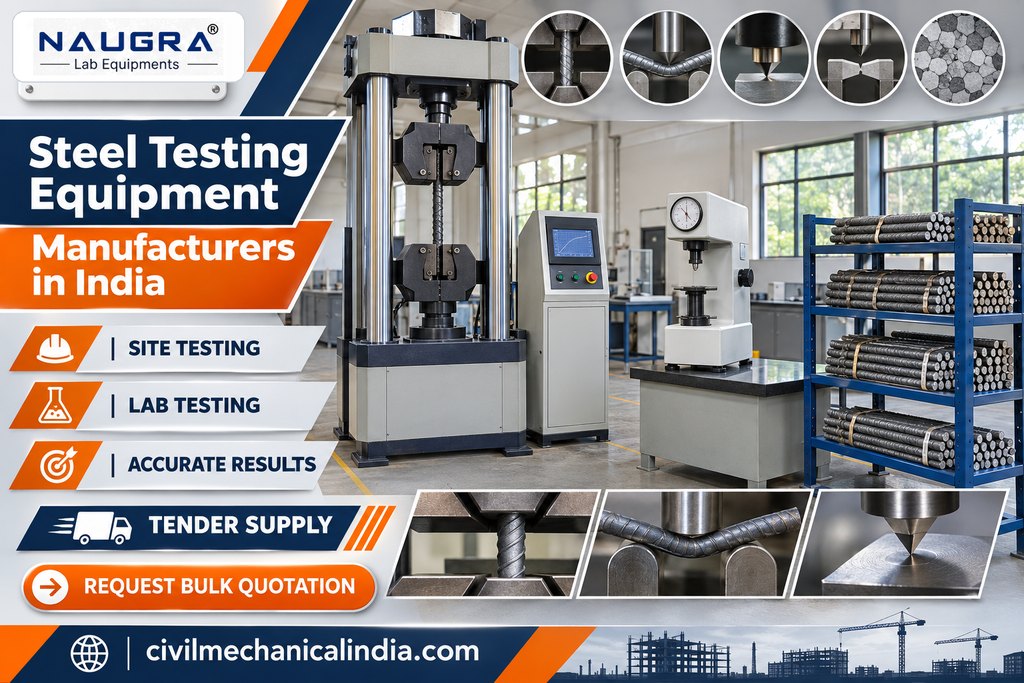
We manufacture steel testing equipment in India for rolling mills, rebar importers, fabricators, standards bodies and construction laboratories. The products below are listed with their model codes, so buyers in Africa and South America can draw up a tender schedule for a steel laboratory with confidence.
Our steel testing equipment range
| Product | Model code | Use |
|---|---|---|
| Hydraulic Computerized UTM | STL-0001 | Tensile, compression and bend tests with computer control |
| Fatigue Testing Machine | STL-0003 | Endurance of steel under repeated loading |
| Rockwell Hardness Tester | STL-0005 | Hardness on the Rockwell scales |
| Brinell Hardness Tester | STL-0006 | Hardness of castings, forgings and plate by ball indentation |
| Bar Cutting Machine | STL-0011 | Cutting reinforcement bars to specimen length |
| Bar Bending Machine | STL-0012 | Bend and rebend tests on reinforcement |
Further machines, including torsion and impact testers, are listed on our Steel Testing Lab Equipment page.
Tests and applications
| Product tested | Tests | Result reported |
|---|---|---|
| Reinforcement bar | Tensile, bend, rebend, mass per metre | Yield, tensile strength, elongation |
| Structural sections and plate | Tensile, bend, impact | Strength and toughness |
| Wire and strand | Tensile, torsion | Breaking load |
| Castings and forgings | Hardness, impact | Hardness number, absorbed energy |
Construction projects test every delivery of reinforcement before it is fixed. Mills test every heat. Regulators sample steel in the market to keep sub-standard bar out of buildings. All three need the same core machines, differing mainly in capacity and throughput.
What to specify in a tender
- The largest bar diameter and highest grade, which decide the capacity of the universal testing machine.
- The product standard, since gauge lengths, bend angles and mandrel sizes come from it.
- Control and reporting: manual reading, digital display or computerised with printed certificates.
- Grips and jaw inserts for every diameter in the range.
- Whether an extensometer is required to determine yield strength accurately.
Installing a steel laboratory
A universal testing machine is a fixed installation. It needs a foundation designed for its weight, headroom for the crosshead, and a three-phase supply for the hydraulic power pack. Hardness testers stand on a rigid bench away from the vibration of the larger machine. Specimen preparation, meaning cutting, marking gauge lengths and weighing, needs its own bench near the door where bars arrive. Plan storage racks for tested and retained samples, since disputed results are settled by retesting the retained half.
Throughput deserves a thought as well. A port inspection laboratory may test dozens of bars a day, each needing cutting, weighing, marking, pulling and bending. Two operators, a bar cutting machine close to the test frame and a computerised machine that prints certificates will keep such a laboratory ahead of the queue.
Markets we supply in Africa and South America
Demand follows construction. Wherever buildings and bridges rise quickly, steel testing capacity has to grow with them.
| Country | Nominal mains supply | Usual port of entry | Note for buyers |
|---|---|---|---|
| Burkina Faso | 220 V, 50 Hz | Abidjan, Tema or Lomé, then road | Imported bar arrives overland from coastal ports. Testing on arrival protects builders. |
| Mauritania | 220 V, 50 Hz | Nouakchott | Mining and port projects use structural steel that must be verified locally. |
| Burundi | 220 V, 50 Hz | Dar es Salaam, then road | A landlocked market with long supply lines. Order grips and spares with the machine. |
| Namibia | 220 V, 50 Hz | Walvis Bay | Mining and energy projects require certified tensile and hardness results. |
| Brazil | 127 V or 220 V, 60 Hz (varies by state) | Santos | A major steel producer with its own standards. Quote the ABNT method numbers. |
| Peru | 220 V, 60 Hz | Callao | Seismic design codes make rebar ductility a critical test. |
Why source from us
- Tensile, hardness, impact and bend machines from one manufacturer.
- Frames, controls, grips and fixtures listed separately in every offer.
- Combined supply with concrete and aggregate laboratories.
- Installation, commissioning and training available on request.
Frequently asked questions
What capacity suits a rebar laboratory?
It depends on the largest bar and grade. Send the range of diameters and we will calculate the breaking loads and recommend a frame with reserve.
Do the machines print test certificates?
Computerised models produce a report with the stress-strain curve. Tell us the fields your certificate must show.
Is calibration included?
We calibrate before dispatch. Many countries also require verification by a local accredited body after installation, which we can support with documents.
Send us your tender requirements
If you are buying for a mill, a port inspection laboratory or a construction project, send us your tender requirements for steel testing. We will answer each line with the machine we offer, its model code, capacity and the standard it meets, and we will flag any point where our offer differs from the specification.
We can supply the whole laboratory from India: universal testing machines, tensile testers, fatigue and torsion machines, impact testers, Rockwell and Brinell hardness testers, bar bending and cutting machines, and the measuring tools used to prepare specimens. Foundation drawings and electrical requirements are shared after order so that the room is ready before the machines arrive.
Tell us the destination, the steel products you test and your delivery deadline. Send everything through our contact page. For metallographic and other mechanical tests, see Materials Testing Lab Equipment. Each tender is quoted separately and itemised, because capacity and accessories change the price.