
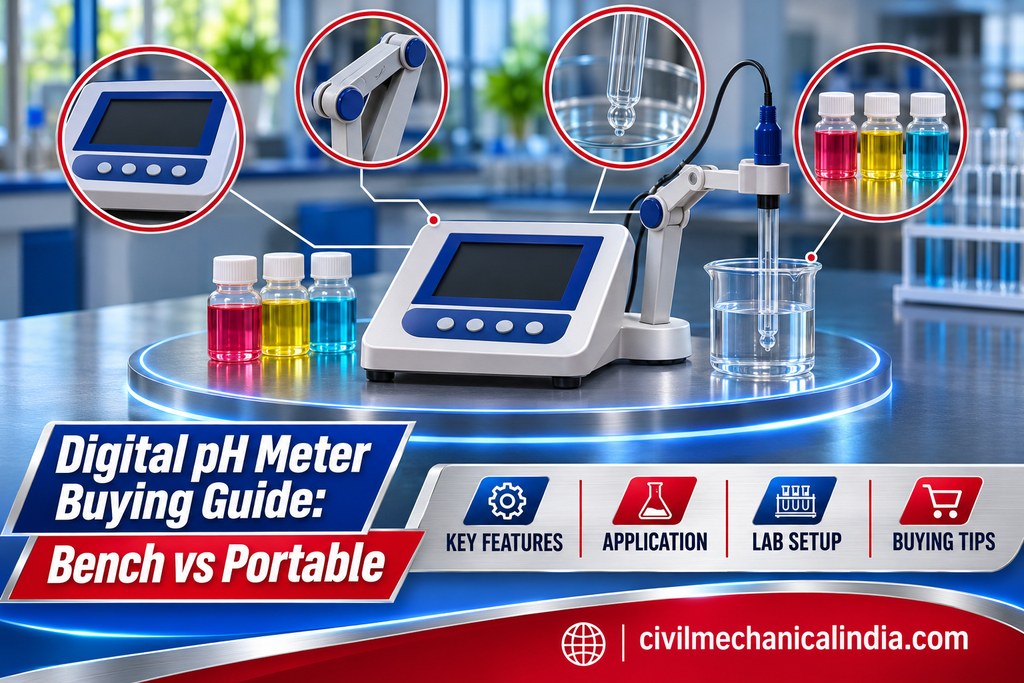
A digital pH meter measures how acidic or alkaline a liquid is, and it is one of the first instruments any water, soil or chemistry lab buys. We manufacture and supply pH meters from India. This guide helps buyers in Zimbabwe, Rwanda, Senegal, Côte d'Ivoire and Cameroon pick the right type and keep it accurate.
Bench, portable or pocket
There are three practical formats.
- A bench laboratory pH meter stays in the lab, runs on mains power and usually offers the best stability and features.
- A portable meter runs on batteries and goes to rivers, boreholes and farms.
- A pocket tester gives a quick check and suits field screening or school use.
Many labs need two: a bench unit for reported results and a portable one for sampling trips.
Digital pH meter models in our range
The following products are listed on our website under Electrochemistry Instruments and Environmental Lab Equipment.
| Product | Code | Note |
|---|---|---|
| Microprocessor pH Meter | ANL-ELC-0001 | Microprocessor pH meter for the laboratory bench |
| Digital pH, Conductivity & Temperature Meter | ANL-ELC-0002 | Combined pH, conductivity and temperature measurement |
| Digital pH Meter | ELE-0003 | Listed with our environmental lab instruments |
| pH Tester | LEA-0045 | Compact tester from our lab accessories range |
| Microprocessor Digital Conductivity Meter | CMI-NP-0058 | Auto temperature compensation and cell constant adjustment |
If you also test dissolved salts, a combined meter saves bench space. If you run many samples a day, separate meters avoid queues.
What to check before you choose
- Temperature compensation. pH changes with temperature, so automatic compensation is worth having for any reported result.
- Calibration points. Two-point calibration is the minimum. Three points give better accuracy across a wide range.
- Resolution. A reading to 0.01 pH is typical for lab work, and 0.1 pH is enough for field screening. These are general industry figures, so check the model you are offered.
- Electrode type. Clean water, dirty water and soil slurry each wear electrodes differently. Tell us the sample.
- Power. Field teams need battery operation.
A microprocessor pH meter stores calibration data and guides the user through the steps, which reduces operator error in busy labs.
Electrode care decides accuracy
The meter rarely fails. The electrode does. Three habits protect it:
- Store the electrode wet, in storage solution, never dry.
- Calibrate with fresh buffer solutions and discard used buffer.
- Rinse between samples with distilled water.
Order a spare electrode and buffer sachets with the meter. They are consumables.
What drives the price
We quote on request. The price of a pH meter depends on:
- Format: bench, portable or pocket.
- Single or multi-parameter measurement.
- Electrode type and whether a temperature probe is included.
- Memory, printer or computer output.
- Quantity and accessories such as stands, buffers and spare electrodes.
For water utilities, a pH meter is normally bought as part of a wider set of water quality testing equipment, including turbidity and conductivity meters.
Country notes for import and use
Bench meters need a stable mains supply. Portable units avoid the issue.
| Country | Nominal mains supply | Usual port of entry | Note for this equipment |
|---|---|---|---|
| Zimbabwe | 240 V, 50 Hz | Beira or Durban, then road (landlocked) | Power cuts are frequent in some areas. A battery-backed or portable meter keeps borehole testing going. |
| Rwanda | 230 V, 50 Hz | Dar es Salaam or Mombasa, then road (landlocked) | Volcanic soils in the north are acidic. Soil labs should order electrodes suited to slurry measurement. |
| Senegal | 230 V, 50 Hz | Dakar | Saline groundwater near the coast calls for a combined pH and conductivity meter. |
| Côte d'Ivoire | 220 V, 50 Hz | Abidjan | Cocoa and rubber processors test effluent. Choose robust electrodes for dirty samples. |
| Cameroon | 220 V, 50 Hz | Douala | High humidity shortens the life of connectors. Keep the meter in a dry cabinet between uses. |
Mistakes to avoid
- Storing the electrode dry or in distilled water.
- Using buffers past their date.
- Buying a pocket tester for results that will be reported to a regulator.
- Forgetting the temperature probe.
- Ordering no spare electrode for a remote site.
Frequently asked questions
How often should a pH meter be calibrated?
For reported results, calibrate at the start of each working day and after any electrode change. Field units should be checked before each trip.
Can one meter test both water and soil?
Yes, if the electrode suits both. As a soil testing device, the meter measures a soil and water slurry, which is harder on electrodes than clean water.
Do you supply other analytical instruments with the meter?
Yes. Our Analytical Lab Instruments category lists related instruments, and the Digital Turbidity Meter is a common companion for water labs.
Get a quotation
Tell us your samples, the number of tests per day and where the meter will be used. We will recommend a model and send an offer. Write to us through the contact page.