
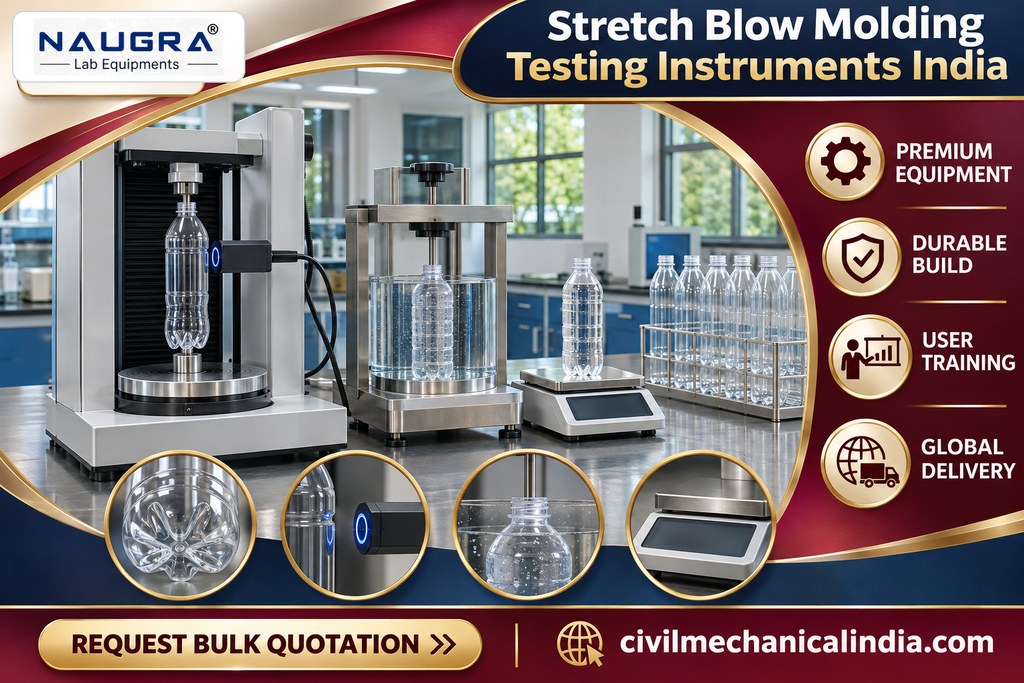
Our stretch blow molding testing instruments show whether a PET bottle has been blown correctly: right material distribution, right volume, enough strength. Converters and self-manufacturing bottlers use them at every mould change. We manufacture them in India. The model codes below are for tender buyers in Africa and South America.
Our stretch blow molding testing instruments range
| Product | Model code | Use |
|---|---|---|
| Bottle Thickness Profile Scanner for Stretch Blown Bottles | CMI-IND-0262 | Wall thickness profile from base to shoulder |
| Bottle Volumetric Capacity and Brimful Measuring Station | CMI-IND-0263 | Brimful and fill point capacity |
| Combined Load Pressure Torque Tester for PET Bottles | CMI-IND-0264 | Top load, pressure and torque in one station |
| Bottle Drop Impact Tester for Stretch Blown PET Containers | CMI-IND-0261 | Drop impact of filled PET containers |
| PET Intrinsic Viscosity Tester Automatic Viscometer | CMI-IND-0265 | Intrinsic viscosity of PET |
| PET Preform Acetaldehyde Content Analyzer | CMI-IND-0266 | Acetaldehyde content of preforms |
Ten instruments are shown on our Stretch Blown Testing Instruments page.
Tests and applications
| Question | Test | Consequence of failure |
|---|---|---|
| Is material in the right place? | Thickness profile | Weak base or shoulder |
| Is the volume right? | Brimful capacity | Wrong fill height |
| Will it survive capping and stacking? | Top load | Crushed bottles |
| Will it hold pressure? | Burst, creep | Burst or bulging bottles |
| Has the resin degraded? | Intrinsic viscosity | Brittle bottles |
| Will water taste right? | Acetaldehyde | Off-taste in bottled water |
Stretch blow moulding distributes a small amount of PET over a large surface. Heating profile, stretch rod timing and blow pressure decide where material ends up. A thickness scan shows the effect of each setting at once.
Lightweighting has pushed bottles close to their limits. A gram removed from the preform saves money on every bottle, but only if top load and burst results remain acceptable.
Resin quality sits behind everything. Intrinsic viscosity falls when PET is processed wet or too hot, and low viscosity means weak bottles. Acetaldehyde, generated in the same way, gives bottled water a fruity taint.
What to specify in a tender
- Bottle sizes, neck finishes and whether products are carbonated.
- Top load and pressure ranges.
- Thickness measuring method and resolution.
- Method for intrinsic viscosity and acetaldehyde.
- Fixtures for each bottle format.
Process control on a blowing line
At each mould change and start-up, section-weigh a bottle: cut it into base, body and shoulder and weigh each part. Together with a thickness scan, section weights confirm the heating recipe.
Check brimful volume and dimensions against the drawing, then top load and burst. Repeat at set intervals and whenever preform lots change, since preforms from different lots heat differently.
Keep preforms dry and at a stable temperature before blowing. Store bottles away from heat, because PET shrinks slightly as it ages, which changes volume. Record all results by mould and cavity number so that a single faulty cavity is quickly identified.
Markets we supply in Africa and South America
PET has become the main package for water, soft drinks and edible oil across both regions.
| Country | Nominal mains supply | Usual port of entry | Note for buyers |
|---|---|---|---|
| Guinea | 220 V, 50 Hz | Conakry | Local water and soft drink bottlers are investing in their own blowing lines. |
| South Sudan | 230 V, 50 Hz | Mombasa, then road | Bottled water plants serve a market with limited piped supply. |
| Central African Republic | 220 V, 50 Hz | Douala, then road | Small bottlers benefit from simple, robust checks. |
| Lesotho | 220 V, 50 Hz | Durban, then road | Bottled water producers supply both domestic and neighbouring markets. |
| Argentina | 220 V, 50 Hz | Buenos Aires | Large beverage and edible oil industries run high-speed PET lines. |
| Colombia | 110 V, 60 Hz | Cartagena or Buenaventura | Supply is 110 V at 60 Hz. Instruments are built to match. |
Why source from us
- Dimensional, strength and material testers from one manufacturer.
- Fixtures for your bottle and neck formats.
- Preform, closure and filling line testers on the same order.
- Installation and training available.
Frequently asked questions
Do you supply hot wire cutters for section weights?
Ask us in your enquiry. We list them with related bottle testing accessories.
Can one station perform top load and burst tests?
A combined load, pressure and torque tester is listed. We confirm ranges in the offer.
Are preform tests covered?
Yes. See our Preforms Testing Instruments range.
Send us your tender requirements
A new blowing line or a new bottle design usually comes with a list of required tests from the brand owner. Send us your tender requirements and we will answer each line with the instrument we offer, its model code, range and fixtures.
We can supply the complete bottle laboratory from India: thickness profile scanners and gauges, brimful volume stations, top load and burst testers, drop testers, intrinsic viscosity and acetaldehyde testers, preform inspection tools, cap torque testers and balances. Filling line instruments are added for integrated plants.
Tell us your bottle sizes, products, neck finishes and the destination port. Write to us through the contact page. We send an itemised quotation with delivery period. Fixtures are made for specific bottles, so each tender is priced on its own list, and change parts for every format are shown separately.
If you already run a blowing line and only need to add one or two instruments, send that shorter list. We supply single testers as readily as complete laboratories, and we will check that fixtures suit the bottles you make today.