
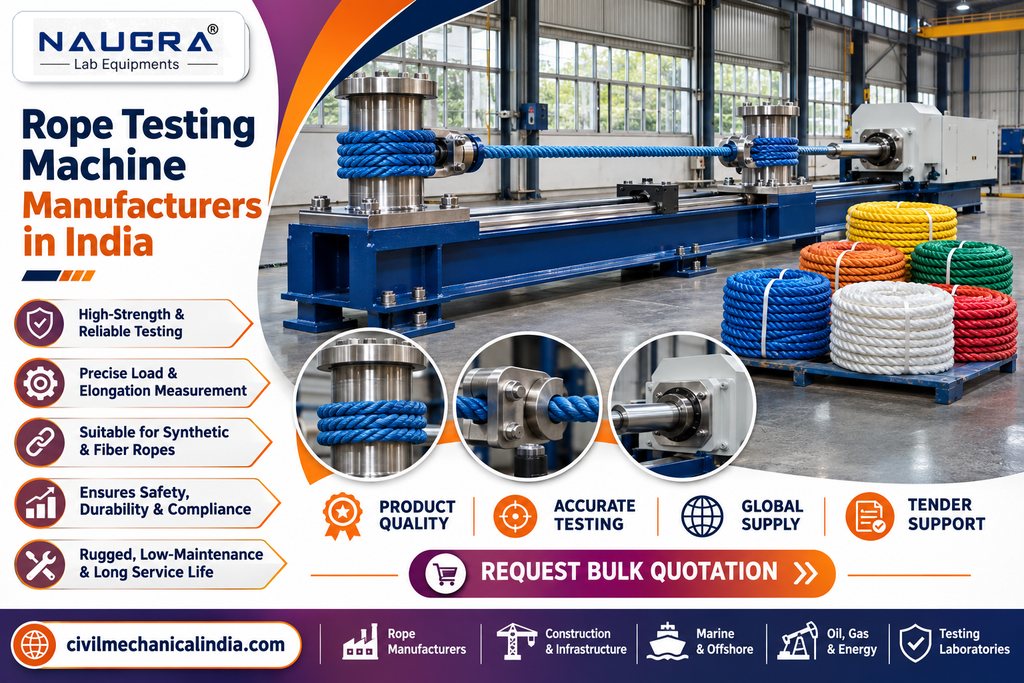
A rope testing machine tells a rope maker and a buyer the same thing: how much load the rope carries and how long it lasts. We manufacture rope testing instruments in India for producers of polypropylene, polyethylene, nylon and polyester ropes, and for fishing, shipping and agricultural buyers. The model codes below are for tender buyers in Africa and South America.
Our rope testing machine range
| Product | Model code | Use |
|---|---|---|
| Rope Knot Strength Test Fixture with Tensile Machine Adaptors | CMI-IND-0214 | Knot strength, with adaptors for a tensile machine |
| Rope Abrasion Resistance Tester Cycle Counter Type | CMI-IND-0211 | Abrasion resistance with cycle counting |
| Rope Fatigue and Flex Cycling Test Machine | CMI-IND-0213 | Fatigue under repeated flexing |
| Rope Diameter and Lay Length Measurement Gauge | CMI-IND-0212 | Diameter and lay length |
| Rope Linear Density and Length Measuring Balance | CMI-IND-0215 | Linear density and length |
| Rope Melting Point and Thermal Behaviour Apparatus | CMI-IND-0216 | Melting point and thermal behaviour |
Ten instruments are shown on our Plastic Rope Testing Instruments page.
Tests and applications
| Property | Test | Matters for |
|---|---|---|
| Breaking strength | Tensile to rupture | Safe working load |
| Knot efficiency | Knotted break | Fishing nets, lashings |
| Wear | Abrasion cycles | Mooring and towing |
| Flex life | Bending fatigue | Ropes over pulleys and fairleads |
| Size | Diameter, lay, linear density | Specification and price |
| Polymer | Melting point | Identifying the fibre |
Rope is sold by diameter and weight per length, and specified by minimum breaking strength. Linear density shows at once whether a rope contains as much material as it should. A rope that is light for its diameter will break below the stated load.
Knots, splices and sharp bends reduce strength considerably, so nets and lashings are judged by knotted strength. Abrasion and flex tests predict service life where ropes run over hardware.
Sunlight degrades polypropylene and polyethylene. Producers add stabilisers, and buyers in tropical regions should ask for weathering results as well as initial strength.
What to specify in a tender
- Rope materials, constructions and diameter range.
- Maximum breaking load, which sets the capacity of the tensile machine.
- Grip type: bollard, wedge or spliced eye.
- Standards followed for fibre ropes.
- Stroke length, since synthetic ropes stretch a great deal before breaking.
Testing ropes correctly
Gripping is the main difficulty. A rope clamped in ordinary jaws breaks at the grip and gives a low result. Bollard or capstan grips spread the load, and spliced eyes on pins are used for larger sizes. Tell us your sizes so the right grips are supplied.
Synthetic ropes extend far more than steel, so the machine needs a long stroke. Pre-tension the rope to the reference load before measuring diameter and length, as standards require.
Condition samples and note whether the rope was tested wet or dry. Nylon in particular loses strength when wet. Record where the break occurred, and discard results where the rope broke inside the grip.
Markets we supply in Africa and South America
Fishing, shipping, agriculture and construction all use synthetic rope, and local production serves each of these in both regions.
| Country | Nominal mains supply | Usual port of entry | Note for buyers |
|---|---|---|---|
| Mali | 220 V, 50 Hz | Dakar or Abidjan, then road | River fishing and agriculture use large quantities of twine and rope. |
| Sudan | 230 V, 50 Hz | Port Sudan | Agriculture and Red Sea shipping are steady buyers of rope. |
| DR Congo | 220 V, 50 Hz | Matadi, or Dar es Salaam for the east | River transport and mining both depend on reliable ropes. |
| Botswana | 230 V, 50 Hz | Durban or Walvis Bay, then road | Imported ropes for mining and farming are checked against specification. |
| Chile | 220 V, 50 Hz | San Antonio or Valparaíso | Aquaculture and fishing fleets are major rope users with strict requirements. |
| Ecuador | 120 V, 60 Hz | Guayaquil | A large fishing fleet and shrimp industry use ropes and nets intensively. |
Why source from us
- Strength, wear, fatigue and dimensional testers from one manufacturer.
- Grips matched to your rope sizes.
- Yarn, tape and woven sack testers on the same order.
- Installation and training available.
Frequently asked questions
Do you supply the tensile machine itself?
Yes. Tell us the maximum breaking load and rope length, and we quote a machine with suitable grips and stroke.
Can the machines test twine and net yarn?
Yes, with a lower-capacity load cell and appropriate grips.
Is UV weathering equipment available?
Yes. Weathering chambers are listed in our Woven Sack Raffia and Tapes Testing Instruments range.
Send us your tender requirements
Rope makers selling to ports, fisheries or government buyers must certify breaking strength. Send us your tender requirements with your rope sizes and constructions, and we will answer each line with the machine we offer, its model code, capacity and grips.
We can supply the complete rope laboratory from India: tensile machines with bollard grips, knot strength fixtures, abrasion testers, flex fatigue machines, diameter and lay gauges, linear density balances, melting point apparatus and weathering chambers. For plants that also make tape, twine or woven sacks, those testers are added.
Tell us the largest and smallest ropes you make, the standards you follow and the destination port. Write to us through the contact page. We reply with an itemised quotation and delivery time. Capacity, stroke and grips depend on your product range, so each tender is quoted individually, and grips for each rope size are listed as separate items.