
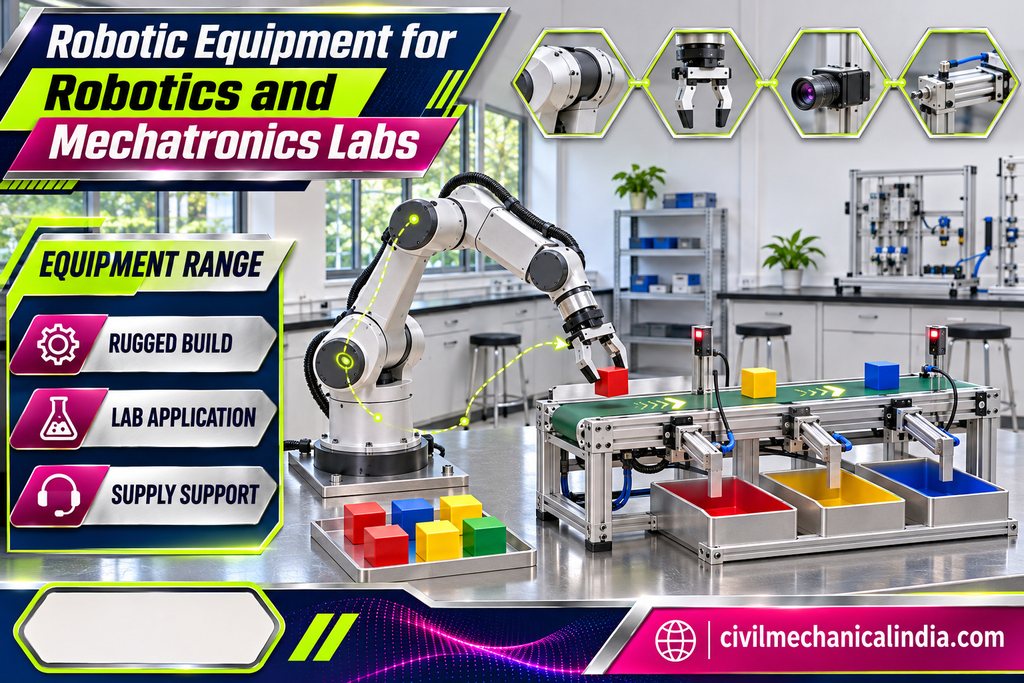
Our robotic equipment for education lets students program, wire and troubleshoot real robot arms and automated stations at bench scale. We manufacture these trainers in India. This page lists model codes for universities, polytechnics and TVET centres in South Africa, Egypt, Kenya, Ethiopia and Ghana.
Our robotic equipment range
These products are from our Robotics and Mechatronics Lab Equipment category. Descriptions for the last three come from the product cards.
| Product | Model code | Description |
|---|---|---|
| 6 Axis Robotic Trainer | CIVIL-ROB-160-0001 | Articulated arm with six axes for programming and kinematics |
| Pick and Place Robot Trainer | CIVIL-ROB-160-0002 | Arm that moves parts between stations |
| Scarab Robot Trainer | CIVIL-ROB-160-0003 | Robot arm trainer listed in our range |
| Delta Parallel Robot Trainer | CMI-NP-1572 | Three-arm delta robot with vacuum gripper and controller for fast pick-and-place demos |
| Mechatronics Conveyor Sorting Trainer | CMI-NP-1573 | Conveyor with sensors, pneumatic pushers and PLC for sorting by material and colour |
| Mobile Robot Line Following Trainer | CMI-NP-1574 | Differential-drive mobile robot with sensors and microcontroller for line following and obstacle avoidance |
Larger cells are listed as separate systems, including Welding Robot Training System, Palletizing Robot Training System and Mechatronic Training System.
What each robot type teaches
| Robot | Motion | Learning focus |
|---|---|---|
| Six-axis arm | Six rotary joints | Kinematics, teach programming, path planning |
| Pick and place | Simple transfer | Sequencing, grippers, cycle time |
| Delta | Parallel arms | High-speed sorting |
| Mobile | Wheeled platform | Sensors, navigation, embedded code |
| Conveyor station | Linear transport with sorting | PLC logic, sensors, pneumatics |
Applications
- Degree courses in mechatronics and automation.
- Technician training for bottling, packaging and assembly plants.
- Final-year projects that combine vision, sensors and control.
- Outreach sessions where a school STEM unit visits the college lab.
Features
- Controller and teach interface supplied with arm trainers.
- Sensors and pneumatic parts on the conveyor station, as described.
- Microcontroller-based mobile robot open to student code.
- Manuals with exercises.
Payload, reach, repeatability and software are model-specific. Our product cards do not publish them, so we state them in the quotation.
Planning a robotics lab
Give each trainer a fixed bench with a clear working envelope marked on the surface. Provide compressed air for pneumatic grippers and stations, a computer for each trainer and network access if software needs it. Start with one arm, one conveyor station and several mobile robots, since small robots let a whole class work at once. Add industrial-scale cells later. Agree safety rules before the first session: no hands inside the envelope while the arm is powered.
Keeping trainers in service
Robots in teaching labs fail from collisions and cable strain more than from wear. Set software limits before students start, route cables with slack at every joint and keep a set of spare grippers, fuses and sensors. Back up controller programs and parameters after commissioning, so that a trainer can be restored quickly if settings are changed by mistake.
Markets served: import and site notes
| Country | Nominal mains supply | Usual port of entry | Note for this equipment |
|---|---|---|---|
| South Africa | 230 V, 50 Hz | Durban | Automotive plants use robots heavily. Colleges need six-axis training that mirrors industry. |
| Egypt | 220 V, 50 Hz | Alexandria | New industrial zones are driving automation courses. PLC-linked stations are a good start. |
| Kenya | 240 V, 50 Hz | Mombasa | Universities run active robotics clubs. Mobile robots suit competitions and projects. |
| Ethiopia | 220 V, 50 Hz | Djibouti, then road or rail (landlocked) | Industrial parks need automation technicians. Conveyor and pick-and-place trainers match that work. |
| Ghana | 230 V, 50 Hz | Tema | Technical universities are adding mechatronics programmes. A mixed starter set fits new labs. |
Why buy from us
- Manufacturer of robot, PLC, pneumatic and sensor trainers.
- Other engineering equipment for the same machine laboratory in one order.
- Model codes for tender schedules.
- Installation, commissioning and training offered.
How to order
- Tell us course level and class size.
- Choose trainer types.
- State voltage, air supply and destination.
- We send a quotation with specifications.
Use our contact page. Robot trainers are priced per configuration.
Frequently asked questions
Which programming languages do the trainers use?
It depends on the trainer and controller. We state the software and language in the offer.
Do you supply physical science kits and basic electronics for beginners?
Our range focuses on engineering trainers. Ask us about entry-level scientific electronics and instrument equipment for first-year students.
Is training included?
We offer installation and instructor training. Ask for it to be quoted.