
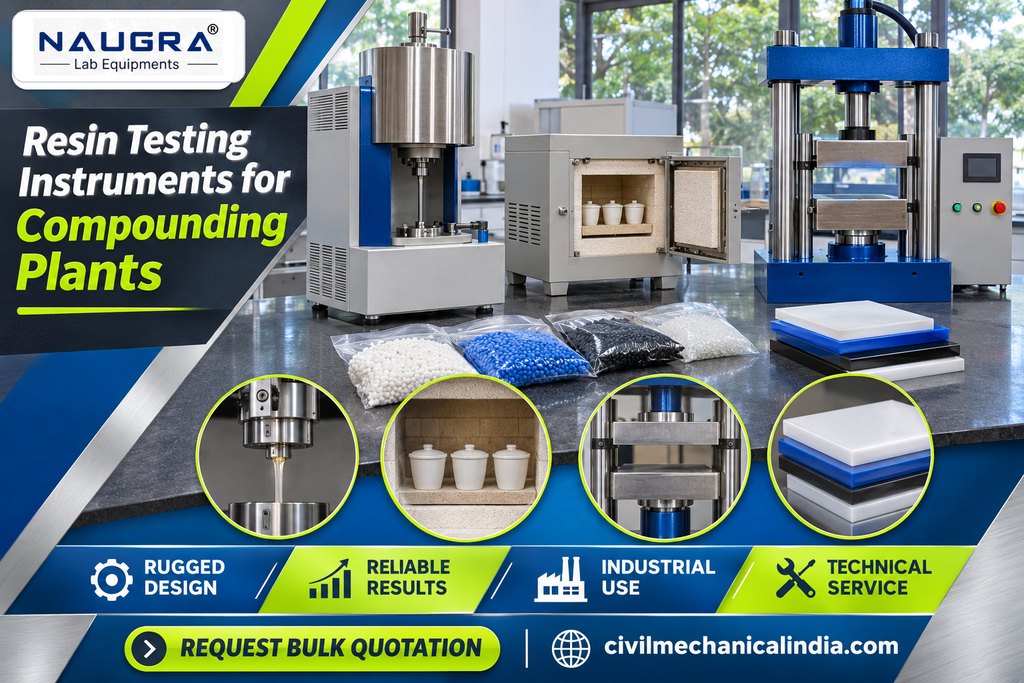
Our resin testing instruments serve compounders, masterbatch producers and resin distributors who must certify each lot before it ships. They measure flow, filler content, density and particle properties. We manufacture them in India. The model codes below are for tender buyers in Africa and South America.
Our resin testing instruments range
| Product | Model code | Use |
|---|---|---|
| Capillary Rheometer for Polymer Compound Melt Viscosity | CMI-IND-0223 | Melt viscosity across shear rates |
| Ash Content Muffle Furnace for Filled Resin Compounds | CMI-IND-0221 | Ash and filler content of filled compounds |
| Hydrostatic Density Balance for Resin Compounds | CMI-IND-0226 | Density of compounds by hydrostatic weighing |
| Bulk Density and Pour Density Apparatus for Resin Powders | CMI-IND-0222 | Bulk and pour density of powders |
| Electromagnetic Sieve Shaker for Resin Powder Particle Size | CMI-IND-0224 | Particle size of resin powder |
| Hydraulic Compression Molding Press for Resin Test Plaques | CMI-IND-0225 | Moulding plaques for further tests |
Ten instruments are shown on our Compound Resin Testing Instruments page.
Tests and applications
| Product | Certificate values | Tests |
|---|---|---|
| Filled compounds | Filler content, density, flow | Ash, density balance, melt flow |
| Masterbatch | Pigment loading, dispersion | Ash, filter test, colour |
| PVC dry blend | Bulk density, flow, stability | Bulk density, flow time, heat stability |
| Engineering compounds | Viscosity, mechanical properties | Rheometer, tensile, impact on plaques |
A compounder's product is a recipe, and the tests confirm the recipe was followed. Ash content shows the mineral filler or glass fibre level. Density confirms it by another route. Flow tests show that the compound will process as the customer expects.
Melt flow rate is a single-point test. A capillary rheometer measures viscosity over a range of shear rates, which predicts behaviour in extrusion and moulding far better for filled and engineering materials.
Powders have their own needs. Bulk density and particle size control how PVC and rotomoulding powders feed and fuse.
What to specify in a tender
- Compound types and fillers used.
- Temperature range and die sizes for the rheometer.
- Furnace temperature and crucible type for ash tests.
- Plaque dimensions and press tonnage.
- Sieve apertures for powder analysis.
Running a compounding laboratory
Sampling decides everything. Take samples from the start, middle and end of each lot, and blend or test them separately according to your procedure. A single grab sample from one bag can misrepresent a ten-tonne lot.
Mould plaques under fixed conditions and condition them before mechanical testing. Keep the press, cutter and test machines close together to save handling.
The furnace needs extraction, since burning polymer produces smoke. Weigh crucibles on an analytical balance and let them cool in a desiccator. Retain a sample of every lot with its certificate, because customers return to the certificate whenever processing problems arise.
Keep a control chart for each product. Ash, density and flow plotted lot by lot reveal a drifting feeder or a change in raw material sooner than any single result.
Markets we supply in Africa and South America
Compounding and masterbatch production are developing wherever plastics conversion is strong.
| Country | Nominal mains supply | Usual port of entry | Note for buyers |
|---|---|---|---|
| Burkina Faso | 220 V, 50 Hz | Abidjan, Tema or Lomé, then road | Converters rely on imported compounds and check them on arrival. |
| Mauritania | 220 V, 50 Hz | Nouakchott | Small volumes are imported for packaging and fishing gear production. |
| Burundi | 220 V, 50 Hz | Dar es Salaam, then road | A landlocked market where reliable incoming inspection avoids costly returns. |
| Namibia | 220 V, 50 Hz | Walvis Bay | Compounds for mining and construction products are tested against specification. |
| Bolivia | 230 V, 50 Hz | Arica in Chile, then road | Local converters import resin and compounds through Pacific ports. |
| Uruguay | 220 V, 50 Hz | Montevideo | Compounders supply agricultural films and packaging to regional customers. |
Why source from us
- Rheology, composition, density and powder testers from one manufacturer.
- Specimen preparation presses on the same order.
- Mechanical testers for plaques and bars available.
- Installation and training offered.
Frequently asked questions
Is a melt flow tester still needed with a rheometer?
Usually yes. Customers expect a melt flow value on the certificate, while the rheometer supports development and troubleshooting.
Can the furnace determine carbon black content?
Carbon black needs a specific method. See our Water Storage Tanks Testing Instruments range for a dedicated tester.
Do you supply colour measuring instruments for masterbatch?
Yes. Tell us the colour system and geometry you use.
Send us your tender requirements
Compounders and distributors issue certificates with every delivery, and each value on them needs an instrument behind it. Send us your tender requirements and we will reply line by line with the instrument we offer, its model code and what is included.
We can supply the compounding laboratory from India: capillary rheometers, melt flow testers, ash furnaces, density balances, bulk density apparatus, sieve shakers, moulding presses, tensile and impact testers, colour meters, ovens and balances. Product-specific testers for pipes, films or moulded parts are added for integrated plants.
Tell us the compounds you produce, the properties you certify and the destination. Contact us through the contact page. We send an itemised quotation with delivery time. Ranges and accessories follow your recipes, so each tender is quoted on its own list. Dies, crucibles, sieves and moulds are shown as separate lines, and we state clearly which consumables are included for the first months of operation.