
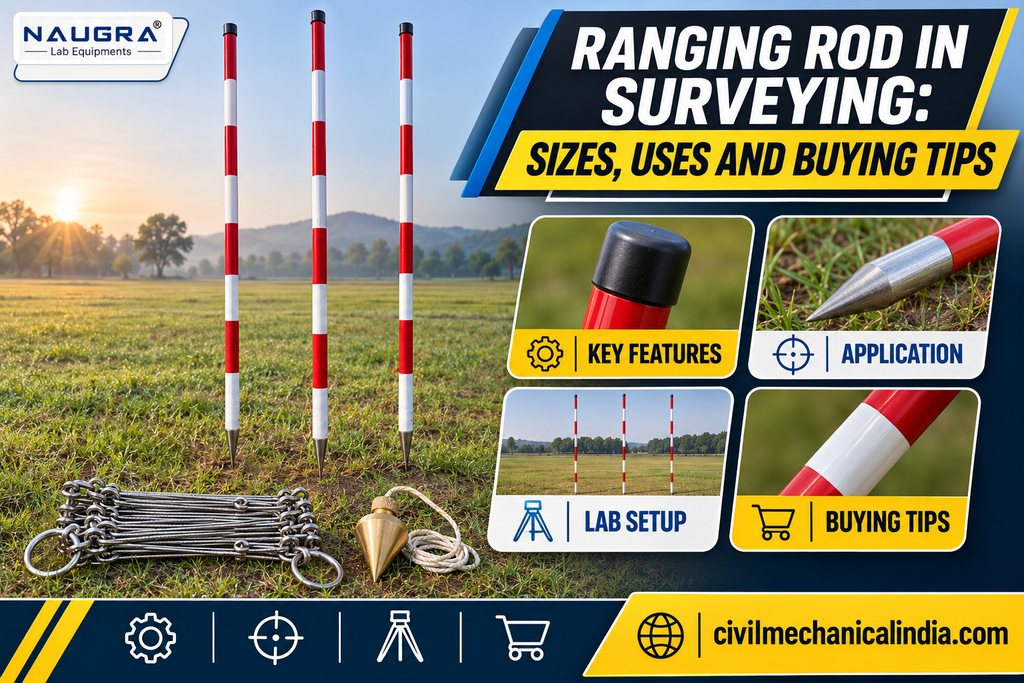
A ranging rod is a straight painted pole that surveyors plant in the ground to mark a point or to set out a straight line between two stations. We supply ranging rods and chain survey accessories from India. This guide is for survey departments, colleges and contractors in South Africa, Egypt, Kenya, Ethiopia and Ghana.
What a ranging rod is used for
In chain and tape surveying the line between two stations is often longer than the chain. Intermediate points must be fixed on the same straight line, a task called ranging. The surveyor sights from one end rod to the other and directs an assistant to place rods in between.
Common uses of the ranging rod in surveying are:
- Marking survey stations so they can be seen from a distance.
- Ranging out intermediate points on a chain line.
- Marking the ends of offsets.
- Acting as a target for a compass, level or theodolite on short sights.
Standard sizes and markings
The length of ranging rod most often supplied is 2 m or 3 m, with a diameter of roughly 30 mm. Rods are painted in alternate bands, usually red and white or black and white, each 200 mm long, and fitted with a pointed steel shoe. These are typical industry dimensions. Tell us if your syllabus or standard asks for something different.
| Item | Typical length | Purpose |
|---|---|---|
| Ranging rod | 2 m or 3 m | Marking stations and ranging lines |
| Ranging pole | 3 m to 5 m or more | Long sights and rough ground |
| Offset rod | About 3 m | Measuring short offsets, has a hook or notch |
The banded pattern is useful: because each band is 200 mm, a rod can be used for rough short measurements. A ranging pole is the same idea made longer, for sights across vegetation or uneven land.
Our survey accessories
The products below are listed in our Survey Laboratory Instruments category.
| Product | Code | Use |
|---|---|---|
| Ranging Pole Set | Not shown on site | Set of rods for marking and ranging survey lines |
| Metric Survey Chain 20 m | Not shown on site | Metric chain for linear measurement |
| Chain Arrows Set | Not shown on site | Marking each chain length on the ground |
| Hand Held Optical Square | Not shown on site | Setting out right angles for offsets |
| Plumb Bob Brass | Not shown on site | Centring over a station mark |
| Steel Tape 30 m | Not shown on site | Taping where a chain is not suitable |
Levels, theodolites and total stations are listed separately under Survey Instruments and Accessories.
How to choose and what affects the price
- Material. Steel tube is durable. Wood is lighter. Fibreglass does not rust.
- One-piece or jointed. Jointed rods are easier to transport.
- Paint quality. Bands must stay bright after a season in the field.
- Set size. A class of 30 students working in six groups needs at least four rods per group.
We quote per order. The price depends on material, length, quantity and whether chains, arrows, tapes and pegs are included as a kit. Long rods add to freight volume, so jointed rods can reduce shipping cost.
Country notes for import and field use
Ranging rods need no power. The practical points are transport and field conditions.
| Country | Nominal mains supply | Usual port of entry | Note for this equipment |
|---|---|---|---|
| South Africa | 230 V, 50 Hz | Durban | Many firms now use GNSS, but colleges still teach chain surveying and need full class sets. |
| Egypt | 220 V, 50 Hz | Alexandria | Bright sun and sand fade paint quickly. Ask for rods with durable enamel bands. |
| Kenya | 240 V, 50 Hz | Mombasa | Survey training is delivered at many technical institutes. Kits packed per group simplify issue and return. |
| Ethiopia | 220 V, 50 Hz | Djibouti, then road or rail (landlocked) | Steep highland terrain makes longer poles helpful for sighting across valleys. |
| Ghana | 230 V, 50 Hz | Tema | Coastal humidity rusts steel shoes. Dry and oil them before storage. |
Mistakes to avoid
- Ordering too few rods, so groups wait for each other.
- Accepting rods that are not straight.
- Forgetting arrows and pegs for the metric chain.
- Storing rods leaning against a wall, where they bend over time.
Frequently asked questions
What is the difference between a ranging rod and an offset rod?
An offset rod is similar in length but has a hook or notch at the top for pulling the chain through hedges and for aligning short offsets. A ranging rod has a plain top.
Is a range rod the same thing?
Yes. Range rod, ranging rod and ranging pole are used loosely for the same tool, with "pole" usually meaning a longer version.
Can you supply complete chain survey kits?
Yes. Tell us the number of groups and we will quote rods, chain, arrows, tape, optical square and plumb bobs as one kit per group.
Order survey sets for your institution
Send the number of student groups and any ranging rod length your syllabus requires through our contact page. We will reply with a kit-wise offer.