
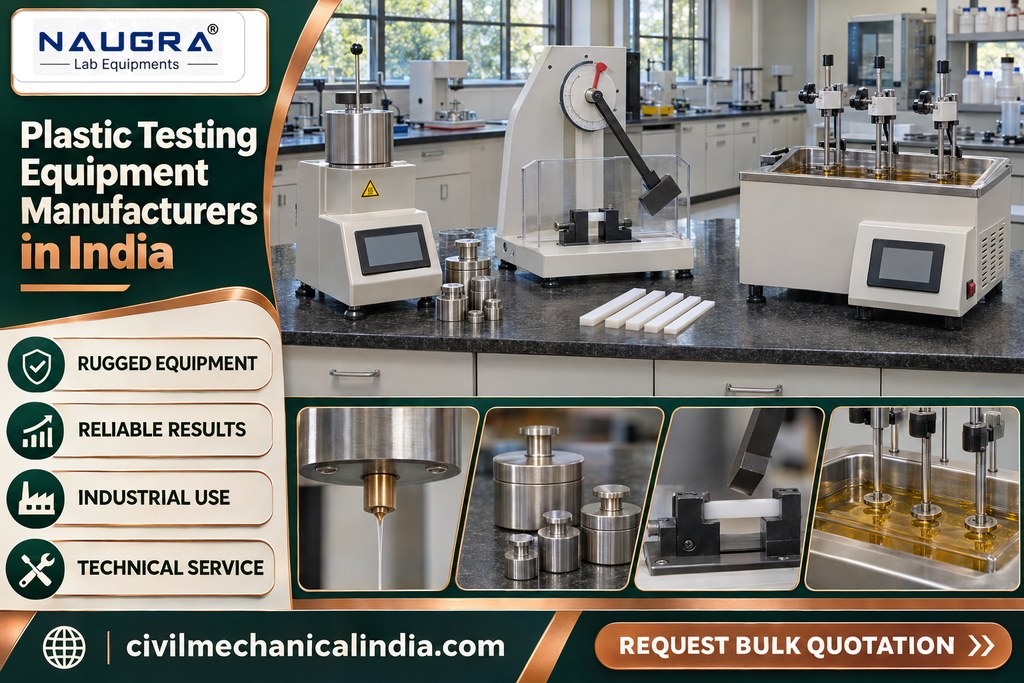
We manufacture plastic testing equipment in India for moulders, extruders, compounders, recyclers and institutional laboratories. These instruments measure flow, toughness, heat resistance and density, the properties that appear on every polymer data sheet. The model codes below are for tender buyers in Africa and South America.
Our plastic testing equipment range
| Product | Model code | Use |
|---|---|---|
| Melt Flow Index Tester with Digital Timer | CMI-IND-0166 | Melt flow rate with digital timing |
| Izod and Charpy Pendulum Impact Tester for Rigid Plastics | CMI-IND-0165 | Izod and Charpy impact strength |
| HDT and Vicat Softening Temperature Tester for Plastics | CMI-IND-0164 | Heat deflection and Vicat softening temperatures |
| Density and Specific Gravity Balance Kit for Plastics | CMI-IND-0161 | Density and specific gravity |
| Falling Weight Impact Tester for Rigid Plastic Sheets | CMI-IND-0163 | Falling weight impact on sheets |
| Environmental Stress Crack Resistance Test Bath | CMI-IND-0162 | Environmental stress crack resistance |
Ten instruments are shown on our Rigid Plastic Testing Equipments page.
Tests and applications
| Property | Test | Used to |
|---|---|---|
| Flow | Melt flow rate | Accept resin, set processing conditions |
| Toughness | Izod, Charpy, falling weight | Prevent brittle failures |
| Heat resistance | HDT, Vicat | Choose materials for hot service |
| Density | Density balance | Identify polymer, check filler level |
| Durability | Stress cracking | Qualify containers for detergents and chemicals |
Melt flow rate is the most common incoming test. It tells a moulder at once whether a new lot of resin will process like the last. Recyclers rely on it to grade material of unknown history.
Impact tests reveal problems no other test shows, such as degraded polymer, contamination or poor moulding conditions. Heat deflection and Vicat temperatures matter for parts used near heat, including electrical fittings and automotive components.
Stress cracking is a slow failure that affects polyethylene containers holding detergents or oils. Testing for it protects producers from field failures months after sale.
What to specify in a tender
- Polymers processed and the forms tested: granules, bars, sheets or parts.
- ISO or ASTM methods, as specimen sizes differ.
- Pendulum energies for impact testing.
- Number of stations on the HDT and Vicat apparatus.
- Specimen preparation: notch cutter, moulding or cutting press.
Equipping a polymer laboratory
Specimen preparation comes first. Most tests need bars of exact dimensions, so plan how they will be made, by injection moulding, compression moulding or cutting from sheet. A notch cutter is essential for impact tests, since notch shape strongly affects the result.
The melt flow tester needs extraction for fumes and a nearby balance. The HDT and Vicat apparatus uses a heated bath and should stand on its own bench. Keep density work away from draughts.
Condition specimens before testing, and note the conditions. Laboratories serving several plants should hold reference materials and test them regularly, so that every site produces comparable figures.
Recycled material needs closer control than virgin resin. Its flow and toughness vary from bale to bale, so test each incoming lot and blend to a target before it reaches the machine.
Markets we supply in Africa and South America
Plastics conversion is one of the most widespread manufacturing activities in both regions, from household goods to pipes and packaging.
| Country | Nominal mains supply | Usual port of entry | Note for buyers |
|---|---|---|---|
| Nigeria | 230 V, 50 Hz | Lagos (Apapa or Tin Can Island) | A large converting industry and local resin production support many laboratories. |
| Algeria | 230 V, 50 Hz | Algiers | Petrochemical investment is expanding local polymer supply and testing needs. |
| Kenya | 240 V, 50 Hz | Mombasa | Packaging and household goods producers are tightening incoming resin checks. |
| South Africa | 230 V, 50 Hz | Durban | Established polymer producers and converters work to ISO methods. |
| Bolivia | 230 V, 50 Hz | Arica in Chile, then road | Equipment reaches highland cities by road. Pack bath-based instruments carefully. |
| Uruguay | 220 V, 50 Hz | Montevideo | Converters supplying food exporters maintain documented quality checks. |
Why source from us
- Flow, impact, thermal, density and durability testers from one manufacturer.
- Specimen preparation tools quoted with the testers.
- Product-specific testers for pipes, bottles and films on the same order.
- Installation and training available.
Frequently asked questions
Do you supply tensile testers for plastics?
Yes. Tell us the load range and whether an extensometer is needed.
Can the impact tester do both Izod and Charpy?
The listed tester covers both. We confirm pendulums and supports in the offer.
Are resin and compound tests covered?
Yes. See our Compound Resin Testing Instruments range for rheology, ash and bulk density.
Send us your tender requirements
Whether you are setting up a moulding plant, a recycling line or a polytechnic polymer laboratory, send us your tender requirements. We will answer each line with the instrument we offer, its model code, the method it follows and the accessories supplied.
We can supply the complete polymer laboratory from India: melt flow testers, impact testers, HDT and Vicat apparatus, density balances, tensile machines, hardness testers, stress crack baths, notch cutters, moulding presses, ovens and balances. Product testers for pipes, tanks, bottles, caps and films are added for plants that need them.
Tell us the polymers and products you work with, the standards you follow and the destination port. Send the list through our contact page. We reply with an itemised quotation and delivery time. Specimen types and standards change the configuration, so each tender is quoted on its own scope.