
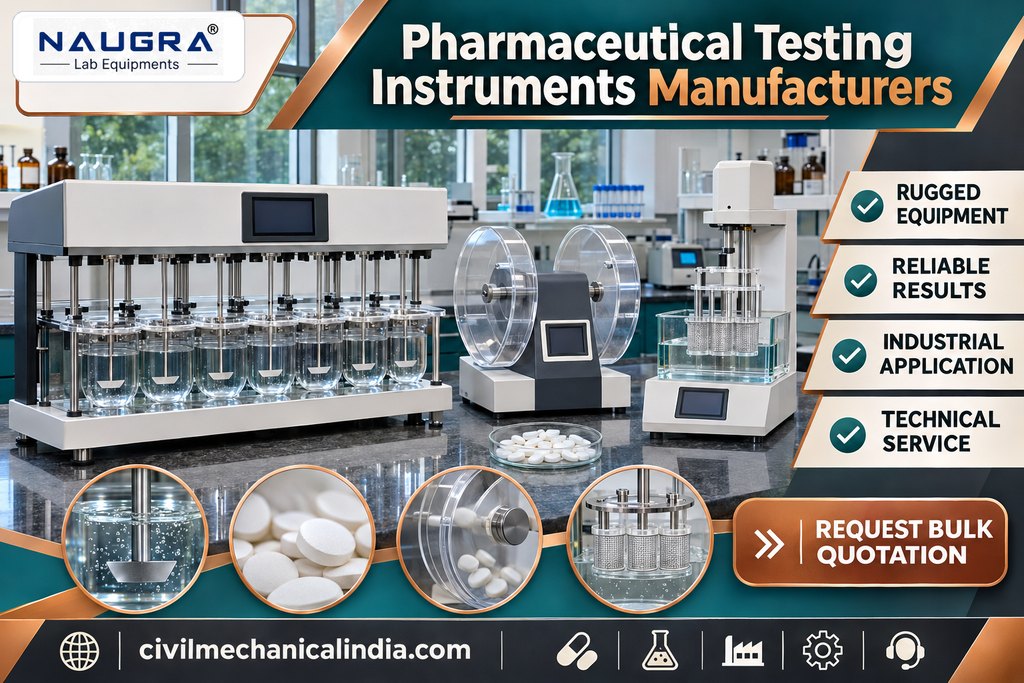
We manufacture pharmaceutical testing instruments in India for tablet and capsule producers, national medicine regulators and pharmacy colleges. These instruments perform the physical tests that pharmacopoeias require on every batch. The model codes below are for tender buyers in Africa and South America.
Our pharmaceutical testing instruments range
| Product | Model code | Use |
|---|---|---|
| Tablet Dissolution Test Apparatus 8 Station | CMI-IND-0285 | Dissolution of tablets and capsules, eight stations |
| Tablet Disintegration Test Apparatus Double Basket | CMI-IND-0284 | Disintegration time, two baskets |
| Tablet Friability Tester Dual Drum USP Type | CMI-IND-0286 | Friability of tablets, two drums |
| Capsule Hardness and Shell Brittleness Tester | CMI-IND-0282 | Hardness and brittleness of capsules |
| Blister Pack Leak Test Apparatus Vacuum Dye | CMI-IND-0281 | Leaks in blister packs by vacuum and dye |
| Moisture Content Karl Fischer Titrator for Pharmaceuticals | CMI-IND-0283 | Water content by titration |
Ten instruments are shown on our Pharmaceutical Testing Instruments page. Station and drum numbers are taken from the product names.
Tests and applications
| Test | What it shows |
|---|---|
| Dissolution | How quickly the drug is released into solution |
| Disintegration | How quickly a tablet or capsule breaks up |
| Friability | Whether tablets chip or crumble in handling |
| Hardness | Mechanical strength of the tablet |
| Leak test | Integrity of blister and strip packs |
| Water content | Stability of moisture-sensitive products |
A tablet that does not dissolve does not work. Dissolution testing is therefore the most important physical test in solid dose manufacture, and regulators use it to detect substandard medicines.
Friability and hardness protect the tablet on its journey through coating, packing and transport. Blister leak testing protects it afterwards, since moisture entering a faulty pocket can degrade the drug.
Regulators in many countries are building national quality control laboratories to screen imported and locally made medicines. Manufacturers need the same instruments in order to release batches with confidence.
What to specify in a tender
- The pharmacopoeia followed: IP, BP, USP or another.
- Number of dissolution stations and apparatus types, paddle or basket.
- Temperature control and timing features.
- Validation documents required.
- Accessories such as vessels, baskets, sinkers and sampling parts.
Setting up a pharmaceutical QC laboratory
Pharmaceutical laboratories work under good practice rules. Every instrument is qualified on installation and calibrated on a schedule, and every test is recorded. Plan the documentation with the equipment, and tell us which qualification documents your quality unit expects.
Dissolution testers need a vibration-free bench, purified water and a method for analysing the samples drawn, usually a spectrophotometer or chromatograph. Keep balances in a separate, draught-free area.
Control temperature and humidity in the laboratory. Friability and water content results change if tablets absorb moisture while waiting to be tested. Train analysts on each method and keep their training records, since auditors review people as well as instruments.
Markets we supply in Africa and South America
Local medicine production and stronger regulation are priorities for governments across both regions.
| Country | Nominal mains supply | Usual port of entry | Note for buyers |
|---|---|---|---|
| Liberia | 120 V, 60 Hz in most areas | Monrovia | Supply is 120 V at 60 Hz in most areas. Confirm it for each instrument. |
| Seychelles | 240 V, 50 Hz | Victoria | A small market served by imports, with testing focused on regulatory control. |
| São Tomé and Príncipe | 220 V, 50 Hz | São Tomé | Regulatory screening of imported medicines needs compact, essential instruments. |
| Gambia | 230 V, 50 Hz | Banjul | Public health programmes support quality control of essential medicines. |
| Bolivia | 230 V, 50 Hz | Arica in Chile, then road | Local manufacturers and the regulator both test solid dose products. |
| Uruguay | 220 V, 50 Hz | Montevideo | An established pharmaceutical industry works to international pharmacopoeias. |
Why source from us
- Solid dose and packaging testers from one manufacturer.
- Multi-station instruments for busy laboratories.
- General laboratory equipment on the same order.
- Installation, qualification support and training available.
Frequently asked questions
Which pharmacopoeia do the instruments comply with?
Tell us which one you follow. We confirm compliance for each instrument in the offer.
Do you provide qualification documents?
Tell us what your quality unit requires. We state what is supplied with each instrument.
Are processing machines for pharmacy colleges available?
Yes. Small-scale processing equipment is listed under Pharmaceutical Laboratory Equipments.
Send us your tender requirements
Regulators, hospitals and manufacturers often buy through formal tenders with detailed specifications. Send us your tender requirements and we will respond clause by clause with the instrument we offer, its model code and the pharmacopoeia it meets.
We can supply the solid dose laboratory from India: dissolution and disintegration testers, friability and hardness testers, capsule testers, blister leak testers, moisture titrators, tap density testers, balances, ovens and water baths. For teaching institutions, small processing machines are added so students can make and test a batch.
Tell us the products you test, the pharmacopoeia, the number of batches per day and the destination port. Contact us through the contact page. We reply with an itemised quotation and delivery period. Station numbers and documents vary with each laboratory, so every tender is quoted on its own scope.
Where a tender is funded by a development programme, there may be fixed formats for technical compliance and delivery schedules. Send those forms with the specification and we will complete them alongside our offer, so that your evaluation team receives everything it needs in one submission from one supplier in India.