
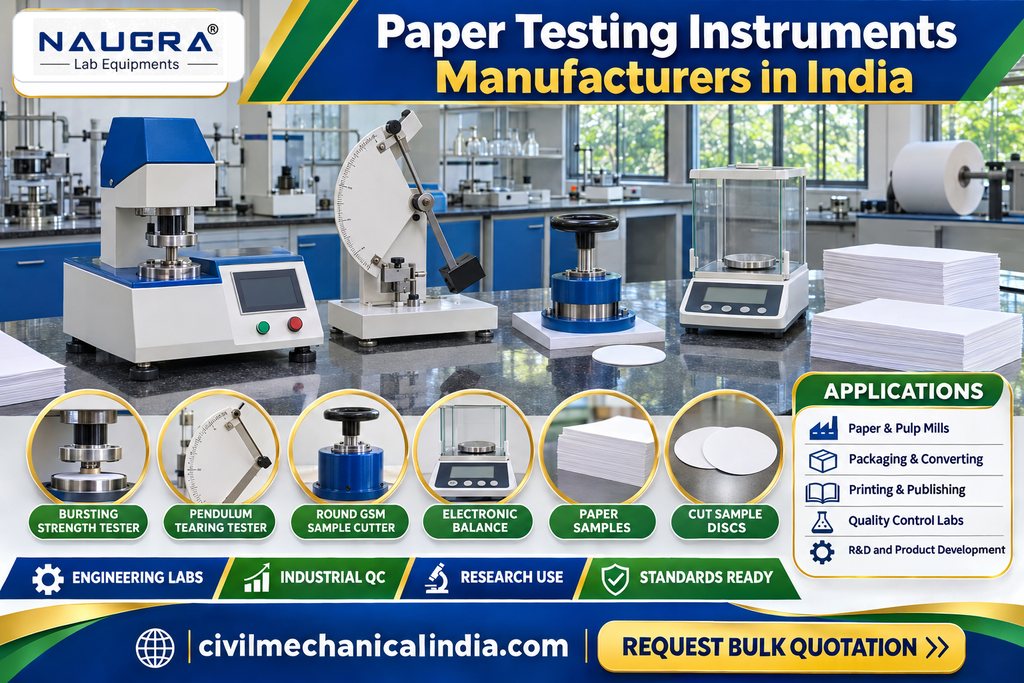
We manufacture paper testing instruments in India for paper mills, converters, printers and packaging buyers. These instruments measure the weight, strength and surface of paper, the properties every purchase specification lists. The model codes below help buyers in Africa and South America prepare a tender.
Our paper testing instruments range
| Product | Model code | Use |
|---|---|---|
| GSM Cutter and Electronic Balance Set for Paper | CMI-IND-0094 | Grammage from a cut sample of known area |
| Digital Bursting Strength Tester for Paper | CMI-IND-0092 | Bursting strength under hydraulic pressure |
| Elmendorf Tearing Strength Tester for Paper | CMI-IND-0093 | Tearing resistance by pendulum |
| Horizontal Tensile Tester for Paper Strips | CMI-IND-0096 | Tensile strength and stretch of paper strips |
| Bekk Smoothness Tester for Paper Surfaces | CMI-IND-0091 | Surface smoothness by air leakage |
| Gurley Type Air Permeability Tester for Paper | CMI-IND-0095 | Air permeability and porosity |
Ten instruments are shown on our Paper Testing Instruments page.
Tests and applications
| Property | Test | Important for |
|---|---|---|
| Basis weight | Grammage | Price, yield, all other calculations |
| Strength | Burst, tensile, tear | Sacks, wrapping, printing runnability |
| Surface | Smoothness | Print quality |
| Porosity | Air permeability | Sack filling, coating, ink absorption |
| Moisture | Moisture content | Curl, strength, dimensional stability |
Grammage is the first test, because paper is sold by weight and every strength result is compared against it. Burst, tensile and tear follow. For printing grades, smoothness and porosity often matter more than strength.
Mills test each reel. Converters and printers test on receipt to settle quality claims quickly. Buyers of sack and wrapping papers use the same instruments to check that a lighter, cheaper grade will still do the job.
Smaller converters can begin with three instruments and add others as they grow. What matters is that tests are done the same way every time, on samples cut from the same positions, so that today's figures can be compared with last month's. Agree the test methods with your paper supplier in writing, which removes most arguments about quality claims.
What to specify in a tender
- Paper grades and grammage range to be tested.
- Test standards, such as ISO or TAPPI methods.
- Capacity ranges for burst, tensile and tear testers.
- Sample cutters for strips and discs.
- Conditioning room or cabinet for standard atmosphere testing.
Running a paper testing laboratory
Paper properties change with humidity, so the standard methods require samples to be conditioned and tested in a controlled atmosphere. A conditioned room is the single most valuable investment for a paper laboratory. Where that is not possible, a conditioning cabinet and a record of room conditions are the minimum.
Arrange instruments in the order of testing: sample cutting, grammage, thickness, then strength and surface tests. Cut all samples from the same sheet positions each time, marking the machine direction, since strength differs along and across the sheet.
Check instruments daily with reference materials. Burst testers are verified with aluminium foils of known strength, and tear testers with check weights. Keep the records, because customers and auditors ask for them.
Markets we supply in Africa and South America
Paper and packaging consumption is rising with population and trade in both regions.
| Country | Nominal mains supply | Usual port of entry | Note for buyers |
|---|---|---|---|
| Burundi | 220 V, 50 Hz | Dar es Salaam, then road | Imported paper is converted locally into exercise books and packaging. |
| Namibia | 220 V, 50 Hz | Walvis Bay | Printers and packaging converters test paper on receipt. |
| Benin | 220 V, 50 Hz | Cotonou | Small converting plants need basic grammage and strength instruments. |
| Djibouti | 220 V, 50 Hz | Djibouti | A transit hub where paper for the region is traded and inspected. |
| Chile | 220 V, 50 Hz | San Antonio or Valparaíso | A major pulp and paper producer with well-equipped mill laboratories. |
| Ecuador | 120 V, 60 Hz | Guayaquil | Supply is 120 V at 60 Hz. Instruments are configured to suit. |
Why source from us
- Weight, strength, surface and porosity testers from one manufacturer.
- Sample cutters and reference materials quoted with instruments.
- Board and carton testers on the same order.
- Installation and training available.
Frequently asked questions
Which tests should a small converter start with?
Grammage, thickness and bursting strength. Add tensile and tear as volumes grow.
Do you supply reference foils for burst testers?
Tell us your tester range. We state in the offer which verification materials are included.
Can the instruments test board as well as paper?
Some can, within their range. Heavier boards need the instruments in our Mono Carton and Paper Board Testing Instruments range.
Send us your tender requirements
Paper mills and converters usually buy a full set of instruments at once. Send us your tender requirements and we will reply to every line with the instrument we offer, its model code, measuring range and the accessories supplied.
We can supply the whole laboratory from India: grammage cutters and balances, thickness gauges, bursting, tensile and tearing testers, smoothness and air permeability testers, Cobb testers, moisture meters, brightness and opacity instruments and conditioning cabinets. If the mill also makes board or the plant makes cartons, those instruments are added to the same offer.
Tell us the grades you make or buy, the standards you work to and the destination. Send the details through our contact page. An itemised quotation with delivery time follows. Ranges and accessories depend on your grades, so every tender is priced on its own list and nothing is bundled into a lump sum.