
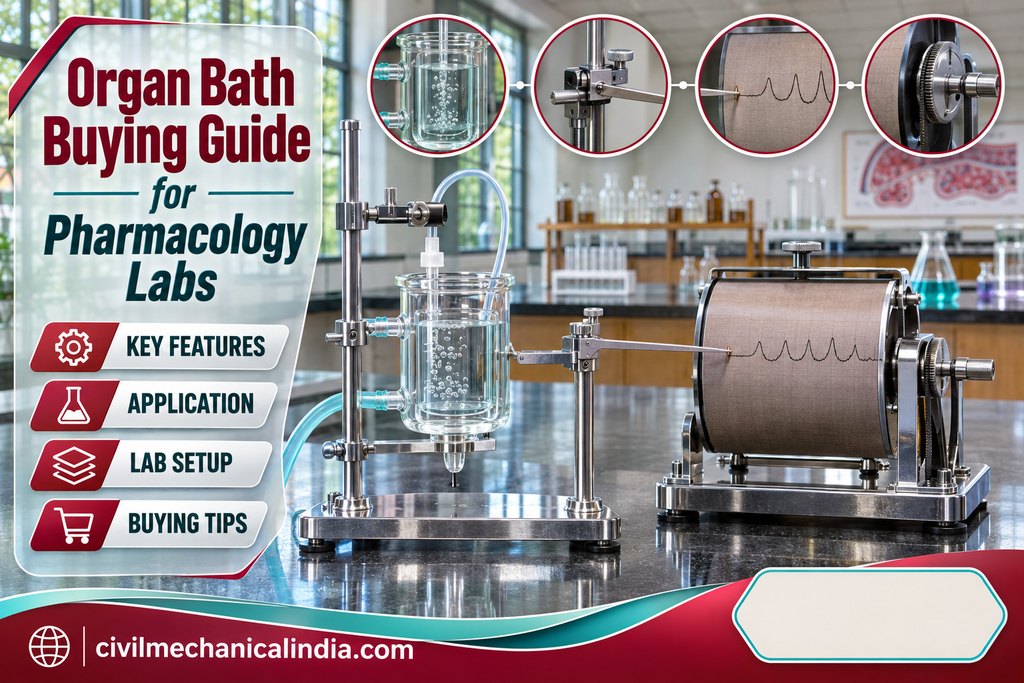
An organ bath keeps a strip of isolated tissue alive in warm, aerated salt solution so that students can record how it contracts or relaxes when a drug is added. It is the central apparatus of experimental pharmacology. We manufacture pharmacology laboratory equipment in India, and this guide helps pharmacy and medical colleges in Morocco, Algeria, Angola, Zambia and Zimbabwe choose a suitable set.
Parts of an organ bath setup
A complete station has five parts:
- The tissue chamber, usually glass, holding 10 to 50 ml of physiological solution. This volume is a typical figure, so check the model offered.
- A water jacket or outer bath with a thermostat to hold body temperature.
- An aeration tube that bubbles air or gas through the solution.
- A tissue holder and thread linking the tissue to a recorder.
- A recording device: a lever writing on a drum, or a force transducer feeding a data system.
The traditional recorder is the Sherrington rotating drum, a kymograph that turns smoked paper at a steady speed while a lever scratches the trace.
Organ bath models in our range
These products are listed in our Apparatus For Isolated Uterus Intestine category, with descriptions from the product cards.
| Product | Code | Description on our website |
|---|---|---|
| Single Chamber Isolated Organ Bath Assembly | CMI-NP-0004 | Jacketed bath with aeration tube and tissue holder, holds smooth muscle at constant temperature |
| Double Chamber Isolated Tissue Organ Bath | CMI-NP-0001 | Twin chambers for two tissue preparations in one thermostatic circuit |
| Four Chamber Multi Organ Bath System | CMI-NP-0002 | Four-station jacketed glass bath with digital temperature controller |
| Isometric Force Transducer for Organ Bath | CMI-NP-0003 | Converts tissue tension into an electrical signal for data acquisition or chart recorders |
| Student Kymograph with Recording Drum | CMI-NP-0005 | Clockwork or motor-driven kymograph with smoked paper drum |
| Apparatus For Isolated Uterus Intestine | ANL-ISU-0001 | Complete assembly for isolated tissue experiments |
How to choose
- Number of chambers. Single-chamber baths suit student pairs. Multi-chamber systems let a class compare drugs side by side.
- Recording method. A kymograph teaches the principle cheaply. A transducer with software gives cleaner data for postgraduate work.
- Temperature control. Digital control holds the set point more closely.
- Bath material. Some syllabuses name a perspex bath assembly single unit. State this if required.
- Spares. Glass chambers, levers and aeration tubes break. Order extras.
Other pharmacology lab equipments to plan for
An isolated tissue lab is rarely bought alone. Departments usually add behavioural and analgesia instruments from our Pharmacology Instruments range, such as the Eddy's Hot Plate Analgesiometer and the Rotarod Apparatus for Mice. Items such as a histamine chamber or rabbit holder appear in many syllabus lists. Our website does not show separate pages for those, so ask us to confirm them by name in your enquiry.
What drives the price
We quote each configuration separately. Costs depend on:
- Number of chambers and stations.
- Analogue or digital temperature control.
- Kymograph, transducer or both.
- Data acquisition hardware and software.
- Spare glass parts and accessories.
A department equipping 15 stations pays less per station than one buying three, so collect the full requirement before asking for prices.
Import and site notes by country
The thermostat and any electronic recorder need mains power. Confirm the supply.
| Country | Nominal mains supply | Usual port of entry | Note for this equipment |
|---|---|---|---|
| Morocco | 220 V, 50 Hz | Casablanca | Pharmacy faculties teach in French. Ask for operating instructions in French if needed. |
| Algeria | 230 V, 50 Hz | Algiers | University tenders list each accessory separately. Send the full list so nothing is missed. |
| Angola | 220 V, 50 Hz | Luanda | New medical schools are still building labs. Choose simple, robust single-chamber units first. |
| Zambia | 230 V, 50 Hz | Dar es Salaam or Durban, then road (landlocked) | Power interruptions spoil long experiments. A small UPS on the thermostat and aerator helps. |
| Zimbabwe | 240 V, 50 Hz | Beira or Durban, then road (landlocked) | Many departments now limit animal tissue work. Multi-chamber baths get more data from each preparation. |
Mistakes to avoid
- Ordering baths without aerators and tubing.
- Forgetting smoked paper, levers and stylus tips for kymographs.
- Skipping spare glass chambers.
- Ignoring ethical approval rules for tissue work, which differ by institution and country.
Frequently asked questions
Is a kymograph still needed if we buy transducers?
Not strictly. Many colleges keep one because the rotating drum in pharmacology practical exams is still part of the syllabus.
What tissues are used?
That depends on your curriculum and ethics rules. The bath itself suits most small smooth muscle preparations.
Can you supply a full pharmacology practical lab?
Yes. Send your syllabus list and we will quote baths, recorders and behavioural instruments together from our Analytical Lab Instruments range.
Request a quotation
Tell us the number of student stations and the recording method you prefer through our contact page. We will send a configured offer.