
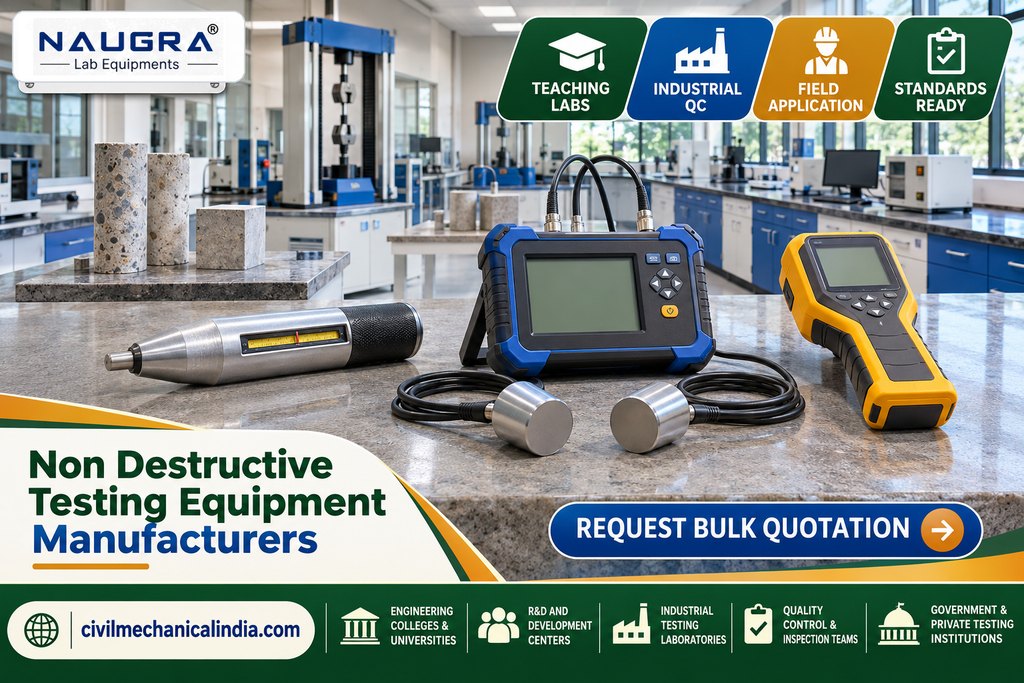
We manufacture non destructive testing equipment in India for assessing concrete structures without damaging them. Consultants, bridge authorities, building inspectors and universities use these instruments to judge strength, uniformity and corrosion risk. The model codes below help buyers in Africa and South America specify them in a tender.
Our non destructive testing equipment range
| Product | Model code | Use |
|---|---|---|
| Rebound Hammer Test Hammer | CMI-NP-0252 | Surface hardness as an indicator of concrete strength |
| Digital Ultrasonic Pulse Velocity Tester | CMI-NP-0248 | Uniformity, voids and cracks by ultrasonic pulse |
| Rebar Locator and Cover Meter | CMI-NP-0251 | Position, depth and spacing of reinforcement |
| Half Cell Potential Corrosion Meter | CMI-NP-0249 | Likelihood of reinforcement corrosion |
| Pull Off Adhesion Tester | CMI-NP-0250 | Bond strength of coatings, repairs and overlays |
| Concrete Core Cutting Machine | CMI-NP-0247 | Cores for laboratory strength testing |
These six instruments make up our Non Destructive Testing Equipment page.
Tests and applications
| Question | Method | Instrument |
|---|---|---|
| Is the concrete uniform? | Pulse velocity | Ultrasonic tester |
| How hard is the surface? | Rebound number | Rebound hammer |
| Where is the steel? | Electromagnetic scan | Rebar locator and cover meter |
| Is the steel corroding? | Half-cell potential | Corrosion meter |
| Is the repair bonded? | Pull-off | Adhesion tester |
| What is the actual strength? | Core test | Core cutting machine |
No single method gives the full picture. Engineers combine rebound and pulse velocity readings, then calibrate them against a small number of cores. That approach limits damage while giving results a designer can rely on.
What to specify in a tender
- The structures to be assessed: buildings, bridges, dams or pavements.
- The test standards your reports must reference.
- Data storage and download, if results go into digital reports.
- Core diameters and drilling depth.
- Calibration accessories such as test anvils and reference bars.
Using the instruments well
Results depend on the operator. Surfaces must be clean and smooth for rebound tests, and transducers need good contact for pulse measurements. Reinforcement should be located before coring, so that bars are not cut. Corrosion surveys need a grid marked on the structure and a sound electrical connection to the steel.
Check the rebound hammer on its test anvil and the ultrasonic tester on its reference bar before each survey. Record temperature and moisture conditions, since both affect readings. Train two operators at least, so that surveys continue when one is unavailable.
Plan how results will be reported. A condition survey produces hundreds of readings tied to locations on a structure. Instruments that store readings against a grid reference, and download them to a computer, save days of transcription and remove copying errors. Agree the report format with your client before the survey, then tell us which data outputs you need so the right versions are supplied. A marking kit with chalk, tape and templates for the survey grid is a small addition that speeds up every site visit.
Markets we supply in Africa and South America
Ageing bridges and buildings in both regions are being surveyed before repair or strengthening.
| Country | Nominal mains supply | Usual port of entry | Note for buyers |
|---|---|---|---|
| Guinea | 220 V, 50 Hz | Conakry | Mining infrastructure and port structures need periodic condition surveys. |
| South Sudan | 230 V, 50 Hz | Mombasa, then road | Goods arrive overland from a seaport in a neighbouring country. Portable kits travel well. |
| Central African Republic | 220 V, 50 Hz | Douala, then road | Remote sites favour battery-powered, hand-held instruments. |
| Lesotho | 220 V, 50 Hz | Durban, then road | Dams and water transfer tunnels are inspected on a regular cycle. |
| Paraguay | 220 V, 50 Hz | River route to Asunción | Hydropower structures and bridges require ongoing assessment. |
| Venezuela | 120 V, 60 Hz | La Guaira or Puerto Cabello | Mains supply is 120 V at 60 Hz. Chargers are supplied to suit. |
Why source from us
- A complete concrete assessment kit from one manufacturer.
- Hand-held instruments suited to site work.
- Laboratory compression machines for testing the cores.
- Training in correct use offered with supply.
Frequently asked questions
Can a rebound hammer give concrete strength directly?
It gives a rebound number. Strength is estimated from a correlation, which should be checked against cores from the same structure.
Do the instruments store readings?
Digital models store and transfer data. Tell us your reporting needs and we will confirm the version.
Are test anvils and reference bars supplied?
They are quoted as separate lines. We recommend including them.
Send us your tender requirements
Inspection programmes are usually tendered as a set of instruments for one or more survey teams. Send us your tender requirements and we will reply line by line with the instrument offered, its model code, what is in the case and which accessories we recommend.
We can supply the full kit from India: rebound hammers, ultrasonic pulse velocity testers, rebar locators and cover meters, half-cell corrosion meters, pull-off adhesion testers and core cutting machines, together with compression machines for testing the cores. Calibration accessories, spare transducers and carrying cases are quoted as separate lines.
Tell us how many teams you are equipping, the structures they will survey and the destination. Send the list through our contact page. For laboratory testing of cores and cubes, see Concrete Testing Lab Equipment. Each enquiry receives an itemised quotation, as team numbers and accessories vary from tender to tender.