
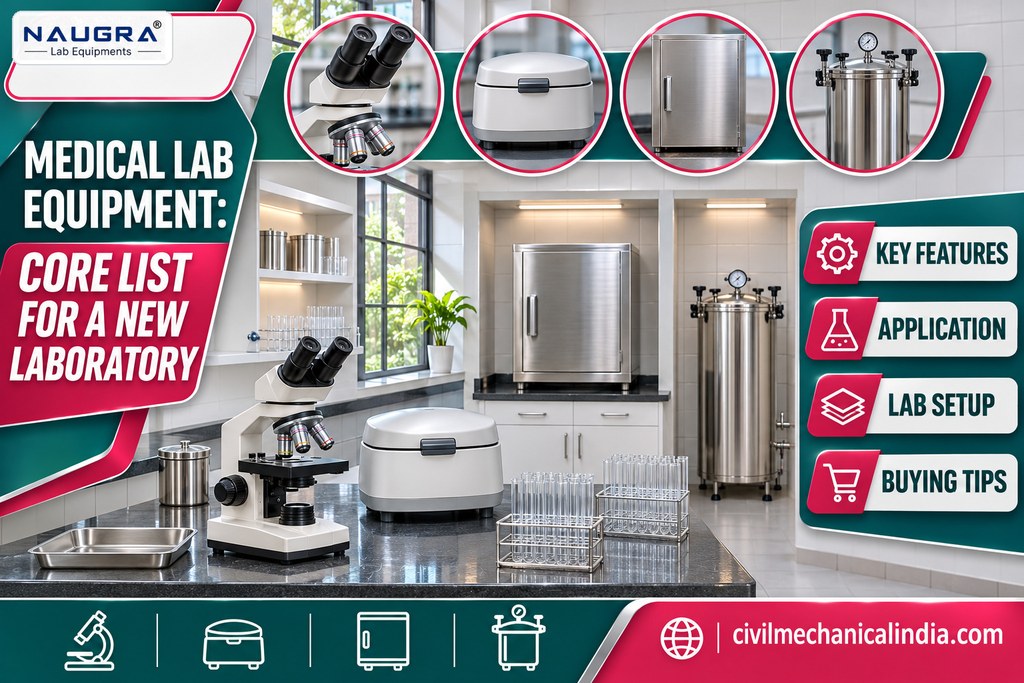
Medical lab equipment for a new diagnostic or teaching laboratory can be reduced to a short core list: something to separate samples, something to look at them, something to grow organisms, and something to sterilise and protect. We manufacture and supply general laboratory instruments from India. This guide is for hospital planners and colleges in Tanzania, Uganda, Morocco, Algeria and Angola.
The core list by function
| Function | Equipment | Notes |
|---|---|---|
| Separate | Clinical centrifuge, haematocrit centrifuge | Serum, plasma and packed cell volume |
| Examine | Binocular microscope | Blood films, parasites, urine deposits |
| Culture | Incubator | Bacteriology at controlled temperature |
| Sterilise | Autoclave | Media, glassware and waste |
| Protect | Biosafety cabinet | Handling infectious samples |
| Support | Water still, water bath, refrigerator | Daily routine work |
Analysers for chemistry and haematology are specialised products that we do not list. This guide covers the general medical laboratory equipment around them.
Medical lab equipment in our range
| Product | Code | Note from our website |
|---|---|---|
| Digital Clinical Centrifuge 12 Place | CMI-NP-0139 | Benchtop, digital speed and timer, 12-place swing-out rotor |
| Micro Haematocrit Centrifuge | CMI-NP-0140 | Spins capillary tubes at 12000 rpm for packed cell volume |
| Refrigerated Clinical Centrifuge 4000 rpm | CMI-NP-0141 | Temperature control from -10 to 40 °C for heat-sensitive samples |
| Binocular Compound Microscope | CMI-NP-1257 | LED illumination, four objectives, inclined binocular head |
| Class II Type A2 Biosafety Cabinet 4 Feet | CMI-NP-0012 | HEPA-filtered laminar downflow with inward airflow |
| Autoclave Vertical | ANL-AUT-0001 | Vertical steam steriliser |
Related categories are Medico Clinical Centrifuge, Incubators Laboratory and Autoclaves Laboratory.
How to choose
- Define the test menu first. Equipment follows tests, not the other way round.
- Size by workload. Count samples per day and choose rotor places and chamber volumes to match.
- Check power reliability. Incubators and refrigerators must ride through power cuts.
- Think about biosafety level. The cabinet class depends on the organisms handled.
- Standardise models across sites so that spares and training are shared.
A refrigerator centrifuge, the term some tenders use for a refrigerated centrifuge, is needed only where samples degrade with heat.
Room layout matters as much as the equipment. Keep a one-way flow from sample reception to testing to waste, place the autoclave away from the clean side, and leave space behind refrigerated units for air to circulate. Drawing the bench plan before ordering avoids instruments that do not fit.
What drives the price
We quote per specification. The main factors are:
- Capacity: rotor places, chamber litres, cabinet width.
- Digital control and alarms.
- Refrigeration.
- Filter class and airflow monitoring on cabinets.
- Accessories such as rotors, adaptors and racks.
- Installation and training.
Import and site notes by country
All these instruments are mains powered. Confirm voltage and plan stabilisers.
| Country | Nominal mains supply | Usual port of entry | Note for this equipment |
|---|---|---|---|
| Tanzania | 230 V, 50 Hz | Dar es Salaam | District hospitals face frequent outages. Water-jacketed incubators hold temperature longer. |
| Uganda | 240 V, 50 Hz | Mombasa, then road (landlocked) | Health centres run malaria and TB microscopy. Robust LED lab microscope models are the priority. |
| Morocco | 220 V, 50 Hz | Casablanca | Private clinics are expanding in cities. Compact benchtop units suit small rooms. |
| Algeria | 230 V, 50 Hz | Algiers | Public hospital tenders are detailed. Send the full technical sheet so we can respond line by line. |
| Angola | 220 V, 50 Hz | Luanda | New provincial labs are far from service engineers. Choose simple controls and order spares. |
Mistakes to avoid
- Buying a centrifuge without the right tube adaptors.
- Placing incubators in direct sun or next to an autoclave.
- Using a clean bench where a biosafety cabinet is needed.
- Ordering no spare gaskets, fuses or lamps.
- Forgetting distilled water for the autoclave and reagents.
Frequently asked questions
Do you supply anaerobic culture equipment?
Our website lists an Anaerobic Incubator Cabinet with Gas Ports with gas ports. If your tender names an anaerobic culture jar, tell us and we will confirm what we can offer.
Vertical or front loading autoclave?
Vertical units save floor space and suit small labs. A front loading autoclave is easier to load with heavy baskets in busy sterilising rooms.
Is an incubator instrument needed in every lab?
Only if you culture organisms. A lab doing microscopy and rapid tests alone can start without one.
Request a quotation
Send your test menu, workload and power situation through our contact page. We will propose medical lab instruments for each room. See our full Analytical Lab Instruments range.