
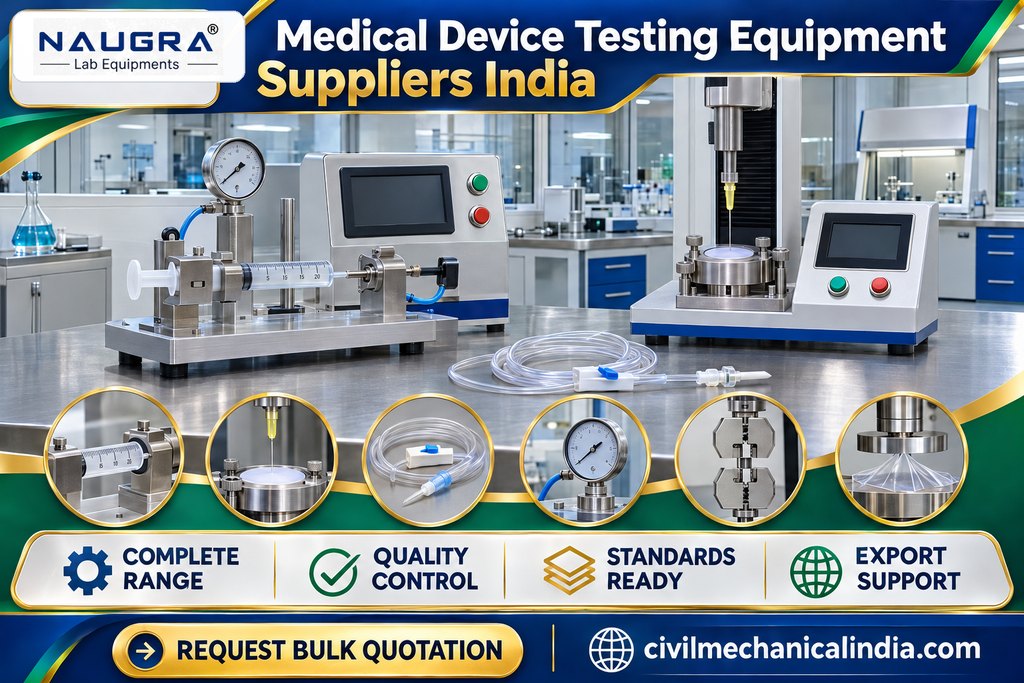
Our medical device testing equipment is built for producers of syringes, needles, catheters, infusion sets and masks, and for the regulators who approve them. Each of these products has a standard with defined physical tests. We manufacture the instruments in India. The model codes below are for tender buyers in Africa and South America.
Our medical device testing equipment range
| Product | Model code | Use |
|---|---|---|
| Luer Taper Gauge and Syringe Leakage Test Set | CMI-IND-0293 | Luer taper conformity and syringe leakage |
| Needle Penetration and Bevel Force Tester for Hypodermic Needles | CMI-IND-0296 | Penetration force of hypodermic needles |
| Catheter Tensile and Bond Strength Tester | CMI-IND-0291 | Tensile and bond strength of catheters |
| Infusion Set Flow Rate and Drip Chamber Tester | CMI-IND-0292 | Flow rate of infusion sets and drip chambers |
| Medical Mask Bacterial Filtration and Differential Pressure Tester | CMI-IND-0295 | Bacterial filtration and breathing resistance of masks |
| Medical Device Particulate Contamination Counter | CMI-IND-0294 | Particulate contamination on devices |
Ten instruments are shown on our Medical Product Testing Instruments page.
Tests and applications
| Device | Key tests |
|---|---|
| Syringes | Leakage, plunger force, luer fit, graduation accuracy |
| Needles | Penetration force, bond to hub, stiffness |
| Catheters and tubing | Tensile strength, joint strength, flow |
| Infusion sets | Flow rate, drip accuracy, leakage |
| Face masks | Filtration efficiency, differential pressure |
| All sterile devices | Particulate contamination, pack integrity |
Single-use devices are made in millions, and a small defect rate still reaches many patients. Batch testing against the product standard is the control regulators and hospital buyers rely on.
Luer connections must fit every other luer device in a hospital, which is why taper gauges appear in every syringe and infusion set standard. Needle sharpness is measured as penetration force, the figure that determines patient comfort.
Mask testing expanded sharply after 2020, and many countries now require filtration and breathability results before masks can be sold for medical use.
What to specify in a tender
- Devices to be tested and their sizes.
- Product standards, usually ISO or national equivalents.
- Force and pressure ranges.
- Fixtures for each device size.
- Clean room compatibility and documentation for regulatory audits.
Testing devices under controlled conditions
Device testing takes place inside a quality system. Instruments are qualified, calibrated and recorded, and results must trace to a batch. Decide where each test is performed, in the production clean room or in a laboratory, since that affects instrument construction and cleaning.
Many tests are dimensional or force-based and need little space, but they need correct fixtures. A syringe leakage test uses a different adaptor for each nominal capacity. Listing every size avoids delays later.
Sampling plans come from the standards. Train inspectors to follow them and to record defects by type. Trends in those records point back to a moulding, assembly or packaging step that needs attention.
Markets we supply in Africa and South America
Several countries in both regions are building local production of syringes, masks and other consumables.
| Country | Nominal mains supply | Usual port of entry | Note for buyers |
|---|---|---|---|
| Guinea-Bissau | 220 V, 50 Hz | Bissau | Regulatory checks on imported devices are being strengthened. |
| Cabo Verde | 230 V, 50 Hz | Praia | An island health system that depends on verified imports. |
| Nigeria | 230 V, 50 Hz | Lagos (Apapa or Tin Can Island) | Local syringe and consumables manufacturing is expanding with government support. |
| Algeria | 230 V, 50 Hz | Algiers | A sizeable domestic medical device industry tests to international standards. |
| Paraguay | 220 V, 50 Hz | River route to Asunción | Hospitals and regulators check imported consumables for conformity. |
| Venezuela | 120 V, 60 Hz | La Guaira or Puerto Cabello | Supply is 120 V at 60 Hz. Instruments are specified to suit. |
Why source from us
- Testers for syringes, needles, tubing, sets and masks from one manufacturer.
- Fixtures for each device size.
- Packaging and seal testers on the same order.
- Installation, documentation and training available.
Frequently asked questions
Do the instruments follow ISO device standards?
Tell us the standard numbers. We confirm in the offer which tests each instrument covers.
Can one force tester serve several tests?
Often yes, with different fixtures. Tell us the tests and we will propose a configuration.
Are sterile pack seal testers available?
Yes. Seal and leak testers are in our Flexible Packaging and Pouch Testing Instruments range.
Send us your tender requirements
New device factories and national laboratories usually specify their test equipment from the product standards. Send us your tender requirements with the standards and device sizes, and we will reply to each line with the instrument we offer, its model code and fixtures.
We can supply the device laboratory from India: luer gauges and syringe testers, needle penetration and bond testers, catheter tensile testers, infusion set flow testers, mask filtration and differential pressure testers, particulate counters, pack seal and leak testers and balances. General laboratory equipment is added so the room is complete.
Tell us the devices you make or inspect, the applicable standards, the batch sizes and the destination. Send the details through our contact page. We reply with an itemised quotation and delivery time. Fixtures are specific to each device size, so every tender is quoted on its own list.
If you are still at the planning stage for a new device factory, send us the product list and the standards you intend to meet. We will propose a test equipment schedule that you can place straight into your tender documents.