
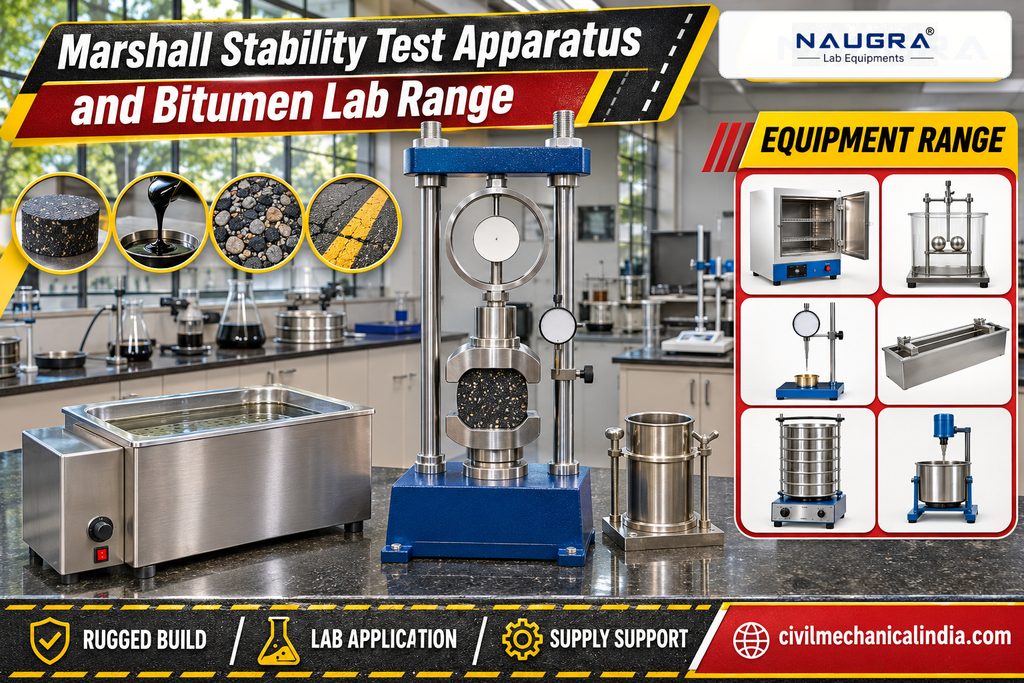
Our Marshall stability test apparatus is the centre of an asphalt mix design laboratory, and we manufacture it in India together with the compactors, extractors and binder testers that surround it. This page gives model codes for road agencies, contractors and universities in Ethiopia, Ghana, Tanzania, Uganda and Morocco.
Our Marshall stability test apparatus and bitumen range
These products are from our Bitumen / Asphalt Testing Lab Equipment category.
| Product | Model code | Purpose |
|---|---|---|
| Marshall Stability Test Apparatus | BTE-0001 | Stability and flow of compacted asphalt specimens |
| Automatic Marshall Stability Test Machine | BTE-0002 | Automatic loading and recording of the Marshall test |
| Automatic Compactor For Bituminous Mixes | BTE-0008 | Compacting specimens with a set number of blows |
| Centrifuge Extractor (Motorised) | BTE-0006 | Binder content by solvent extraction |
| Ductility Testing Apparatus | BTE-0004 | Ductility of bitumen |
| Digital Penetrometer | BTE-0005 | Penetration grade of bitumen |
| Automatic Ring And Ball Apparatus | BTE-0023 | Softening point |
| Rolling Thin Film Oven | BTE-0017 | Short-term ageing of binder |
| Benkelman Beam | BTE-0010 | Pavement deflection under a wheel load |
| Pavement Core Drilling Machine | BTE-0003 | Cutting cores from finished pavement |
Applications
The Marshall method remains the most widely used asphalt mix design procedure on African road projects. The equipment serves:
- Mix design, where specimens at several binder contents are compacted and tested to find the optimum.
- Plant control, where daily samples confirm the mix stays on target.
- Acceptance testing, where cores from the road are checked for density and binder content.
- Teaching highway engineering.
In the standard test, specimens are conditioned in a water bath at 60 °C and loaded at about 50 mm per minute. These are values from the test method, so confirm them against the standard you use.
Features
- Built to IS, BS, EN, ASTM or AASHTO as applicable.
- Manual and automatic versions of the test frame and compactor.
- Breaking head, moulds, hammer and extractor quoted as a set.
- Water bath and oven sized for the number of specimens.
Laying out an asphalt laboratory
An asphalt lab works with hot material, so the layout should keep hot and cold work apart. Ovens, the mixer and the compactor belong together on a heat-resistant bench with extraction. The water bath and the Marshall frame sit next to each other, because a specimen must be tested within seconds of leaving the bath. Solvent extraction needs its own ventilated corner, away from flames.
Binder tests such as penetration, softening point and ductility are best kept in a cooler, cleaner part of the room with a controlled water bath. If you tell us the room size, we can suggest which bench each item should stand on.
Consumables are easy to forget. Filter papers for specimens and extractors, solvent, release paper discs and spare thermometers should be on the first order, since a missing box of filter rings can stop a mix design for weeks.
Markets served: import and site notes
| Country | Nominal mains supply | Usual port of entry | Note for this equipment |
|---|---|---|---|
| Ethiopia | 220 V, 50 Hz | Djibouti, then road or rail (landlocked) | Federal and regional road programmes run many site labs. Standardise on one model across projects. |
| Ghana | 230 V, 50 Hz | Tema | Hot, wet conditions test asphalt durability. Stripping and binder content tests matter. |
| Tanzania | 230 V, 50 Hz | Dar es Salaam | Long trunk road contracts need mobile asphalt labs near the plant. |
| Uganda | 240 V, 50 Hz | Mombasa, then road (landlocked) | Oil-region road works brought new asphalt plants. Each needs a control lab. |
| Morocco | 220 V, 50 Hz | Casablanca | Motorway projects follow EN mix design. Tell us which methods apply. |
Why buy from us
- We manufacture the complete asphalt lab, not only the Marshall frame.
- Bitumen, aggregate and soil civil equipment can travel in one container.
- Line-by-line tender offers.
- Commissioning and training on request.
How to order
- Send your civil engineering equipment list for the asphalt lab.
- State the standard and whether automatic versions are wanted.
- Give power supply and port.
- We quote with delivery time.
Use our contact page. Prices are given per enquiry because the set, automation and quantity vary.
Frequently asked questions
Do you supply a dynamic shear rheometer for the DSR test?
Our website does not list a dynamic rheometer. The DSR test belongs to performance-grade binder specifications. Ask us and we will tell you what we can offer.
How many moulds should we order?
Mix design uses sets of three specimens at several binder contents, so twelve to eighteen moulds is a practical number.
Can aggregate tests be added?
Yes. See our Aggregate Testing Lab Equipment range.