
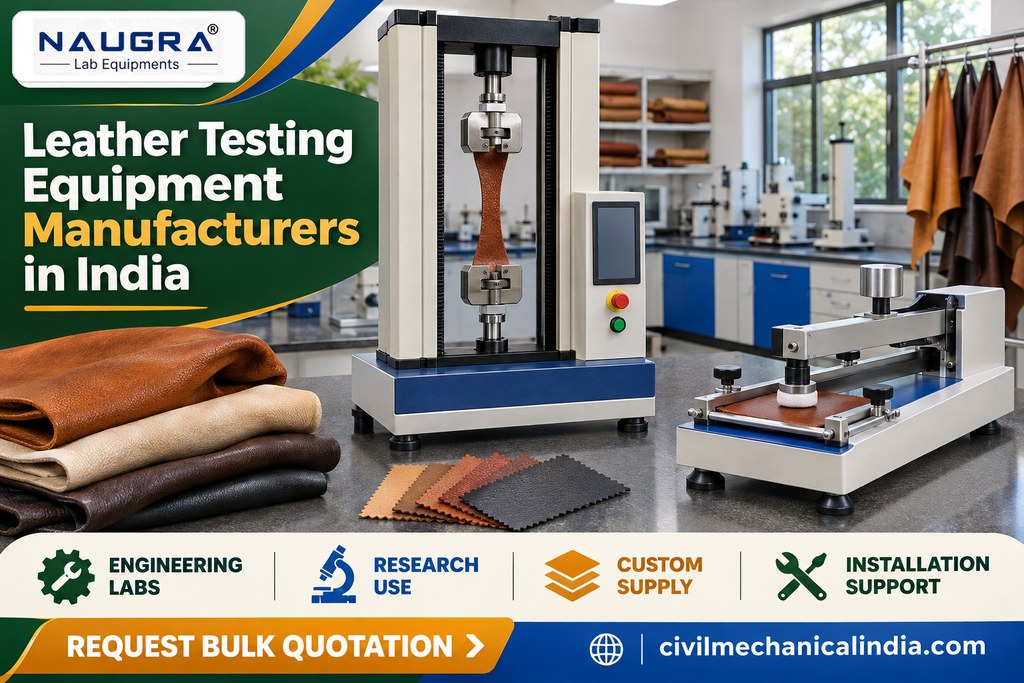
We manufacture leather testing equipment in India for tanneries, footwear and leather goods factories, and leather institutes. Hides and skins are natural and variable, so testing is how tanners prove that each lot meets a buyer's specification. The model codes below are for tender buyers in Africa and South America.
Our leather testing equipment range
| Product | Model code | Use |
|---|---|---|
| Leather Tensile and Tear Strength Testing Machine | CMI-IND-0377 | Tensile strength, elongation and tear strength |
| Leather Lastometer Grain Crack and Burst Tester | CMI-IND-0374 | Grain crack and burst by ball distension |
| Leather Colour Fastness to Rubbing Crockmeter | CMI-IND-0372 | Colour fastness to dry and wet rubbing |
| Leather Shrinkage Temperature Tester | CMI-IND-0375 | Shrinkage temperature of tanned leather |
| Leather Softness Tester with Digital Display | CMI-IND-0376 | Softness with digital display |
| Leather Water Vapour Permeability Tester | CMI-IND-0380 | Water vapour permeability |
Ten instruments are shown on our Leather Testing Instruments page.
Tests and applications
| Property | Test | Relevant for |
|---|---|---|
| Strength | Tensile, tear | Shoe uppers, upholstery, belts |
| Grain quality | Distension to crack | Uppers that are lasted and stretched |
| Finish durability | Rub fastness, flexing | Shoes, bags, car seats |
| Tannage | Shrinkage temperature | Process control in the tannery |
| Handle | Softness | Garment and glove leather |
| Comfort | Water vapour permeability | Footwear linings and uppers |
Shrinkage temperature tells a tanner whether the tannage is complete, and it is checked during processing. The physical tests follow on finished leather and are the values a shoe or car seat maker writes into a purchase contract.
Export buyers send detailed specifications. A tannery that can test in-house avoids shipping leather that will be rejected at the other end, which is by far the most expensive way to learn of a fault.
Many countries are working to export finished leather and products instead of raw hides. That shift depends on tanneries and factories that can measure quality as their customers do.
What to specify in a tender
- Leather types: upper, lining, upholstery, garment or sole leather.
- Standards followed, usually ISO or IULTCS methods.
- Load range and grips for tensile and tear tests.
- Specimen cutting dies and a cutting press.
- Conditioning facilities for standard atmosphere.
Sampling and conditioning leather
Leather varies across the hide. Standards define the sampling position, and specimens must be cut from that area in the stated direction. Use steel dies and a press, since hand cutting distorts the shape.
Condition specimens at standard temperature and humidity before testing. Leather takes up and loses moisture quickly, and strength and softness shift with it. A conditioning cabinet is essential in very dry or very humid climates.
Measure thickness with a gauge that applies the specified pressure, because thickness enters every strength calculation. Record the lot, the hide position and the conditions with each result, and keep a cut reference piece from every lot shipped.
Markets we supply in Africa and South America
Livestock is abundant in both regions, and governments want more of the leather value chain at home.
| Country | Nominal mains supply | Usual port of entry | Note for buyers |
|---|---|---|---|
| Congo | 230 V, 50 Hz | Pointe-Noire | Small tanneries and craft producers serve local demand. |
| Malawi | 230 V, 50 Hz | Beira or Nacala, then road or rail | Hides are a by-product of a growing meat industry and are increasingly processed locally. |
| Togo | 220 V, 50 Hz | Lomé | Leather crafts and regional trade support small-scale processing. |
| Eritrea | 230 V, 50 Hz | Massawa | A traditional leather and footwear sector supplies the domestic market. |
| Brazil | 127 V or 220 V, 60 Hz (varies by state) | Santos | One of the world's largest leather exporters, testing to international methods. |
| Peru | 220 V, 60 Hz | Callao | Tanneries supply a well-known domestic footwear industry. |
Why source from us
- Physical, fastness and process control instruments from one manufacturer.
- Cutting dies and presses quoted with the testers.
- Footwear testing equipment on the same order.
- Installation and training available.
Frequently asked questions
Do you supply flexing testers for leather finishes?
Yes. A flexing resistance tester is listed in this category. Tell us the number of stations you need.
Which dies are needed?
It depends on the tests. We list a die for each specimen shape in the offer.
Are footwear tests covered?
Yes. See our Footwear Testing Instruments range.
Send us your tender requirements
Leather institutes, export tanneries and product factories usually buy a complete set to match a list of test methods. Send us your tender requirements and we will reply to each line with the instrument we offer, its model code and the method it follows.
We can supply the leather laboratory from India: tensile and tear machines, grain crack testers, rub fastness and flexing testers, shrinkage temperature apparatus, softness testers, thickness gauges, water resistance and vapour permeability testers, cutting presses with dies and conditioning cabinets. Footwear machines are added for integrated producers.
Tell us the leathers you produce, your customers' specifications and the destination port. Send the list through our contact page. We reply with an itemised quotation and delivery time.
Methods and specimen shapes vary with the leather type, so each tender is quoted on its own scope. If a development programme is funding a leather institute, send the programme's formats and we will complete them with the offer.