
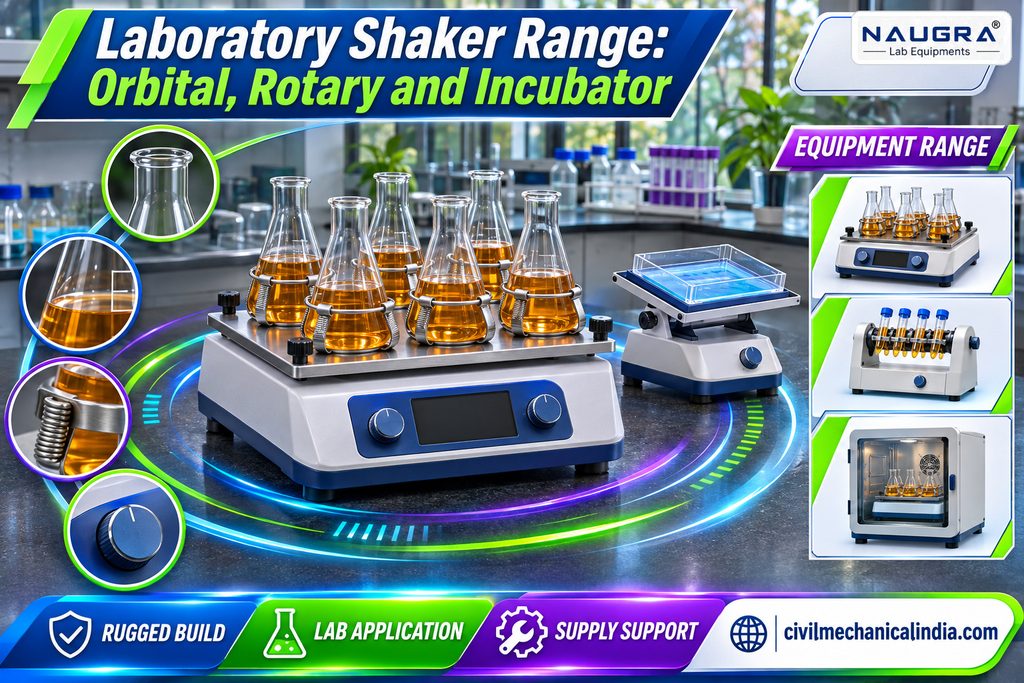
A laboratory shaker mixes samples by moving the whole vessel, which keeps cultures aerated and extractions consistent without anything touching the liquid. We manufacture shakers in India. This page lists model codes for universities, research institutes and quality labs in Mozambique, DR Congo, Botswana, Nigeria and South Africa.
Our laboratory shaker range
These products are from our Shaker category. Descriptions come from the product cards.
| Product | Model code | Description on our website |
|---|---|---|
| Digital Orbital Shaker 300 mm Platform | CMI-NP-0201 | Variable speed, 300 mm platform |
| Mini Orbital Shaker Variable Speed | CMI-NP-0202 | Compact, small platform, variable speed |
| Reciprocating Shaking Machine | LABLABS-2070 | Flask and bottle rack, 220 V AC 50 Hz single phase |
| Rocking Platform Shaker Digital | CMI-NP-0203 | Gentle see-saw motion for gels and blots |
| Rotary Flask Shaker 12 Flask | CMI-NP-0204 | Holds twelve 250 ml flasks |
| Wrist Action Flask Shaker | CMI-NP-0205 | Arc-swing motion for extraction and solubility |
Shakers with temperature control are listed under Orbital Shaking Incubator, and further models under Shaking Machines And Stirrers.
Which motion for which job
| Motion | Movement | Typical use |
|---|---|---|
| Orbital | Platform moves in a small circle | Cell culture, general mixing |
| Reciprocating | Back and forth in a line | Extraction, solubility, soil shaking |
| Rocking | See-saw tilt | Staining and washing gels and blots |
| Rotary flask | Flasks rotate on a wheel or platform | Culture and dissolution |
| Wrist action | Arc swing like a hand shake | Solvent extraction in stoppered flasks |
Applications
- Microbiology: growing bacteria and yeast in flasks.
- Soil science: shaking soil with extractant before analysis.
- Chemistry: solubility and extraction studies.
- Molecular biology: staining and destaining gels.
- Water testing: leaching and mixing samples.
Features
- Variable speed on the models described with it.
- Platforms and racks for flasks, bottles and trays.
- Continuous running for long culture times.
- Compact models for crowded benches.
Speed ranges, load limits and timers depend on the model. We confirm them in the quotation.
Choosing platform and clamps
The shaker is only half the purchase. Decide which vessels you shake most and order the matching clamps or racks. Count the flasks per run, check the total weight with liquid, and leave a margin so the lab shaker machine does not walk across the bench at high speed. For overnight cultures, place the unit where noise and vibration will not disturb balances.
Looking after a shaker
Most failures come from overloading and spills. Keep the load within the stated limit, balance flasks evenly across the platform and wipe spills before they reach the drive. Check clamps and screws monthly, since vibration loosens them. Where the unit runs for days at a time, a spare drive belt and a few extra clamps on the shelf avoid interrupted experiments.
Markets served: import and site notes
| Country | Nominal mains supply | Usual port of entry | Note for this equipment |
|---|---|---|---|
| Mozambique | 220 V, 50 Hz | Maputo, Beira or Nacala | Agricultural labs shake soil extracts in batches. Reciprocating units with bottle racks fit that work. |
| DR Congo | 220 V, 50 Hz | Matadi (west); Dar es Salaam route for the east and south | Mineral labs run leach tests. Wrist action and reciprocating shakers are common choices. |
| Botswana | 230 V, 50 Hz | Durban or Walvis Bay, then road (landlocked) | Veterinary and vaccine labs grow cultures. Orbital shakers inside incubators are preferred. |
| Nigeria | 230 V, 50 Hz | Lagos (Apapa or Tin Can Island) | University microbiology classes need many flask places. Rotary flask shakers serve groups. |
| South Africa | 230 V, 50 Hz | Durban | Research institutes run long experiments. Order spare belts and clamps with the unit. |
Why buy from us
- Manufacturer of several shaker types, so one supplier covers the lab.
- Product codes for each model.
- Other items from your chemistry lab equipment list on the same order.
- Itemised offers for tenders.
How to order
- Tell us the vessels, volumes and number per run.
- Choose the motion.
- State voltage and destination.
- We send a quotation.
Write to us through the contact page. The shaker machine price depends on type, platform and accessories, so we quote each enquiry.
Frequently asked questions
What is the difference between a shaker and a stirrer?
A shaker moves the vessel. A stirrer moves a bar or paddle inside it. See our Laboratory Stirrer range for stirrers.
Can a shaker run inside an incubator?
Compact models can, if the incubator has a power outlet and enough shelf strength. A combined shaking incubator is the cleaner solution.
Which laboratory machine suits sieving?
That is a sieve shaker, a different product. See Digital Sieve Shaker.