
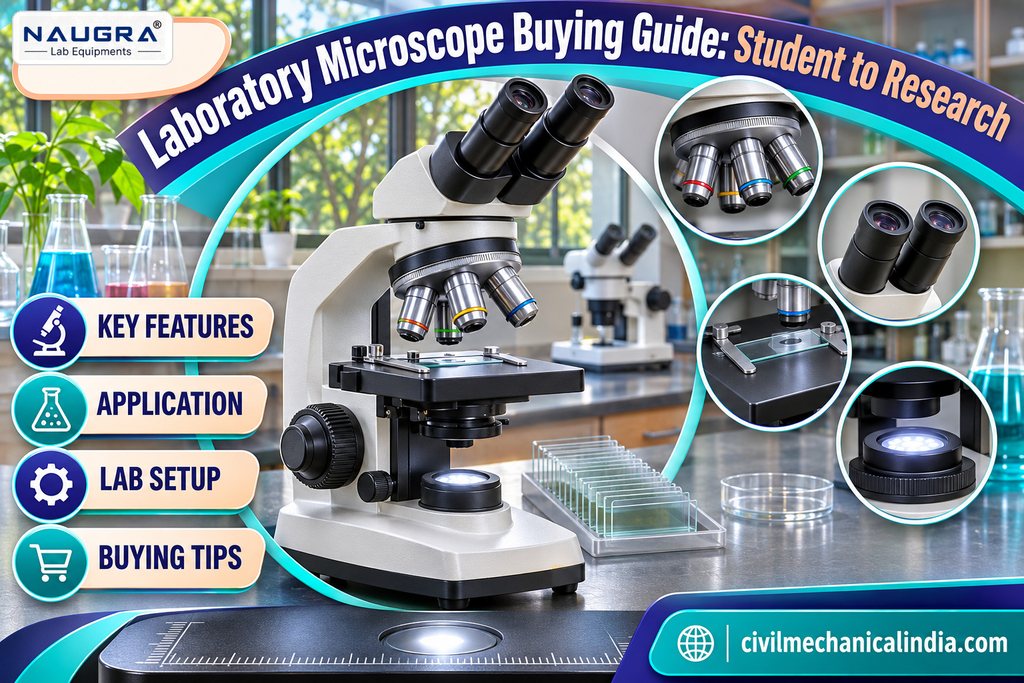
The right laboratory microscope depends on what you look at and who is looking: a school pupil viewing onion cells needs something very different from a pathologist screening slides all day. We supply microscopes from India to schools, universities and clinical labs. This guide is for buyers in Zambia, Zimbabwe, Rwanda, Senegal and Côte d'Ivoire.
Types of laboratory microscope
| Type | What it shows | Typical user |
|---|---|---|
| Student compound, monocular | Thin, transparent specimens on slides | Schools |
| Binocular compound | Same, with comfort for long sessions | Colleges, clinics |
| Stereo zoom | Whole objects in three dimensions at low power | Biology, electronics, geology |
| Dissecting | Low-power view with working space for instruments | Biology practicals |
| Inverted | Cells at the bottom of a culture dish | Tissue culture labs |
| Digital or USB camera | Image on a screen for group teaching | Lecture demonstrations |
A student compound microscope with a single eyepiece and one nosepiece is often called a single nose microscope in school tenders.
Microscopes in our range
These products are listed in our Microscopes Laboratory category. Descriptions are from the product cards.
| Product | Code | Description on our website |
|---|---|---|
| Student Microscope | EDU-MIC-0002 | Entry model for classroom use |
| Dissecting Microscope | EDU-MIC-0001 | Low-power instrument for dissection work |
| Binocular Compound Microscope | CMI-NP-1257 | LED illumination, four objectives, inclined binocular head |
| Stereo Zoom Microscope | CMI-NP-1260 | 0.7x to 4.5x zoom, binocular head, top and bottom lighting |
| Inverted Biological Microscope | CMI-NP-1259 | Inverted optics, long working distance objectives |
| Digital USB Camera Microscope | CMI-NP-1258 | Built-in 5 MP camera, USB connection to PC |
For metal samples, a Metallurgical Microscope is listed with our materials testing equipment.
How to choose a lab microscope
- Specimen. Slides need a compound microscope. Solid objects need a stereo microscope.
- Magnification. Compound microscopes commonly carry 4x, 10x, 40x and 100x objectives. The 100x lens needs immersion oil and a trained user.
- Head. Binocular heads reduce eye strain for anyone working more than an hour a day.
- Illumination. LED runs cool, lasts long and can work from batteries.
- Mechanical stage. It makes scanning a slide far easier than stage clips.
- Camera. Useful for teaching, reports and remote consultation.
A research microscope adds better optics, contrast methods and a camera port. Buy at that level only if the work needs it.
What drives the lab microscope price
We quote per model and quantity. The cost depends on:
- Optical quality of objectives.
- Monocular, binocular or trinocular head.
- Illumination type.
- Mechanical stage and condenser.
- Camera and software.
- Number of units, since class sets attract better unit prices.
Spare bulbs or LED modules, immersion oil, lens tissue and dust covers should be on the same order.
Import and site notes by country
Check voltage for mains-powered models. In humid regions, storage matters more than anything else.
| Country | Nominal mains supply | Usual port of entry | Note for this equipment |
|---|---|---|---|
| Zambia | 230 V, 50 Hz | Dar es Salaam or Durban, then road (landlocked) | Rural clinics rely on microscopy for malaria. Choose LED models that run from a battery or solar supply. |
| Zimbabwe | 240 V, 50 Hz | Beira or Durban, then road (landlocked) | Schools share few instruments among many pupils. A digital model on a screen helps large classes. |
| Rwanda | 230 V, 50 Hz | Dar es Salaam or Mombasa, then road (landlocked) | High rainfall encourages fungus on lenses. Store microscopes in a cabinet with a low-watt bulb or silica gel. |
| Senegal | 230 V, 50 Hz | Dakar | Harmattan dust settles on optics. Dust covers and regular blower cleaning are essential. |
| Côte d'Ivoire | 220 V, 50 Hz | Abidjan | Coastal humidity is high all year. Ask for anti-fungus treated optics where available. |
Mistakes to avoid
- Buying the highest magnification instead of the best optics.
- Ordering 100x objectives for young pupils.
- Forgetting spare lamps and oil.
- Storing microscopes uncovered or in damp cupboards.
- Choosing mirror illumination for a room with poor daylight.
Frequently asked questions
How many microscopes does a class need?
One per two students is a good target for colleges. Schools often manage with one per four, supported by a demonstration camera.
Why buy a microscope from India?
Microscope India manufacturers supply teaching models in volume, which keeps class sets affordable. We quote export packing and documents with every order.
Do you supply prepared slides?
Ask in your enquiry. We will confirm slide sets against your syllabus list.
Get a quotation
Send the type, quantity and power situation through our contact page. We will recommend models and send an offer. More teaching equipment is listed under Educational Lab Equipments.