
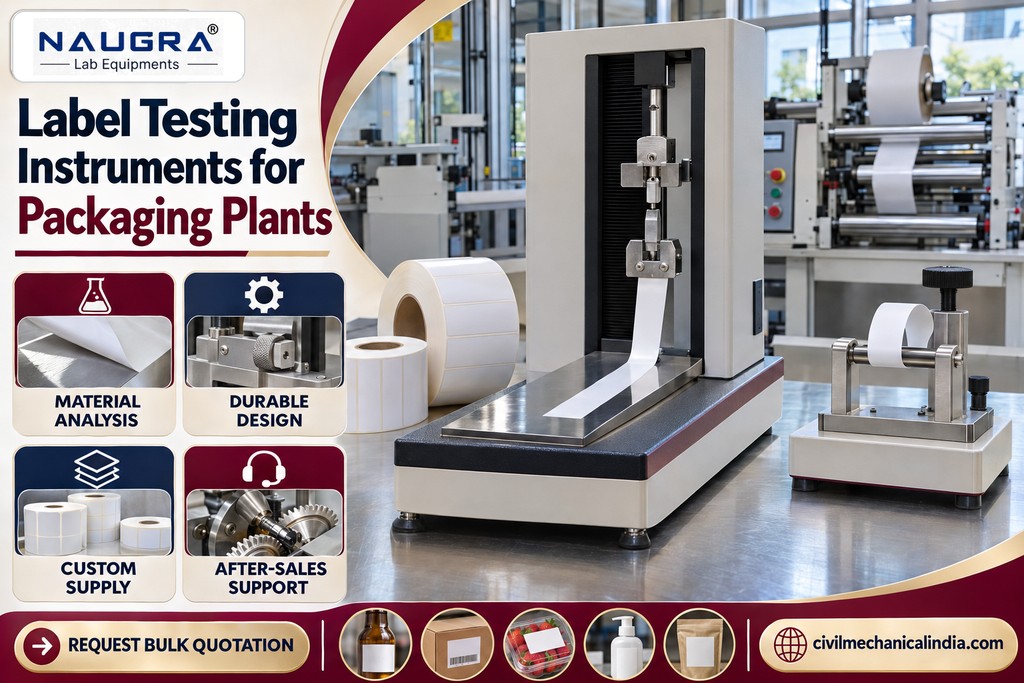
Our label testing instruments measure how well a self-adhesive label sticks, releases from its liner and scans at the checkout. Label stock producers, converters and the bottlers and packers who apply labels all use them. We manufacture them in India, and the model codes below are for tender buyers in Africa and South America.
Our label testing instruments range
| Product | Model code | Use |
|---|---|---|
| 180 Degree Peel Adhesion Tester for Labels | CMI-IND-0111 | Peel adhesion of labels at 180 degrees |
| Loop Tack Tester for Pressure Sensitive Labels | CMI-IND-0116 | Initial tack of pressure sensitive adhesive |
| Liner Release Force Tester for Label Stock | CMI-IND-0115 | Force to release the label from its liner |
| Digital Thickness Gauge for Label Laminates | CMI-IND-0114 | Thickness of face stock and laminate |
| Barcode Print Quality Verifier for Labels | CMI-IND-0112 | Print quality grade of barcodes |
| Digital Microscope for Die Cut Depth Inspection of Labels | CMI-IND-0113 | Die cut depth under magnification |
Ten instruments are shown on our Packaging Labels Testing Instruments page.
Tests and applications
| Problem on the line | Property | Test |
|---|---|---|
| Labels fall off | Adhesion, tack | Peel and loop tack |
| Labels fail to dispense | Release force | Liner release test |
| Liner breaks | Die cut depth | Microscope inspection |
| Scanner rejects | Barcode quality | Barcode verifier |
| Labels wrinkle | Thickness, stiffness | Thickness gauge |
Labelling machines apply hundreds of labels a minute. If release force is too high, labels do not dispense. If it is too low, they fly off early. Peel adhesion and tack decide whether the label stays on a cold, wet bottle or a dusty carton.
Die cutting is the most delicate step in converting. The die must cut the face and adhesive without scoring the liner. A microscope check of cut depth prevents liner breaks on the customer's machine. Retailers increasingly reject deliveries with unreadable barcodes, so verification has become a routine release test.
Service conditions should be discussed with the customer early. Labels for chilled, frozen, oily or outdoor products each need a different adhesive, and the test plan should reflect the real conditions of use.
What to specify in a tender
- Label materials: paper, film, and the adhesive types used.
- Test methods, such as FINAT or ASTM procedures.
- Peel angles and speeds required.
- Barcode symbologies and the grading standard.
- Test panels in the materials your labels are applied to.
Testing labels the way they are used
Adhesion depends on the surface. Test on glass, PET, HDPE or carton board as your customers use them, and at the temperature of application. A label that performs well on a clean steel panel may fail on a chilled bottle.
Condition samples before testing and record dwell time, since adhesion builds over hours. Agree those details with customers so that both sides measure the same thing.
Keep retained samples from each production lot with their test results. When a complaint arrives weeks later, retesting the retained roll shows quickly whether the fault lies with the label, the storage or the application.
Markets we supply in Africa and South America
Bottled drinks, packaged food and personal care goods all carry labels, and their production is growing in both regions.
| Country | Nominal mains supply | Usual port of entry | Note for buyers |
|---|---|---|---|
| Gabon | 220 V, 50 Hz | Libreville (Owendo) | Beverage producers source labels locally and expect consistent adhesion. |
| Madagascar | 220 V, 50 Hz | Toamasina | Exporters of spices and vanilla need labels that meet buyers' barcode rules. |
| Niger | 220 V, 50 Hz | Cotonou, then road | Dry heat and dust test label adhesion on bottled water and food packs. |
| Somalia | 220 V, 50 Hz | Mogadishu or Berbera | Small bottlers and packers are building basic quality checks. |
| Paraguay | 220 V, 50 Hz | River route to Asunción | Food and beverage plants supply regional markets with labelled goods. |
| Venezuela | 120 V, 60 Hz | La Guaira or Puerto Cabello | Supply is 120 V at 60 Hz. Motorised testers are specified to suit. |
Why source from us
- Adhesion, release, dimensional and barcode instruments from one manufacturer.
- Test panels and fixtures quoted with each tester.
- Ink and print testers on the same order.
- Installation and training available.
Frequently asked questions
Can one tester perform peel and release tests?
Often yes, with different fixtures. Tell us the methods and we will confirm the configuration.
Which barcodes can the verifier grade?
Tell us the symbologies you print. We confirm compatibility in the offer.
Do you supply shear adhesion testers?
Ask us in your enquiry. Related adhesion instruments are listed in our Adhesive Testing Instruments range.
Send us your tender requirements
Label quality problems are expensive, because they stop a customer's filling line. Send us your tender requirements for label testing and we will answer each line with the instrument we offer, its model code and the fixtures and panels supplied.
We can supply the full label laboratory from India: peel adhesion and loop tack testers, release force testers, thickness gauges, inspection microscopes, barcode verifiers, rub testers and conditioning cabinets. If you also print flexible packaging or cartons, the instruments for those products are added to the same offer.
Tell us the label types you make or use, the surfaces they go onto and the destination. Send the list through our contact page. We reply with an itemised quotation and delivery period. Test methods and panel materials differ from customer to customer, so every tender is quoted individually, with each fixture shown as a separate line.