
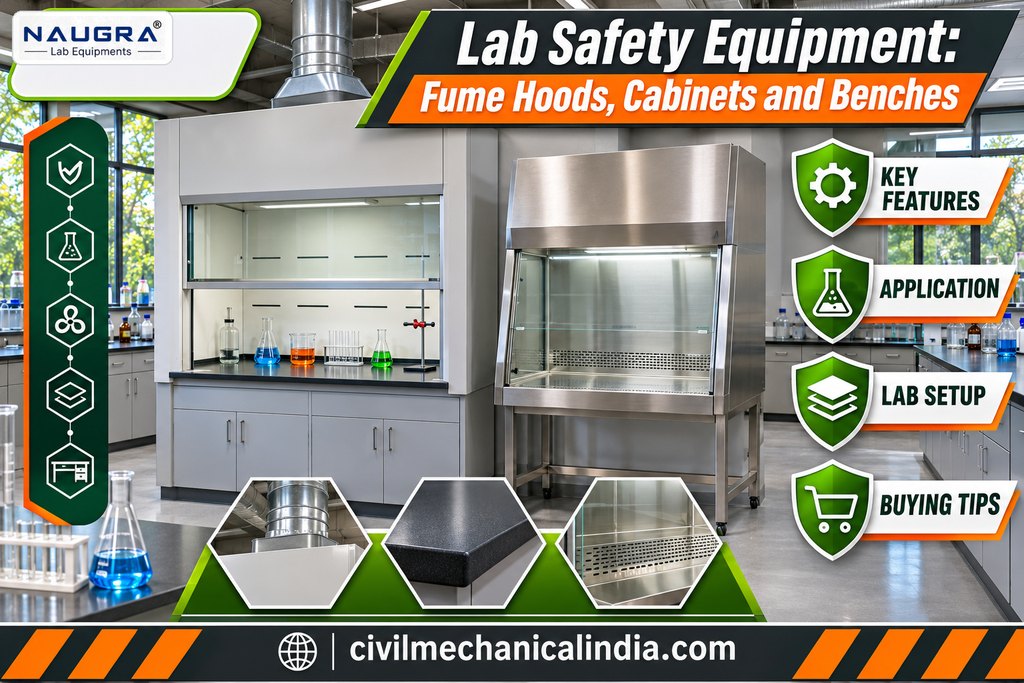
Lab safety equipment that moves air, such as fume hoods, biosafety cabinets and laminar flow benches, is often confused, and choosing the wrong one can leave the operator unprotected. We manufacture these units in India. This guide explains the differences for laboratory planners in Algeria, Angola, Zambia, Zimbabwe and Rwanda.
Three units, three different jobs
| Unit | Protects the user | Protects the sample | Used for |
|---|---|---|---|
| Fume hood | Yes, from chemical vapour | No | Acids, solvents, digestion |
| Laminar flow bench | No | Yes, from dust and microbes | Media pouring, sterile assembly |
| Biosafety cabinet | Yes, from infectious agents | Yes, in Class II | Microbiology, clinical samples |
| Glove box cabinet | Yes, full barrier | Yes | Highly hazardous agents |
The key point: a laminar flow bench blows clean air towards the operator. It must never be used for infectious or toxic material.
Lab safety equipment in our range
These products are listed under Laboratory Fume Hoods and Bio Safety Cabinet. Descriptions come from the product cards.
| Product | Code | Description on our website |
|---|---|---|
| Ducted Laboratory Fume Hood 1200 mm | CMI-NP-0120 | 1200 mm ducted hood with epoxy worktop and exhaust blower connection |
| Ductless Fume Hood with Carbon Filter | CMI-NP-0121 | Activated carbon filter and blower that recirculate treated air |
| Perchloric Acid Fume Hood with Wash Down | CMI-NP-0122 | Stainless steel interior with wash-down system |
| Class II Type A2 Biosafety Cabinet 4 Feet | CMI-NP-0012 | HEPA-filtered laminar downflow with inward airflow |
| Class II Type B2 Total Exhaust Biosafety Cabinet | CMI-NP-0013 | Ducts all air outside, for volatile toxic chemicals and biological agents |
| Class III Glove Box Biosafety Cabinet | CMI-NP-0014 | Gas-tight glove box with attached rubber gloves and HEPA-filtered supply and exhaust |
Laminar flow benches are listed separately under Clean Air Equipments.
How to choose
- List the hazards. Chemical vapour points to a fume hood. Infectious material points to a biosafety cabinet.
- Ducted or ductless. Ducted hoods exhaust outside and handle most chemicals. Ductless hoods use filters matched to specific chemicals and suit rooms where ducting is impossible.
- Width. Common widths run from about 900 to 1800 mm. These are industry sizes, so confirm the model.
- Special chemistry. Perchloric acid needs a dedicated wash-down hood.
- Building services. A ducted hood needs a route to the roof, make-up air and a blower.
What drives the price
We quote per unit and specification. Cost depends on:
- Type and class.
- Width and internal height.
- Worktop and liner material.
- Filters, blower and ducting length.
- Airflow monitors and alarms.
- Installation on site.
Ducting and installation can cost as much as the hood in an existing building. Share a room drawing with your enquiry.
Import and site notes by country
All units need mains power for blowers and lights. Large hoods ship in sections.
| Country | Nominal mains supply | Usual port of entry | Note for this equipment |
|---|---|---|---|
| Algeria | 230 V, 50 Hz | Algiers | Petrochemical and university labs handle solvents daily. Ducted hoods with explosion-safe fittings should be discussed. |
| Angola | 220 V, 50 Hz | Luanda | Many labs occupy converted buildings. Ductless hoods avoid cutting through concrete roofs. |
| Zambia | 230 V, 50 Hz | Dar es Salaam or Durban, then road (landlocked) | Mine assay labs run hot acid digestions. Specify acid-resistant liners and scrubbers. |
| Zimbabwe | 240 V, 50 Hz | Beira or Durban, then road (landlocked) | Power cuts stop blowers. Train staff to close the sash and stop work when airflow fails. |
| Rwanda | 230 V, 50 Hz | Dar es Salaam or Mombasa, then road (landlocked) | New biomedical labs need certified cabinets. Plan for on-site airflow testing after installation. |
Mistakes to avoid
- Using a clean bench for hazardous work.
- Blocking the hood slot with stored bottles.
- Fitting a ductless hood without checking the filter suits your chemicals.
- Placing hoods near doors, where draughts disturb airflow.
- Skipping periodic airflow tests.
Frequently asked questions
Does a pharmaceutical lab need both hoods and cabinets?
Usually yes. Chemistry and quality control rooms use fume hoods, while microbiology rooms use biosafety cabinets and laminar benches.
What else belongs in a chemistry lab setup for safety?
Eye wash, safety shower, extinguishers, spill kits and chemical storage. We focus on the air-handling units. Ask us about the rest.
Which unit suits a food analytical lab or an industrial laboratory?
A ducted fume hood for digestion and solvent extraction, plus a laminar bench or cabinet if microbiology is done.
Request a quotation
Send your room drawing, hazards and widths through our contact page. We will recommend units and quote them with installation options. See also our Analytical Lab Instruments range.