
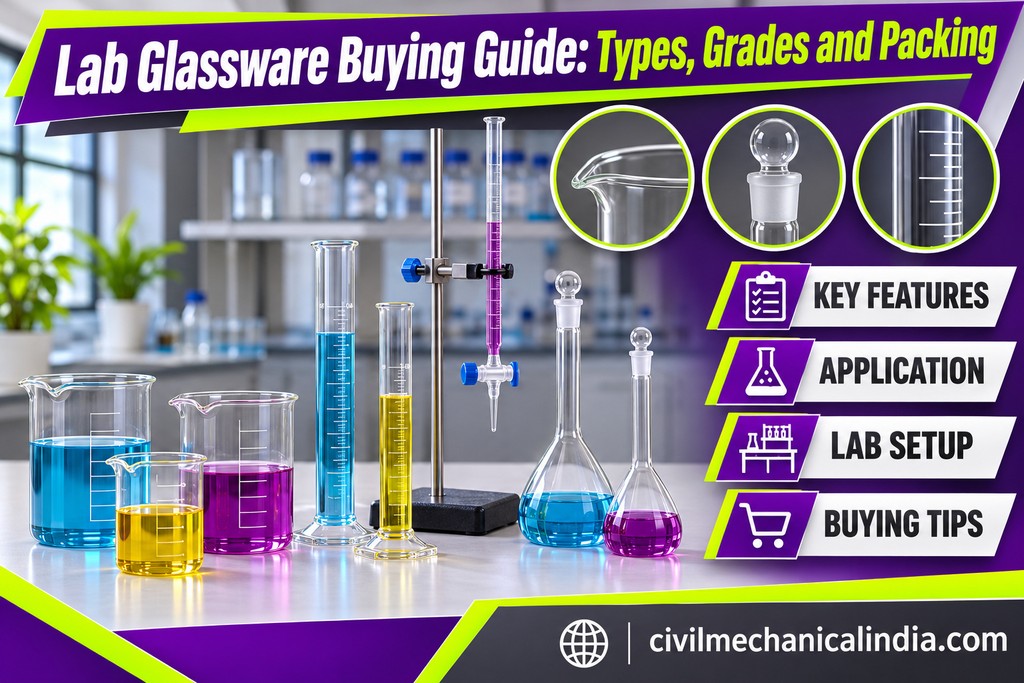
Lab glassware looks simple, yet the wrong glass type or accuracy class can spoil results or crack on the first heating. We supply laboratory glass from India to schools, universities and test labs. This guide explains the choices for buyers in Algeria, Angola, Zambia, Zimbabwe and Rwanda.
Glass types: borosilicate and soda
Two materials cover almost all scientific glassware.
- Borosilicate glass, often described as 3.3 glass, resists heat and sudden temperature change. Use it for anything that is heated or holds hot liquid.
- Soda glass is cheaper and fine for cold work, storage and items such as watch glasses.
A common fault in tenders is asking only for "glass". Name the material against every line.
Glassware names and what each item is used for
Buyers often ask us for glassware names with their uses. The table covers the core items.
| Item | Main use | Accuracy |
|---|---|---|
| Beaker | Mixing, heating, rough volume | Low |
| Conical flask | Titration, swirling without spills | Low |
| Volumetric flask | Making solutions to an exact volume | High |
| Measuring cylinder | Measuring volume quickly | Medium |
| Burette | Delivering a measured volume in titration | High |
| Pipette | Transferring a fixed volume | High |
The main types of flasks are conical, round-bottom, flat-bottom and volumetric. Round-bottom flasks suit heating and distillation, while volumetric flasks must never be heated.
Lab glassware in our range
These products appear in our Laboratory Glassware category. The notes are from the product cards.
| Product | Code | Note on our website |
|---|---|---|
| Borosilicate Glass Beaker Set | CMI-NP-1253 | Graduated Griffin beakers with spout, borosilicate 3.3 glass |
| Glass Burette with PTFE Stopcock | CMI-NP-1254 | Borosilicate tube, PTFE stopcock, no grease needed |
| Graduated Measuring Cylinder Set | CMI-NP-1255 | Borosilicate glass, hexagonal base |
| Volumetric Flask Class A Set | CMI-NP-1256 | Class A, ground stoppers, borosilicate glass |
| Watch Glasses Soda | EDU-GLS-0001 | Soda glass watch glasses for covering and evaporation |
Burettes and pipettes for civil test labs are also listed as Pipette And Burettes.
Class A or Class B?
Volumetric glass is sold in two accuracy classes. Class A has tighter tolerances and is used for analysis and calibration work. Class B is acceptable for teaching. These classes are defined in the glassware standards, so state the class in your order. If your lab is audited, ask for batch or individual certificates at the enquiry stage, because they cannot always be added later.
What drives the price
Our quotations are prepared per order. The price of glass lab equipment depends on:
- Glass type, with borosilicate above soda.
- Accuracy class and whether certificates are needed.
- Capacity, since large flasks and cylinders cost more to make and to ship.
- Quantity per size.
- Packing level for sea or air freight.
Glass is light but bulky. Freight is charged on volume, so a mixed order of lab glassware and equipment fills a container more efficiently than glass alone.
Import and handling notes by country
Glassware needs no power, so the practical issues are transport, clearance and storage.
| Country | Nominal mains supply | Usual port of entry | Note for this equipment |
|---|---|---|---|
| Algeria | 230 V, 50 Hz | Algiers | Ask your importer which product descriptions customs expects, and we will match the invoice wording. |
| Angola | 220 V, 50 Hz | Luanda | Unloading in Luanda can be slow. Order early if the glass is needed for the start of term. |
| Zambia | 230 V, 50 Hz | Dar es Salaam or Durban, then road (landlocked) | The road leg from the coast is long. Request double-wall cartons with dividers for every flask. |
| Zimbabwe | 240 V, 50 Hz | Beira or Durban, then road (landlocked) | Many labs keep buffer stock because resupply takes weeks. Add spares for burettes and pipettes. |
| Rwanda | 230 V, 50 Hz | Dar es Salaam or Mombasa, then road (landlocked) | Hilly roads mean more vibration in transit. Small, tightly packed cartons survive better than large ones. |
Mistakes to avoid
- Heating soda glass or volumetric flasks.
- Ordering only one size of beaker or cylinder.
- Forgetting stoppers, stopcocks and brushes.
- Storing glass loose in drawers, where it chips.
- Accepting a delivery without opening cartons and noting breakage on the delivery note.
Frequently asked questions
Are you among the laboratory glassware manufacturers in India who export small orders?
We supply both small college orders and bulk tender quantities. Small glass orders are best combined with other equipment to share freight.
How is glassware packed for export?
Each piece is separated inside cartons, and cartons are packed into outer cases suited to sea freight. Tell us if the goods will travel a long road leg after the port.
Can I get a list covering the uses of glassware for training new technicians?
Yes. Ask in your enquiry and we will send a simple table of items and uses with our offer.
Request your glassware quotation
Send sizes, classes and quantities through our contact page. We will reply with an itemised offer and packing details. You can also view all Educational Lab Equipments categories on our website.