
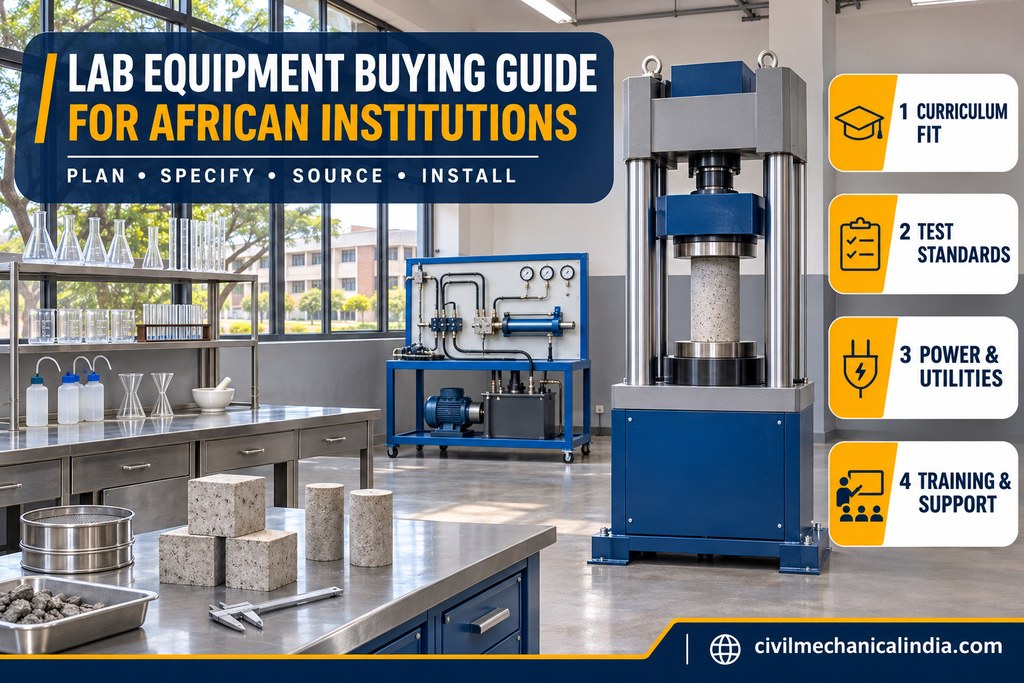
Buying lab equipment for a college, polytechnic or materials testing laboratory is easier when the list is built around the tests you must run, not around a catalogue. We manufacture and export laboratory equipment from India, and this guide explains how we advise buyers in Nigeria, South Africa, Egypt, Kenya and Ethiopia to plan an order, compare quotations and avoid costly mistakes.
Start with the syllabus or the test standard
Every item on a lab equipment list should trace back to one of two things: an experiment in the curriculum, or a test method in a standard. A teaching lab needs one working set per student group. A commercial test lab needs equipment that meets the named method, with calibration records.
Write down three details for each line before you ask for prices:
- The experiment or test method, for example a concrete cube strength test.
- The standard you work to. Our equipment is manufactured to IS, BS, EN, ASTM or AASHTO as applicable, so name the one your regulator accepts.
- The number of sets and the class size.
Main groups of lab equipment we supply
Most tenders we receive fall into the groups below. Each links to the matching category on our website so you can copy exact product names and codes into your enquiry.
| Group | Typical buyers | Where to look |
|---|---|---|
| Materials and construction testing | Civil departments, road agencies, contractors | Civil Engineering Laboratory Equipment |
| Mechanical teaching rigs | Universities and polytechnics | Mechanical Engineering Lab Equipment |
| General and analytical instruments | Chemistry, environment and quality labs | Analytical Lab Instruments |
| School and college science | Secondary schools, teacher colleges | Educational Lab Equipments |
| Vocational workshops | TVET centres | TVET Equipment |
One example of how the site lists a product: our Compression Testing Machine carries the code CTE-0001 and is shown with a 3000 kN capacity and platens for 150 mm and 100 mm cubes. Quote the code and we know exactly what you mean.
How to choose between similar items
Two machines can share a name and still differ in capacity, readout and automation. Ask these questions:
- What is the largest sample or load you will ever test? Choose capacity for that, not for the average.
- Do you need a digital readout or data logging for reports?
- Who will maintain it? Simple manual apparatus suits remote campuses with few technicians.
- Is there three-phase power in the room, or only single-phase sockets?
Basic lab equipment such as balances, ovens and sieves is used by every department, so buy enough of it. A shortage of small lab apparatus stops more practical classes than the failure of a large machine.
What drives the price of laboratory equipment
We do not publish fixed prices because each order is built to a specification. The main cost drivers are:
- Capacity and frame size of testing machines.
- Manual, digital or computerised control.
- The standard and the accessories it requires.
- Quantity, since tenders for several campuses reduce the unit cost.
- Packing, freight and insurance to your port.
- Installation and training on site, if requested.
Send the full list in one enquiry. A single consolidated shipment costs less to move than several small ones.
Import and site notes for our target countries
All five countries use a 50 Hz supply, but nominal voltage differs, so confirm the figure with your electrician and state it in the purchase order.
| Country | Nominal mains supply | Usual port of entry | Note for this equipment |
|---|---|---|---|
| Nigeria | 230 V, 50 Hz | Lagos (Apapa or Tin Can Island) | Many campuses run on generators. Ask for voltage stabilisers on digital instruments and allow time for clearance in Lagos. |
| South Africa | 230 V, 50 Hz | Durban | Test labs often work to SANS methods derived from BS or EN. Tell us the method so the accessories match. |
| Egypt | 220 V, 50 Hz | Alexandria | Heat and dust are common in summer. Keep balances and optical instruments in a closed, air-conditioned room. |
| Kenya | 240 V, 50 Hz | Mombasa | Inland delivery from the coast to Nairobi or western counties adds days. Plan installation dates after arrival on site. |
| Ethiopia | 220 V, 50 Hz | Djibouti, then road or rail (landlocked) | Cargo arrives through a neighbouring port, so strong export packing and a complete packing list matter even more. |
Mistakes buyers make
- Copying an old lab instruments list without checking that the syllabus has changed.
- Comparing quotations line by line when the capacities are different.
- Forgetting consumables, spares and calibration weights.
- Leaving out the voltage and plug type.
- Ordering large rigs before the room, water supply and drainage are ready.
Frequently asked questions
Can you supply a complete laboratory in one order?
Yes. We accept a single enquiry covering several departments and quote it line by line. Start from our product list and send the product names and codes you need.
Do you work with tender documents?
We do. Send the bill of quantities and technical specification. As laboratory instruments suppliers for tenders, we answer each line with our offered model and note any deviation clearly.
Which documents come with a shipment?
A commercial invoice, packing list and transport document are standard. Tell us in advance if your customs authority needs a certificate of origin or pre-shipment inspection, because requirements differ by country.
Get a quotation for your lab equipment list
Send us your list, the standards you follow and your destination port. As a scientific equipment supplier and manufacturer, we will reply with an itemised offer and delivery time. Use our contact page to start, or read more about us on the About Us page.