
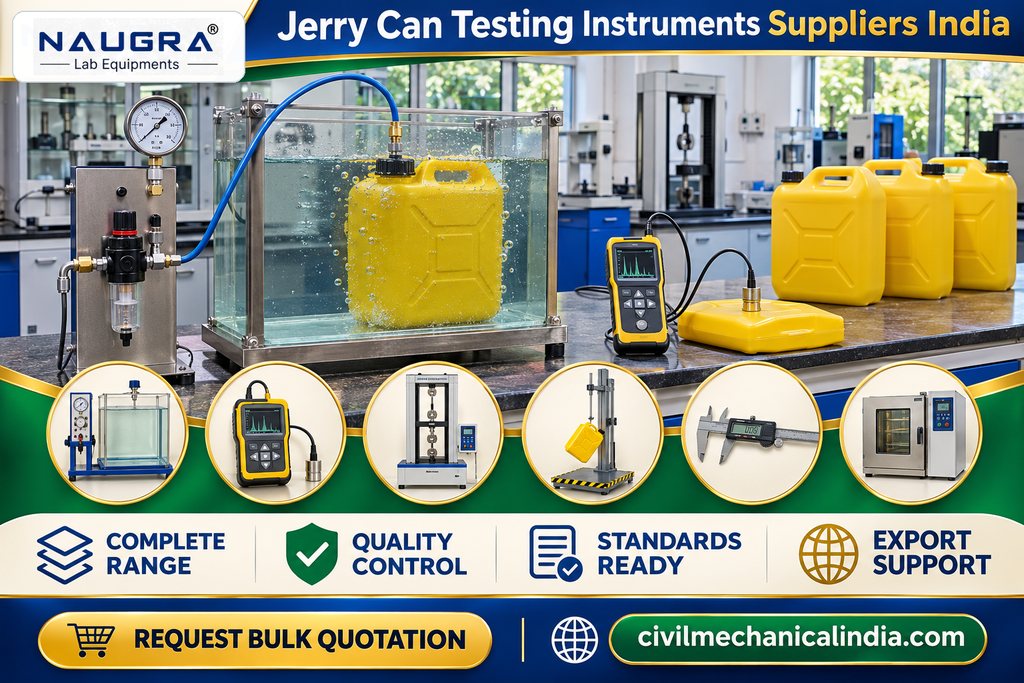
Our jerry can testing instruments are used by blow moulders who make plastic cans and by the edible oil, lubricant, chemical and water packers who fill them. A jerry can is carried by its handle, stacked, dropped and often reused, so it must be tested as it is used. We manufacture the instruments in India. The model codes below are for tender buyers in Africa and South America.
Our jerry can testing instruments range
| Product | Model code | Use |
|---|---|---|
| Air Pressure Leakproofness Tester for Jerry Cans | CMI-IND-0531 | Leakproofness under air pressure |
| Hydraulic Internal Pressure Test Bench for Jerry Cans | CMI-IND-0536 | Internal hydraulic pressure resistance |
| Handle Pull and Carrying Load Tester for Jerry Cans | CMI-IND-0534 | Handle pull and carrying load |
| Heavy Duty Closure Torque Tester for Jerry Can Caps | CMI-IND-0535 | Closure torque on large caps |
| Dual Element Ultrasonic Thickness Gauge for Jerry Cans | CMI-IND-0533 | Wall thickness by ultrasonic gauge |
| Chemical Compatibility Soak Test Cabinet for Jerry Cans | CMI-IND-0532 | Compatibility with chemicals by soaking |
Ten instruments are shown on our Jerry Cans Testing Instruments page.
Tests and applications
| Risk | Test | Who requires it |
|---|---|---|
| Leaks at seams or cap | Air leak, hydraulic pressure | Packers, transport rules |
| Handle breaks | Handle pull | Consumers, retailers |
| Collapse in a stack | Stacking, compression | Warehouses |
| Damage when dropped | Drop test | Transport rules |
| Thin corners | Ultrasonic thickness | Moulders |
| Attack by contents | Chemical soak | Chemical packers |
Edible oil in 5, 10 and 20 litre cans is a staple product in many countries. A leaking can ruins a pallet of goods, so packers test leakproofness on each delivery and moulders test every can or a defined sample.
Cans for chemicals and fuels fall under dangerous goods rules. They must pass drop, stacking, leakproofness and pressure tests before they can be marked for that service.
Wall thickness is measured without cutting the can. Corners and the base thin out during blowing, and an ultrasonic gauge finds them. Handles carry the full weight repeatedly, and a pull test confirms that they will not tear out.
What to specify in a tender
- Can volumes, shapes and closure sizes.
- Products filled and any transport regulations.
- Pressure levels and holding times.
- Load and cycles for handle tests.
- Drop heights and stacking loads.
Quality routine for can producers and packers
Moulders should weigh every can, measure thickness at marked points and leak test with closures fitted. Record by machine and mould, and react to any downward trend in weight or thickness before cans fail.
Run drop tests on filled cans at start-up and after any change of resin, colour or regrind proportion. Condition cans cold if your standard requires it.
Packers should check incoming cans for weight, thickness and leaks, and check closure torque on the filling line. Reused cans need extra care, since scratches and old contents weaken them. Keep retained samples and records for each lot, with the moulder's batch number.
Markets we supply in Africa and South America
Jerry cans are everyday containers in both regions for cooking oil, water, fuel and farm chemicals.
| Country | Nominal mains supply | Usual port of entry | Note for buyers |
|---|---|---|---|
| Guinea | 220 V, 50 Hz | Conakry | Palm oil and water are widely sold and carried in plastic cans. |
| South Sudan | 230 V, 50 Hz | Mombasa, then road | Water and fuel distribution depends heavily on jerry cans. |
| Central African Republic | 220 V, 50 Hz | Douala, then road | Durable cans matter where goods travel on rough roads. |
| Lesotho | 220 V, 50 Hz | Durban, then road | Packers of oil and household chemicals buy cans from regional moulders. |
| Paraguay | 220 V, 50 Hz | River route to Asunción | Agrochemical and edible oil packers need leakproof, compatible containers. |
| Venezuela | 120 V, 60 Hz | La Guaira or Puerto Cabello | Supply is 120 V at 60 Hz. Motorised testers are specified to suit. |
Why source from us
- Leak, pressure, handle, thickness and compatibility testers from one supplier.
- Fixtures for your can sizes and closures.
- Blow moulding and resin testers on the same order.
- Installation and training available.
Frequently asked questions
Can the leak tester handle different can sizes?
Yes. Tell us the sizes and neck dimensions so the right adaptors are supplied.
Do you supply drop and stacking testers?
Yes. They are listed in our Blow Molding Testing Instruments range and can be added to the offer.
Which regulation do the tests follow?
Tell us the rules that apply to your products. We state which tests each instrument supports.
Send us your tender requirements
Can makers and packers often equip their laboratories after a customer complaint or ahead of a dangerous goods approval. Send us your tender requirements and we will answer each line with the instrument we offer, its model code and fixtures.
We can supply from India: air leak testers, hydraulic pressure benches, handle pull testers, closure torque testers, ultrasonic thickness gauges, chemical soak cabinets, drop and stacking testers, stress crack baths, melt flow testers and balances.
Tell us the cans you make or fill, the contents, any transport regulations and the destination. Contact us through the contact page. We reply with an itemised quotation and delivery period.
Adaptors and loads depend on can size, so each tender is quoted on its own list. Aid agencies and water programmes buying cans in bulk can ask for an inspection kit to check deliveries at the warehouse.