
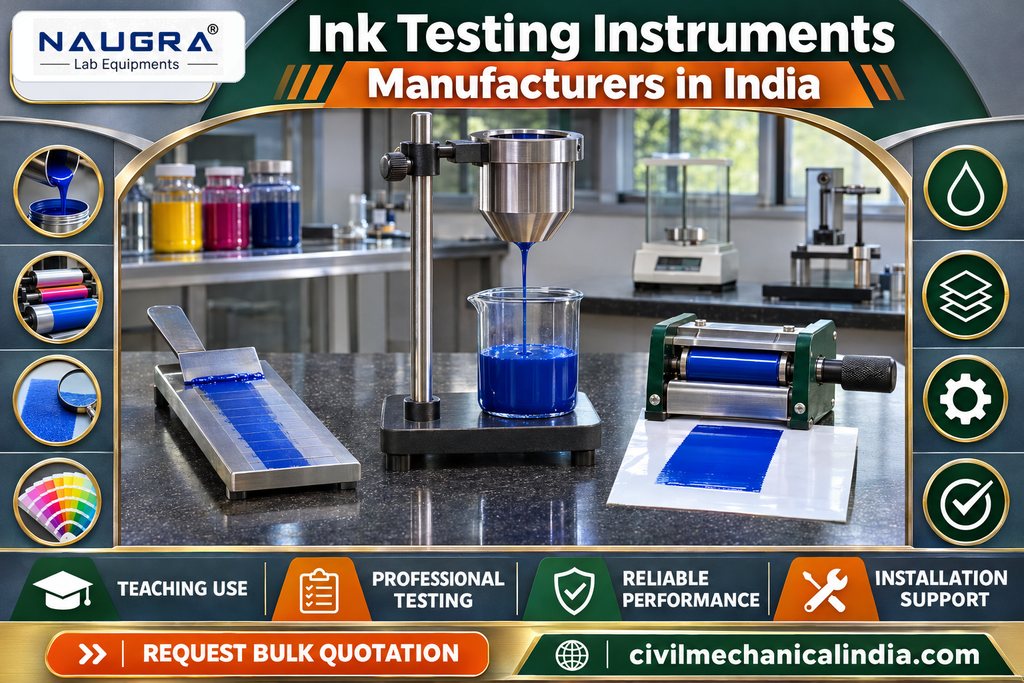
We manufacture ink testing instruments in India for ink makers and for flexographic, gravure and offset printers. These instruments control viscosity, dispersion, tack, drying and adhesion, the properties that decide whether a job prints cleanly at speed. The model codes below are for tender buyers in Africa and South America.
Our ink testing instruments range
| Product | Model code | Use |
|---|---|---|
| Flow Cup Set for Ink Viscosity DIN 4 mm | CMI-IND-0125 | Ink viscosity by flow time, 4 mm DIN cup |
| Fineness of Grind Gauge for Printing Ink | CMI-IND-0124 | Pigment dispersion and oversize particles |
| Digital Ink Tack Tester Inkometer | CMI-IND-0123 | Tack of paste inks |
| Anilox Hand Proofer for Flexo Inks | CMI-IND-0121 | Proof prints of flexo inks for colour matching |
| Ink Drying Time Recorder | CMI-IND-0126 | Drying time of ink films |
| Cross Hatch Adhesion Test Kit for Printed Film | CMI-IND-0122 | Adhesion of ink to printed film |
Ten instruments are shown on our Ink and Printing Testing Instruments page.
Tests and applications
| Property | Test | Effect on printing |
|---|---|---|
| Viscosity | Flow cup | Colour strength and transfer |
| Dispersion | Grind gauge | Gloss, scratches on cylinders |
| Tack | Inkometer | Picking and trapping in offset |
| Colour | Hand proofer drawdown | Match to the approved standard |
| Drying | Drying time recorder | Blocking and set-off |
| Adhesion | Cross hatch and tape | Ink flaking from film |
Viscosity is checked most often. On a flexo or gravure press it drifts as solvent evaporates, and operators correct it throughout the run with a flow cup at the press side.
Ink makers test every batch for dispersion, colour and tack before release. Printers repeat key tests on receipt and keep drawdowns as a record of the approved shade. On film, adhesion tests after printing confirm that surface treatment and ink are compatible.
Colour is judged against an approved standard. Printers keep signed drawdowns for every repeat job, and many now back up visual checks with numerical colour measurement. Whichever approach you use, a consistent proofing method is the foundation, because a drawdown made at the wrong film weight will never match the press.
What to specify in a tender
- Ink types: solvent, water-based, UV or paste inks.
- Flow cup standard and orifice sizes.
- Grind gauge range in microns.
- Proofer anilox specification to match the press.
- Substrates used for adhesion and drying tests.
Ink control from laboratory to press
An ink laboratory needs good ventilation and flameproof storage, because many inks contain solvents. Keep viscosity cups clean, since dried ink in the orifice changes flow time, and check them periodically against a reference oil.
Make drawdowns on the same substrate as the job and compare them with the approved standard under standard lighting. Label and file each one.
At the press, give operators their own flow cup and stopwatch, and record viscosity at set intervals. Many colour complaints trace back to viscosity drift during long runs. A simple log kept at the press side often solves problems that no laboratory test would catch.
Markets we supply in Africa and South America
Flexible packaging and label printing are among the fastest growing industries in both regions.
| Country | Nominal mains supply | Usual port of entry | Note for buyers |
|---|---|---|---|
| Chad | 220 V, 50 Hz | Douala, then road | Printed packaging is mostly imported, but local converting is beginning. |
| Mauritius | 230 V, 50 Hz | Port Louis | An established printing and packaging sector serves export industries. |
| Guinea | 220 V, 50 Hz | Conakry | Packaging for food and beverages is increasingly printed locally. |
| South Sudan | 230 V, 50 Hz | Mombasa, then road | Goods arrive overland. Compact instruments in sturdy cases travel best. |
| Guyana | 120 V or 240 V, 60 Hz (varies by area) | Georgetown | Supply is 60 Hz and voltage varies by area. Confirm before ordering. |
| Suriname | 127 V, 60 Hz | Paramaribo | Small printers gain most from basic viscosity and adhesion tools. |
Why source from us
- Viscosity, dispersion, tack, colour and adhesion instruments from one manufacturer.
- Tools for both the ink laboratory and the press side.
- Film and label testers on the same order.
- Training in correct use offered.
Frequently asked questions
Which flow cup should a flexo printer use?
It depends on ink viscosity and your customer's method. Tell us the inks and we will suggest suitable cups.
Do you supply rub resistance testers?
Yes. Rub testers are listed in our Printing Testing Instruments range.
Can the proofer match my press anilox?
Tell us the anilox line count and volume. We confirm what can be supplied in the offer.
Send us your tender requirements
Ink makers and printers often buy instruments piecemeal and end up with tools that do not match their customers' methods. Send us your tender requirements, and we will respond to each line with the instrument we offer, its model code and the standard it follows.
We can supply the ink laboratory from India: flow cups and stands, grind gauges, tack testers, hand proofers, drying time recorders, adhesion test kits, rub testers, gloss meters and viewing aids. For printers of film, labels or cartons, we add the substrate testers so one order equips both press room and laboratory.
Tell us the printing processes you run, the inks you use and the destination port. Contact us through the contact page. We send an itemised quotation with delivery time. Cup sizes, gauge ranges and proofer specifications depend on your work, so each tender is quoted on its own list, with every item priced separately.