
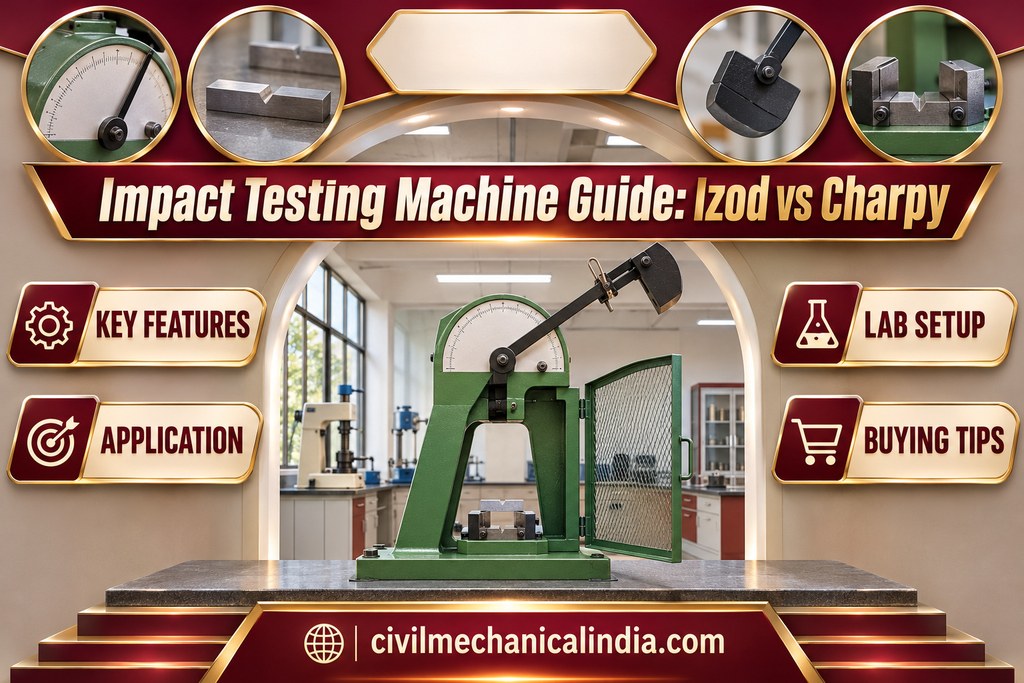
An impact testing machine measures how much energy a notched metal specimen absorbs when a swinging pendulum breaks it. The result shows whether a steel is tough or brittle. We manufacture impact testers in India, and this guide helps colleges and steel labs in Ethiopia, Ghana, Tanzania, Uganda and Morocco choose between Izod and Charpy configurations.
How the test works
A pendulum of known mass is raised to a fixed height and released. It strikes the specimen at the bottom of its swing and carries on to a lower height on the other side. The difference between the starting and finishing heights gives the energy absorbed, read in joules from a dial or a digital display.
Izod and Charpy compared
| Feature | Charpy | Izod |
|---|---|---|
| Specimen position | Horizontal, supported at both ends | Vertical, clamped at one end |
| Strike point | Behind the notch, at mid-span | Above the notch, on the notch side |
| Typical metal specimen | 10 x 10 x 55 mm | 10 x 10 x 75 mm |
| Typical pendulum energy | 300 J | About 170 J |
| Main use | Structural steel, weld and low-temperature tests | Teaching and some material specifications |
The dimensions and energies are typical values from the common test standards, not figures specific to our machines. Charpy is the test most steel specifications call for, because the specimen can be cooled and placed quickly for low-temperature work.
Impact testing machine models we list
| Product | Code | Listed under |
|---|---|---|
| Impact Testing Machine-Digital | MTL-0004 | Materials Testing Lab Equipment |
| Charpy Impact Tester | STL-0004 | Steel Testing Lab Equipment |
| Digital Rockwell Hardness Tester | MTL-0005 | Hardness testing alongside impact work |
| Computerised Universal Testing Machine | MTL-0001 | Tensile, compression and bend tests |
Many teaching labs ask for a combined machine that performs both tests by changing the striker and supports. State this in your enquiry if you need an Izod impact testing machine function as well as Charpy.
How to choose
- Tests required. Check the material standards you work to. If they name Charpy V-notch, that decides it.
- Capacity. The pendulum energy must exceed the toughest material you test.
- Readout. A dial is simple. A digital display removes reading error and can store results.
- Safety. A guard around the swing path and a secure latch are essential in a student lab.
- Specimen preparation. Notches must be cut accurately, so plan for a notch-cutting tool or broach.
What drives the testing machine price
We quote each machine against a specification. The cost depends on:
- Pendulum capacity and frame weight.
- Charpy only, Izod only or combined.
- Dial or digital readout.
- Safety enclosure and accessories such as centring tongs and gauges.
- Low-temperature bath, if required.
- Freight, since the cast base is heavy.
Import and site notes by country
The machine itself needs little power, but digital units and any cooling bath need a stable supply.
| Country | Nominal mains supply | Usual port of entry | Note for this equipment |
|---|---|---|---|
| Ethiopia | 220 V, 50 Hz | Djibouti, then road or rail (landlocked) | Growing steel fabrication for construction means more demand for Charpy tests on rebar and plate. |
| Ghana | 230 V, 50 Hz | Tema | University labs use the machine mainly for teaching. A combined Izod and Charpy unit gives best value. |
| Tanzania | 230 V, 50 Hz | Dar es Salaam | Pipeline and structural work often specifies low-temperature Charpy values. Ask about a cooling bath. |
| Uganda | 240 V, 50 Hz | Mombasa, then road (landlocked) | Road delivery from the coast is long. Insist on the pendulum being secured for transport. |
| Morocco | 220 V, 50 Hz | Casablanca | Automotive suppliers work to European norms. Name the EN or ISO method in the order. |
Mistakes to avoid
- Mounting the machine on a weak floor. It must be bolted to a solid foundation.
- Using specimens with poorly cut notches.
- Ignoring friction and windage checks before testing.
- Letting students stand in the swing path.
Frequently asked questions
Can one machine do both Izod and Charpy tests?
Yes, combined machines exist. The striker, supports and release height are changed between tests. Ask for the combined configuration in your enquiry.
What foundation does the machine need?
A level concrete base with anchor bolts. We send a foundation drawing with the order confirmation on request.
Which other test instruments complete a materials lab?
A universal testing machine, hardness testers and a metallurgical microscope. All are listed under Materials Testing Lab Equipment.
Request an offer
Tell us the test standard, capacity and readout you need, plus your power supply, through our contact page. We will send a specification and quotation for this lab testing machine. You can also browse our wider Mechanical Engineering Lab Equipment range of engineering equipment.