
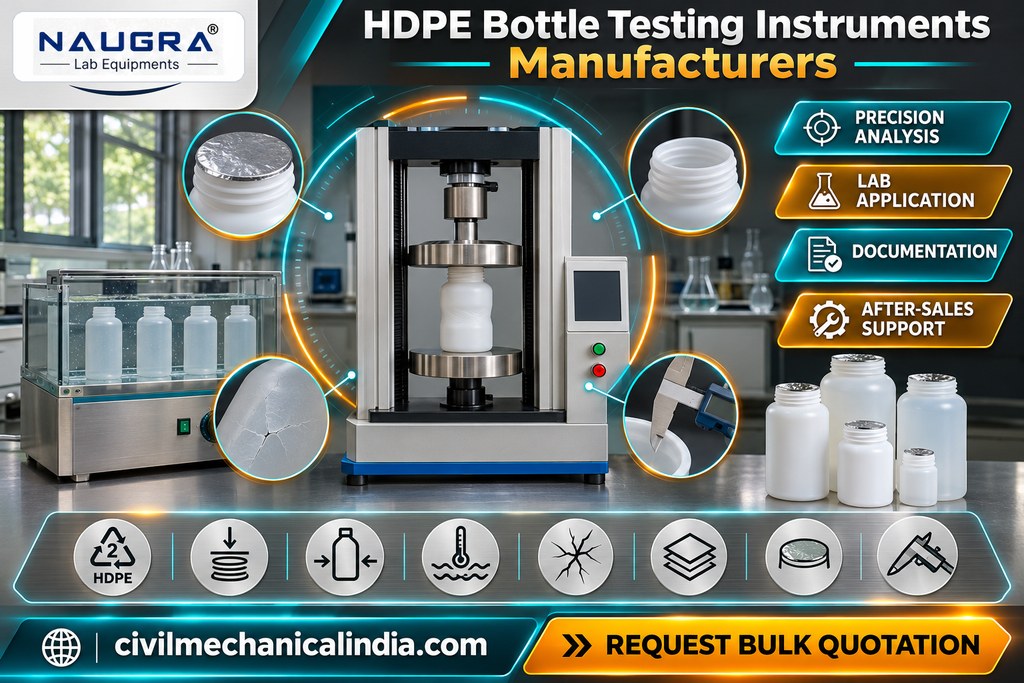
We manufacture HDPE bottle testing instruments in India for blow moulders and for pharmaceutical, agrochemical, lubricant, dairy and personal care packers. HDPE bottles are tough and chemical resistant, but they can stress crack, leak at the seal or buckle under load. The model codes below are for tender buyers in Africa and South America.
Our HDPE bottle testing instruments range
| Product | Model code | Use |
|---|---|---|
| Column Crush Tester for HDPE Bottles | CMI-IND-0542 | Column crush strength |
| Hydrostatic Pressure Tester for HDPE Bottles with Burst Mode | CMI-IND-0545 | Hydrostatic pressure with burst mode |
| Environmental Stress Crack Resistance Tester for HDPE Bottles | CMI-IND-0544 | Environmental stress crack resistance |
| Induction Seal Peel Strength Tester for HDPE Bottle Liners | CMI-IND-0546 | Peel strength of induction seal liners |
| Child Resistant Closure Torque Tester for HDPE Bottles | CMI-IND-0541 | Torque of child resistant closures |
| Digital Density Balance for Polyethylene Bottles and Resin | CMI-IND-0543 | Density of bottles and resin |
Ten instruments are shown on our HDPE Bottles Testing Instruments page.
Tests and applications
| Concern | Test | Typical product |
|---|---|---|
| Stacking and capping | Column crush | All bottles |
| Leaks and weak pinch-off | Hydrostatic pressure | Liquids, chemicals |
| Cracking with detergents or oils | Stress crack resistance | Detergent, agrochemical, lubricant |
| Seal failure or hard-to-open seals | Induction seal peel | Pharmaceutical, dairy, agrochemical |
| Child safety | Closure torque and function | Medicines, chemicals |
| Correct resin | Density | All bottles |
Stress cracking is the failure HDPE users fear most. A bottle of detergent or pesticide can pass every test on the day it is made and split weeks later. Testing bottles in an aggressive solution at raised temperature brings that failure forward so the resin and design can be corrected.
Induction seals protect medicines and chemicals from tampering and leakage. If the seal is weak, it leaks. If too strong, users cannot remove it. Peel strength gives the packer a number to set the sealing machine by.
Pharmaceutical bottles also have requirements for moisture transmission and for the closure system, which auditors review.
What to specify in a tender
- Bottle volumes, shapes and neck finishes.
- Products filled and their effect on polyethylene.
- Stress crack method, reagent and temperature.
- Load and pressure ranges.
- Closure types and torque ranges.
Bottle checks for moulders and packers
Moulders should record weight and wall thickness continuously, and run column crush and pressure tests at start-up and at intervals. The pinch-off at the base deserves particular attention, as most leaks begin there.
Start a stress crack test for every new resin lot and bottle design. Tests run for days, so results must be planned ahead of shipment.
Packers should verify induction seal peel at the start of each run and after any change of liner, cap or bottle. Check that the seal is complete around the whole rim. For child resistant closures, test opening torque and function on samples from each closure lot. Keep retained bottles filled with product from each batch for stability observation.
Markets we supply in Africa and South America
Agrochemicals, medicines, lubricants and dairy products are packed in HDPE bottles made locally in both regions.
| Country | Nominal mains supply | Usual port of entry | Note for buyers |
|---|---|---|---|
| Sierra Leone | 230 V, 50 Hz | Freetown | Pharmaceutical and household product packers use locally sourced bottles. |
| Comoros | 220 V, 50 Hz | Moroni | Imported bottles and small local packers serve island markets. |
| Equatorial Guinea | 220 V, 50 Hz | Malabo or Bata | Lubricants and chemicals for the oil sector need leak-free containers. |
| Eswatini | 230 V, 50 Hz | Durban or Maputo, then road | Agrochemical packing for sugar and forestry uses HDPE bottles and cans. |
| Guyana | 120 V or 240 V, 60 Hz (varies by area) | Georgetown | Supply is 60 Hz and voltage varies by area. Confirm before ordering. |
| Suriname | 127 V, 60 Hz | Paramaribo | Agricultural and household chemical packers need stress crack tested bottles. |
Why source from us
- Strength, pressure, durability and seal testers from one manufacturer.
- Fixtures for your bottle and closure formats.
- Resin and closure testers on the same order.
- Installation and training available.
Frequently asked questions
Which reagent is used for stress crack tests?
Your standard names it. Tell us the method and we state what is supplied.
Can the peel tester test different liner sizes?
Yes. Tell us the neck sizes and we confirm the grips and fixtures.
Are closure tests covered?
Yes. See our Plastic Caps and Closure Testing Instruments range.
Send us your tender requirements
Bottle moulders supplying pharmaceutical or chemical companies are audited before approval. Send us your tender requirements and we will reply to each line with the instrument we offer, its model code, range and fixtures.
We can supply the HDPE bottle laboratory from India: column crush testers, hydrostatic pressure testers, stress crack baths, induction seal peel testers, closure torque testers, density balances, thickness gauges, drop testers, melt flow testers and balances.
Tell us the bottles you make or fill, the products, any pharmacopoeia or regulatory requirement and the destination port. Send the list through our contact page. We reply with an itemised quotation and delivery time.
Fixtures follow bottle and closure sizes, so each tender is quoted on its own list. Packers who buy bottles can ask for an incoming inspection set covering weight, crush, leak and seal checks, which is usually enough to qualify a new bottle supplier.