
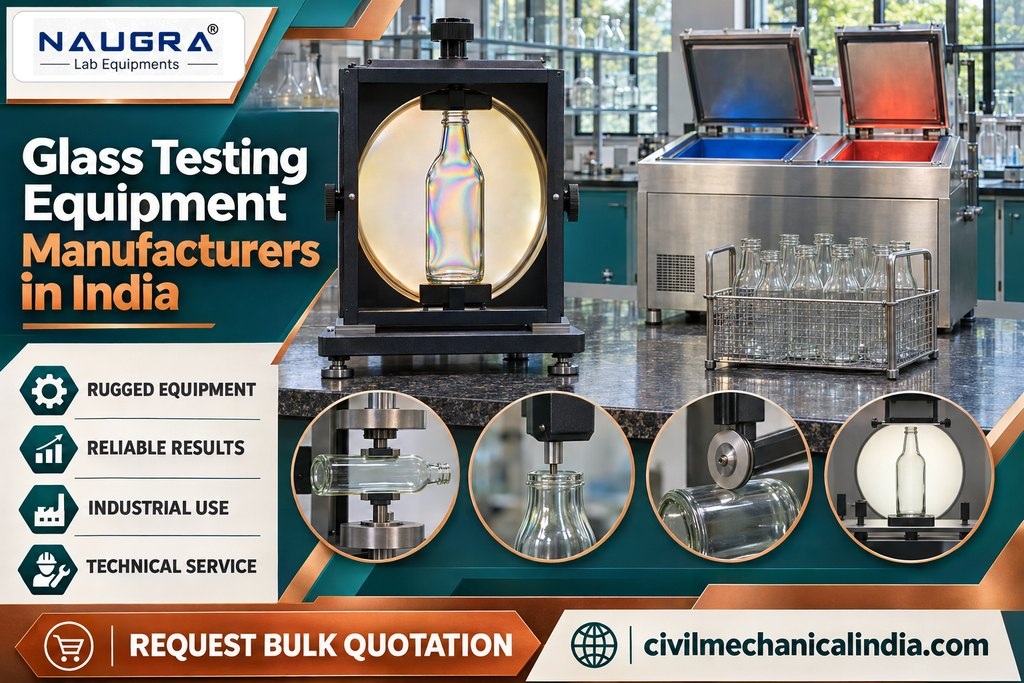
We manufacture glass testing equipment in India for container glassworks, flat and safety glass processors, pharmaceutical vial makers and the bottlers who buy glass. Glass is strong but unforgiving, and tests focus on residual stress, pressure, thermal shock and impact. The model codes below are for tender buyers in Africa and South America.
Our glass testing equipment range
| Product | Model code | Use |
|---|---|---|
| Glass Annealing Strain Polariscope with Sensitive Tint Plate | CMI-IND-0462 | Annealing strain viewed in polarised light |
| Glass Bottle Thermal Shock Tester with Twin Baths | CMI-IND-0463 | Thermal shock resistance of bottles, twin baths |
| Glass Container Internal Pressure Resistance Tester | CMI-IND-0464 | Internal pressure resistance of containers |
| Flat Glass Pendulum Impact Tester for Safety Glass | CMI-IND-0461 | Pendulum impact on safety glass |
| Glass Hydrolytic Resistance Autoclave for Pharmaceutical Vials | CMI-IND-0465 | Hydrolytic resistance of pharmaceutical vials |
| Glass Light Transmittance Haze and Solar Heat Spectrophotometer | CMI-IND-0466 | Light transmittance, haze and solar heat properties |
Ten instruments are shown on our Glass Products Testing Instruments page.
Tests and applications
| Product | Tests |
|---|---|
| Beverage bottles | Annealing strain, internal pressure, thermal shock, dimensions |
| Food jars | Thermal shock, vertical load, finish dimensions |
| Pharmaceutical vials | Hydrolytic resistance, dimensions |
| Toughened and laminated glass | Impact, fragmentation |
| Glazing | Light and solar transmittance |
Annealing removes stress from newly formed glass. If the lehr is set wrongly, stress remains and bottles break later for no visible reason. A polariscope shows that stress as colour, and operators check samples from every lehr row.
Carbonated drinks put bottles under constant pressure, so internal pressure tests are run on every production lot. Hot-fill and pasteurised products need thermal shock tests, since bottles pass from hot to cold on the filling line.
Safety glass for buildings and vehicles is tested by impact. Pharmaceutical glass is tested for the alkali it releases into water, which affects drug stability. Returnable bottles are tested again by the bottler, as scuffing weakens them with each trip.
What to specify in a tender
- Glass products and their size range.
- Pressure range and holding time.
- Bath temperatures and transfer time for thermal shock.
- Impact energy and specimen size for safety glass.
- Standards followed, such as ISO, ASTM or pharmacopoeia methods.
Running tests in a glassworks
Sampling follows the forming machine. Take bottles from each mould cavity at set intervals, and record results by mould number so that a faulty mould is pulled quickly.
Hot end checks include weight and visual defects. Cold end tests add strain, pressure, thermal shock, capacity and dimensions. Place the polariscope where light can be controlled, and train inspectors with reference discs showing known stress grades.
Pressure and thermal shock testers use water and should have splash guards and drains. Broken glass must be contained, so fit guards and provide gloves and eye protection. Keep records by date, shift and mould for the period your customers require.
Lightweight bottles leave less margin. As glassmakers reduce bottle weight to save energy and freight, pressure and impact results need watching more closely, and coating checks on the bottle surface become part of the routine.
Markets we supply in Africa and South America
Beverage growth and construction are increasing glass production and imports across both regions.
| Country | Nominal mains supply | Usual port of entry | Note for buyers |
|---|---|---|---|
| Côte d'Ivoire | 220 V, 50 Hz | Abidjan | Breweries and soft drink bottlers use large numbers of returnable bottles. |
| Tunisia | 230 V, 50 Hz | Radès (Tunis) | Glass packaging serves olive oil, wine and food exporters. |
| Uganda | 240 V, 50 Hz | Mombasa, then road | Beverage producers test incoming and returned bottles. |
| Mozambique | 220 V, 50 Hz | Maputo, Beira or Nacala | New building projects specify safety glazing that must be verified. |
| Bolivia | 230 V, 50 Hz | Arica in Chile, then road | High-altitude bottling puts extra demand on pressure resistance checks. |
| Uruguay | 220 V, 50 Hz | Montevideo | Wine and food producers buy glass to export market requirements. |
Why source from us
- Stress, pressure, thermal, impact and chemical testers from one manufacturer.
- Fixtures for your bottle and specimen sizes.
- Filling line and closure testers on the same order.
- Installation and training available.
Frequently asked questions
Do you supply vertical load testers for bottles?
Yes. Tell us the load range and bottle heights.
Can the polariscope give a numerical strain grade?
Tell us the grading method you use. We confirm the accessories in the offer.
Are filling line checks covered?
Yes. See our Filling Line Testing Instruments range.
Send us your tender requirements
Glassworks, bottlers and processors of safety glass each need a different set of tests. Send us your tender requirements and we will answer each line with the instrument we offer, its model code, range and fixtures.
We can supply the glass laboratory from India: polariscopes, internal pressure testers, thermal shock testers, vertical load and impact testers, capacity and dimension gauges, hydrolytic resistance autoclaves, pendulum impact testers for safety glass, and light transmittance instruments.
Tell us the glass products you make or use, the standards that apply and the destination. Contact us through the contact page. We reply with an itemised quotation and delivery period.
Fixtures depend on product sizes, so each tender is quoted on its own list. Bottlers who only need incoming inspection can ask for a compact set for strain, pressure and dimensions.
Glass processors supplying buildings can send the glazing specification from a project. We will identify which impact and optical tests it calls for and quote the instruments needed to demonstrate compliance to the architect or the building authority.