
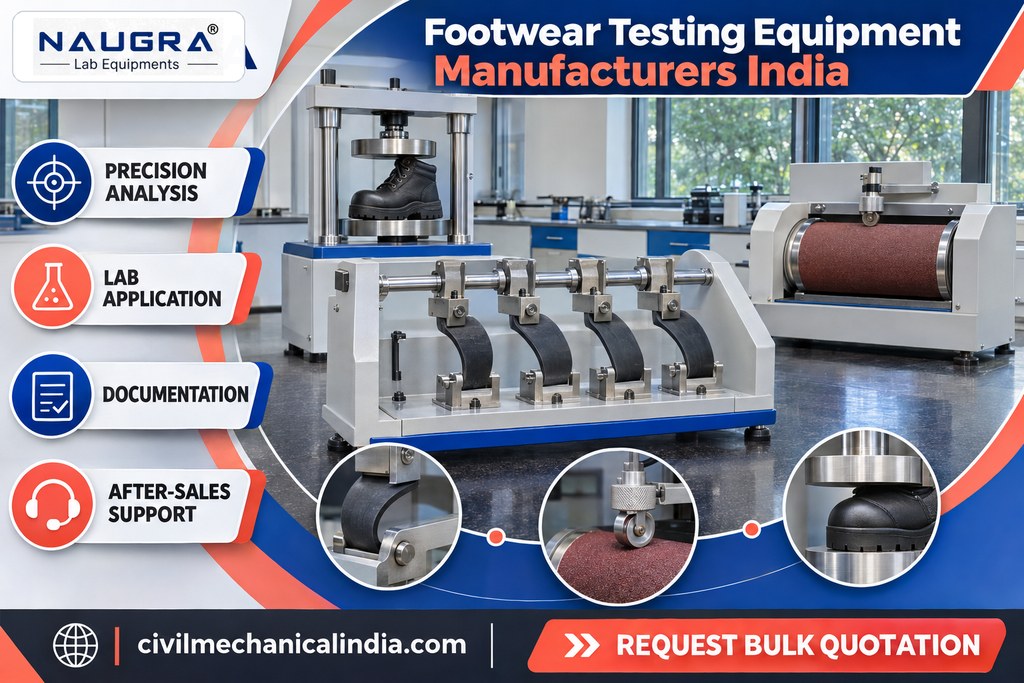
We manufacture footwear testing equipment in India for shoe factories, sole makers, safety footwear producers and standards bodies. The instruments check that soles do not crack, wear out or slip, and that safety boots protect the toes. The model codes below are for tender buyers in Africa and South America.
Our footwear testing equipment range
| Product | Model code | Use |
|---|---|---|
| Footwear Sole Flexing Resistance Tester | CMI-IND-0364 | Flex cracking resistance of soles |
| Footwear Abrasion Resistance Tester for Outsoles with Rotary Drum | CMI-IND-0361 | Abrasion resistance of outsoles on a rotary drum |
| Footwear Slip Resistance Testing Machine with Force Plate | CMI-IND-0363 | Slip resistance measured with a force plate |
| Footwear Whole Shoe Flex Fatigue Tester with Environmental Chamber | CMI-IND-0365 | Flex fatigue of whole shoes in a climate chamber |
| Safety Footwear Compression Test Machine for Toe Caps | CMI-IND-0366 | Compression resistance of safety toe caps |
| Footwear Insole Water Absorption and Desorption Tester | CMI-IND-0362 | Water absorption and desorption of insoles |
Ten instruments are shown on our Footwear Testing Instruments page.
Tests and applications
| Component | Tests |
|---|---|
| Outsole | Flexing, abrasion, slip resistance, hardness |
| Upper | Tensile, tear, flexing, colour fastness |
| Insole and lining | Water absorption, abrasion |
| Whole shoe | Sole bond strength, flex fatigue, water resistance |
| Safety footwear | Toe cap impact and compression, penetration resistance |
Most complaints about shoes concern the sole: it cracks across the flex line, wears through or comes away from the upper. Flexing, abrasion and bond tests address those three failures directly.
Slip resistance has become a legal matter for work footwear in many countries. It is measured on defined floor surfaces with defined contaminants.
Safety footwear must be certified. Toe caps are tested by impact and by compression, and the clearance left under the cap is measured. Governments, mines and construction firms buy only certified boots, so local producers need access to these tests.
School shoe programmes and military procurement also issue tenders with test requirements, which gives local factories a reason to invest.
What to specify in a tender
- Footwear types: casual, school, sports, military or safety.
- Standards followed, typically ISO or EN methods.
- Flexing angle, speed and number of stations.
- Floor surfaces and lubricants for slip tests.
- Loads and fixtures for toe cap tests.
Organising a footwear laboratory
Divide the work into materials, components and finished footwear. Materials tests on leather, textile and rubber need a tensile machine, cutters and conditioning. Component tests on soles need flexing and abrasion machines. Whole shoe tests need the larger machines for bond, flex and safety.
Condition specimens for the time the standard states. Rubber and leather both change with temperature and humidity, and results on unconditioned samples vary widely.
Flexing tests run for tens of thousands of cycles, often overnight. Fit counters and automatic stops, and inspect at the intervals the method defines. Keep failed specimens with their records, since photographs of cracks are part of most test reports.
Markets we supply in Africa and South America
Footwear is made in many countries of both regions, from large export factories to small workshops supplying schools and industry.
| Country | Nominal mains supply | Usual port of entry | Note for buyers |
|---|---|---|---|
| Burundi | 220 V, 50 Hz | Dar es Salaam, then road | Small manufacturers supply school and work shoes to local buyers. |
| Namibia | 220 V, 50 Hz | Walvis Bay | Mining companies require certified safety footwear for their workforce. |
| Benin | 220 V, 50 Hz | Cotonou | Local workshops and importers serve a price-sensitive market. |
| Djibouti | 220 V, 50 Hz | Djibouti | Port and logistics workers use safety footwear checked against standards. |
| Guyana | 120 V or 240 V, 60 Hz (varies by area) | Georgetown | Supply is 60 Hz and voltage varies by area. Confirm before ordering. |
| Suriname | 127 V, 60 Hz | Paramaribo | Mining and forestry employers specify tested safety boots. |
Why source from us
- Sole, upper, whole shoe and safety testers from one manufacturer.
- Multi-station machines for higher throughput.
- Leather testing instruments on the same order.
- Installation and training available.
Frequently asked questions
Do you supply sole bond strength testers?
Yes. Tell us the footwear types and we include the appropriate tester.
Can the slip tester use different floor tiles?
Tell us the surfaces your standard names. We confirm what is supplied in the offer.
Are leather tests covered?
Yes. See our Leather Testing Instruments range.
Send us your tender requirements
Footwear factories bidding for school, military or industrial contracts must show test results. Send us your tender requirements and we will answer each line with the machine we offer, its model code and the standard it meets.
We can supply the footwear laboratory from India: sole flexing and whole shoe flex testers, abrasion testers, slip resistance machines, toe cap impact and compression testers, bond strength testers, hardness testers, tensile machines with cutters, and leather testing instruments. Conditioning cabinets and balances complete the list.
Tell us the footwear you make, the standards in your contracts and the destination port. Reach us through the contact page. We reply with an itemised quotation and delivery period.
Standards and footwear types decide the configuration, so each tender is quoted on its own scope. Fixtures, flexing mandrels and test surfaces are listed one by one.
Standards bodies setting up a national footwear laboratory can send us the list of product standards they intend to enforce. We will prepare a schedule of machines against each test clause, ready to use in the tender documents.