
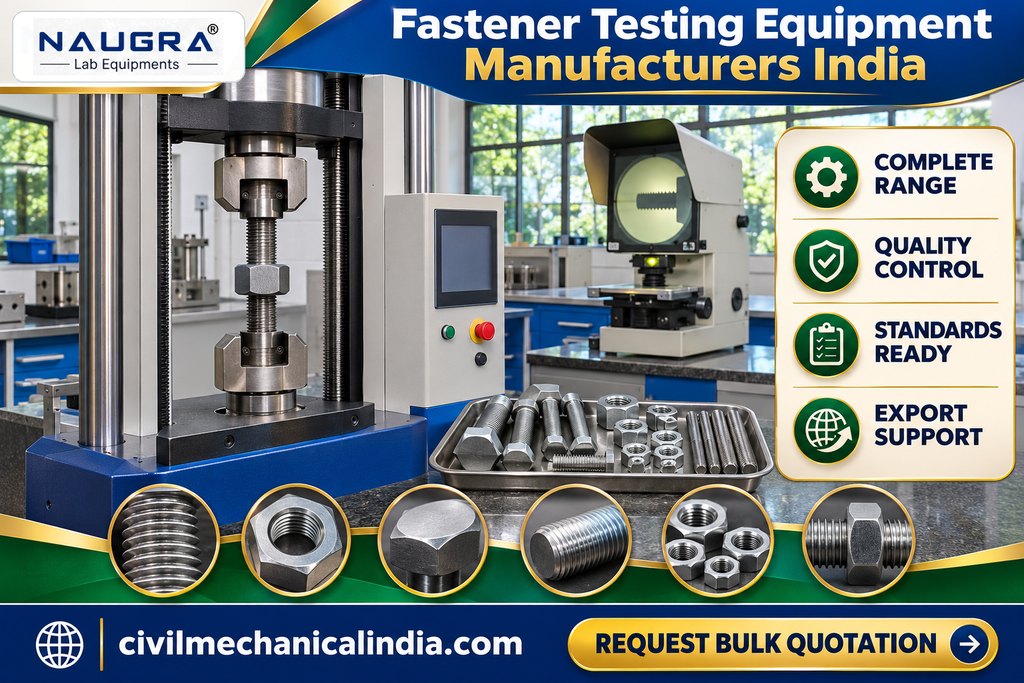
We manufacture fastener testing equipment in India for bolt and nut makers, importers, steel erectors and inspection laboratories. A structural bolt is small and cheap, yet a failed one can bring down a joint, so standards define its tests precisely. The model codes below are for tender buyers in Africa and South America.
Our fastener testing equipment range
| Product | Model code | Use |
|---|---|---|
| Bolt and Stud Proof Load Tensile Testing Machine | CMI-IND-0411 | Proof load and tensile strength of bolts and studs |
| Digital Torque Tension Test Machine for Fasteners | CMI-IND-0412 | Relationship between tightening torque and bolt tension |
| Fastener Locking Torque Prevailing Torque Tester | CMI-IND-0414 | Prevailing torque of locking nuts |
| Fastener Thread Pitch and Profile Measuring Projector | CMI-IND-0415 | Thread pitch and profile by projection |
| Fastener Coating Thickness and Adhesion Test Set | CMI-IND-0413 | Coating thickness and adhesion |
| Hydrogen Embrittlement Sustained Load Test Frame for Fasteners | CMI-IND-0416 | Delayed cracking from hydrogen under sustained load |
Ten instruments are shown on our Fasteners Testing Instruments page.
Tests and applications
| Property | Test | Risk if it fails |
|---|---|---|
| Strength | Proof load, tensile, wedge tensile | Bolt breaks in service |
| Hardness | Rockwell, Vickers | Wrong heat treatment |
| Tightening behaviour | Torque tension | Joints under or over tightened |
| Locking | Prevailing torque | Nuts loosen under vibration |
| Dimensions | Thread gauge, projector | Poor fit, stripped threads |
| Embrittlement | Sustained load | Sudden delayed fracture |
Property class markings on a bolt head are a promise of strength. Proof load and tensile tests confirm it. Counterfeit and mismarked fasteners are a known problem in international trade, so importers and site laboratories test deliveries before use.
Torque tension testing explains how much clamp force a given torque produces with a particular coating and lubricant. Steel erectors need that figure to tighten high-strength bolts correctly.
High-strength plated fasteners can absorb hydrogen during plating and crack days later under load. A sustained load test finds affected batches before they reach a structure.
What to specify in a tender
- Fastener sizes and property classes.
- Standards followed, typically ISO 898 or ASTM equivalents.
- Maximum load, which sets the capacity of the tensile machine.
- Threaded adaptors and wedges for each size.
- Torque range for tightening tests.
Testing fasteners properly
Full-size testing needs the right fixtures. Each diameter and thread needs its own adaptor, and wedge tests need hardened wedges of the specified angle. List every size, since missing adaptors are the usual reason a new laboratory cannot start.
Sample each lot according to the standard and keep heats and coating batches separate. Record head markings and manufacturer identification with the results.
Hardness tests on a prepared cross-section support the tensile results and reveal decarburised surfaces. For embrittlement, keep the test fixtures loaded for the full period the standard requires and inspect at the stated times.
Keep a library of failed samples. A bolt that broke under the head, stripped its thread or cracked after plating teaches inspectors what to look for in the next delivery.
Markets we supply in Africa and South America
Steel buildings, bridges, transmission towers, mines and wind farms all use high-strength bolts, most of them imported into both regions.
| Country | Nominal mains supply | Usual port of entry | Note for buyers |
|---|---|---|---|
| Equatorial Guinea | 220 V, 50 Hz | Malabo or Bata | Oil and gas structures use critical bolting that must be verified. |
| Eswatini | 230 V, 50 Hz | Durban or Maputo, then road | Sugar mills and construction projects check imported fasteners. |
| Liberia | 120 V, 60 Hz in most areas | Monrovia | Supply is 120 V at 60 Hz in most areas. Machines are specified accordingly. |
| Seychelles | 240 V, 50 Hz | Victoria | A marine climate makes coating quality on fasteners important. |
| Paraguay | 220 V, 50 Hz | River route to Asunción | Transmission lines and hydropower works consume large quantities of structural bolts. |
| Venezuela | 120 V, 60 Hz | La Guaira or Puerto Cabello | Oil industry maintenance depends on certified bolting. |
Why source from us
- Strength, torque, dimensional and embrittlement testers from one manufacturer.
- Adaptors and wedges for each fastener size.
- Hardness and coating testers on the same order.
- Installation and training available.
Frequently asked questions
What capacity machine do I need?
Tell us the largest diameter and property class. We calculate the breaking load and recommend a capacity.
Do you supply thread gauges?
Yes. Ring and plug gauges are quoted per size and tolerance class.
Are hardness testers included?
They are listed in our Metal Components Testing Instruments range and can be added to the offer.
Send us your tender requirements
Fastener makers seeking approval, and importers or project laboratories checking deliveries, work from the same standards. Send us your tender requirements with sizes and property classes, and we will reply to each line with the machine we offer and its model code.
We can supply the fastener laboratory from India: tensile and proof load machines with adaptors and wedges, torque tension testers, prevailing torque testers, thread projectors and gauges, hardness testers, coating thickness and adhesion sets, salt spray chambers and embrittlement test frames.
Tell us the fasteners you make or use, the standards that apply and the destination. Send the details through our contact page. We reply with an itemised quotation and delivery time.
Adaptors are size specific, so each tender is quoted on its own list. Site laboratories for a single project can ask for a reduced set covering only the bolt sizes on the drawings.