
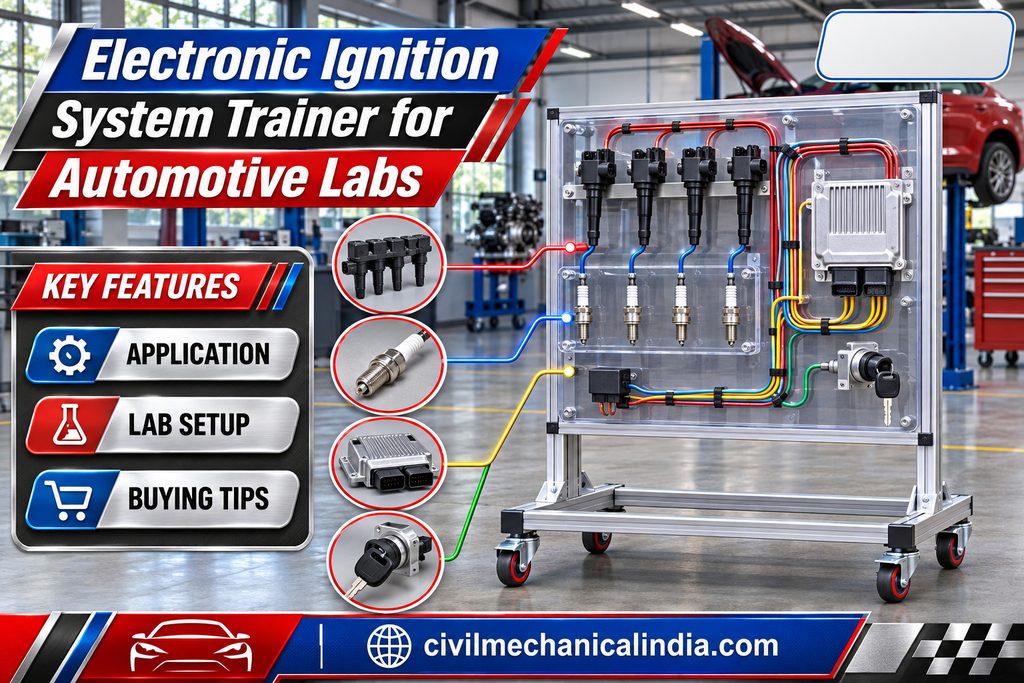
An electronic ignition system trainer shows students how a modern engine creates and times its spark, using real components laid out on a panel where they can be measured safely. We manufacture automotive training equipment in India. This guide helps vocational centres and engineering colleges in Zimbabwe, Rwanda, Senegal, Côte d'Ivoire and Cameroon choose the right trainer.
How ignition systems have developed
Students need to know all three generations, because all three are still on the road in Africa.
| System | How the spark is triggered | Where it is found |
|---|---|---|
| Contact breaker with distributor | Mechanical points open the coil circuit | Older vehicles |
| Electronic ignition with distributor | A sensor and module replace the points | Vehicles from the 1980s onward |
| Distributorless and coil-on-plug | The engine computer fires a coil for each cylinder | Most current vehicles |
In every case a coil turns battery voltage into the thousands of volts needed to jump the spark plug gap. What changes is how the timing is controlled.
Electronic ignition system trainers in our range
These products are listed under Thermal Engineering Lab Equipment and Automotive Engineering Trainings Equipments.
| Product | Code | Covers |
|---|---|---|
| Distributor Ignition System Trainer | TEE-0004 | Distributor-based ignition |
| Coil On Plug Ignition System Trainer | TEE-0002 | Individual coil per cylinder |
| Spark Ignition System Trainer | TEE-0016 | Basic spark generation and plug behaviour |
| Auto Ignition 6-in-1 Comprehensive Teaching Set | CIVIL-ATE-09-0003 | Several ignition types on one teaching unit |
| Gasoline Direct Injection Engine Test Bench | TEE-0009 | Engine running with direct injection and electronic control |
A common plan is one distributor trainer and one coil-on-plug trainer, so students can compare signals between the two.
How to choose
- Match the vehicles in your region. If workshops still see many older cars, include a distributor trainer.
- Look for test points. Students should be able to connect a meter or oscilloscope without stripping wires.
- Ask for fault insertion. Switches that create open circuits or weak signals teach diagnosis.
- Check the power source. Trainers should run from a 12 V supply as a vehicle does.
- Insist on a manual with wiring diagrams and exercises.
Ignition is taught alongside fuelling. Most courses pair it with the fuel supply system in petrol engine modules, so consider ordering both together.
What drives the price
We quote each trainer against a specification. The cost depends on:
- Number of systems shown on one panel.
- Real components versus simulated signals.
- Fault insertion and measurement panel.
- Stand, power supply and accessories.
- Quantity.
Test equipment such as multimeters, timing lights and an oscilloscope should be budgeted with the trainers.
Import and site notes by country
Panel trainers need single-phase mains for their 12 V supply. Confirm the voltage.
| Country | Nominal mains supply | Usual port of entry | Note for this equipment |
|---|---|---|---|
| Zimbabwe | 240 V, 50 Hz | Beira or Durban, then road (landlocked) | The vehicle fleet is older on average. Distributor and early electronic systems still matter in training. |
| Rwanda | 230 V, 50 Hz | Dar es Salaam or Mombasa, then road (landlocked) | TVET centres are being equipped quickly. Mobile trainers on wheels let rooms be shared. |
| Senegal | 230 V, 50 Hz | Dakar | Instruction is in French. Ask for French labels and manuals if required. |
| Côte d'Ivoire | 220 V, 50 Hz | Abidjan | Imported used vehicles vary widely. Trainers covering several ignition types are most useful. |
| Cameroon | 220 V, 50 Hz | Douala | Humidity corrodes connectors. Store trainers indoors and keep contact cleaner at hand. |
Mistakes to avoid
- Buying only the newest system and ignoring older vehicles in the local fleet.
- Ordering trainers without measuring instruments.
- Letting students touch high-tension leads on a live unit.
- Skipping instructor training.
- Running trainers from an unfused battery supply, which risks burnt wiring when a student makes a wrong connection.
Frequently asked questions
Can the trainers be used without an engine?
Yes. Panel trainers simulate engine speed with a motor or signal generator, so sparks can be studied on the bench.
Do you supply charging and starting system trainers?
Ask us by name. Many colleges request a dynamo model or alternator trainer and other electrical apparatus with ignition units.
Are engine test benches available as well?
Yes. Petrol and diesel engine test benches are listed in the same Thermal Engineering Lab Equipment category of engineering equipment.
Request a quotation
Send your course outline and student numbers through our contact page. We will suggest a trainer set and quote it. See also Vocational Automobile Engineering in our TVET range.