
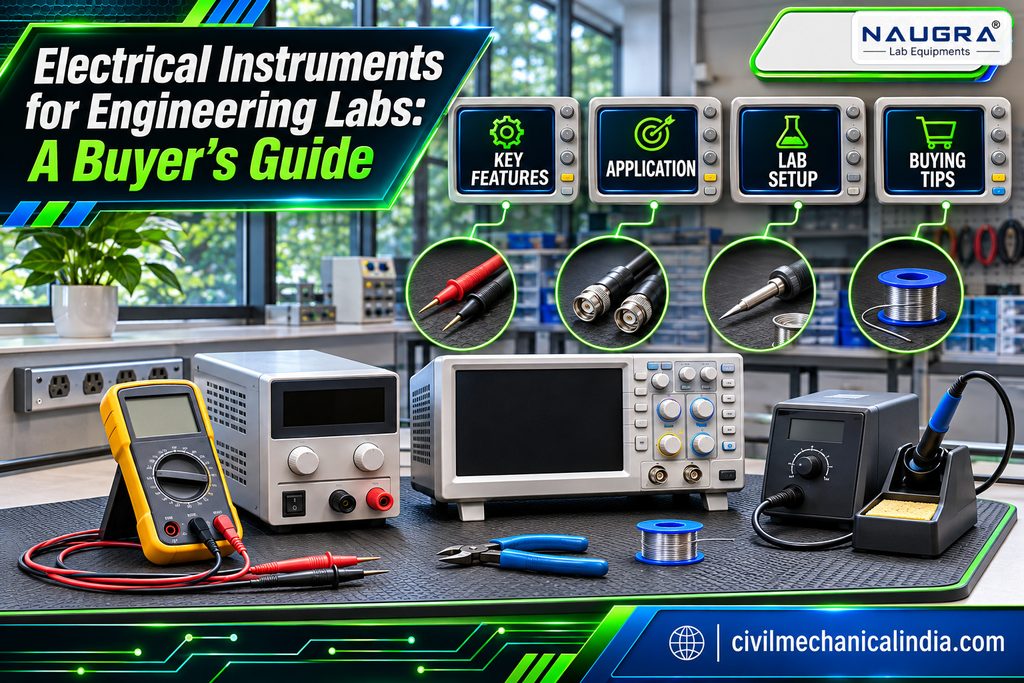
Electrical instruments for a teaching lab fall into a few clear groups: instruments that measure, sources that supply, and trainers that let students wire circuits safely. We manufacture and supply electrical lab equipment from India. This guide helps institutions in Cameroon, Mozambique, DR Congo, Botswana and Nigeria choose what to buy first.
The main groups of electrical instruments
| Group | Examples | Purpose |
|---|---|---|
| Measuring | Multimeter, clamp meter, oscilloscope | Read voltage, current, resistance and waveforms |
| Sources | DC power supply, function generator | Feed circuits with controlled power and signals |
| Safety testers | Earth tester, insulation tester | Prove an installation is safe |
| Bench tools | Soldering and desoldering station, tool kit | Build and repair circuits |
| Trainers | Machine, drive and circuit trainers | Teach principles on a safe panel |
A first-year lab needs measuring instruments and sources on every bench. Safety testers and trainers can be shared.
Electrical instruments in our basic range
These products are listed in our Basic Electrical Engineering Lab Equipment category, with descriptions from the product cards.
| Product | Code | Description on our website |
|---|---|---|
| Digital Multimeter Trainer Kit | CMI-NP-1266 | Auto-ranging handheld multimeter with probes and test board, 4000-count display |
| Electrical Safety and Earthing Resistance Test Kit | CMI-NP-1267 | Earth tester, insulation tester and continuity meter |
| Function Generator and Cathode Ray Oscilloscope Combo Trainer | CMI-NP-1268 | Sine, square and triangle output with dual-trace display |
| Variable DC Power Supply Bench Unit | CMI-NP-1269 | Regulated dual-output supply with digital display |
| Soldering Station with Digital Display | ELC-BEE-0002 | Bench soldering with temperature shown on a digital display |
| Electronic Tools Kit | ELC-BEE-0001 | Hand tools for electronics assembly |
For motors, generators and drives, see Electrical Machines and Drives Lab. For insulation and breakdown tests at high voltage, see High Voltage Lab Equipment.
How to choose
- Match ranges to the experiments. A current device rated for milliamps is useless on a motor bench.
- Check the safety category of meters used on mains circuits.
- Prefer instruments with protected inputs and fuses students can replace.
- Standardise. One model of multimeter across the lab makes teaching and spares simpler.
- Decide on analogue or digital. Analogue meters still teach scale reading and loading effects well.
What drives the price
We prepare quotations per enquiry. Costs depend on:
- Accuracy class and measuring range.
- Bandwidth, for oscilloscopes and generators.
- Number of benches to equip.
- Trainer panels versus loose electrical apparatus.
- Accessories such as leads, probes and spare fuses.
Ask for leads and probes to be priced per bench. They are the first things to wear out.
Import and site notes by country
Every powered instrument must match the local supply. State voltage, frequency and socket type in your order.
| Country | Nominal mains supply | Usual port of entry | Note for this equipment |
|---|---|---|---|
| Cameroon | 220 V, 50 Hz | Douala | Voltage dips are common outside the main cities. Fit benches with stabilisers or isolated supplies. |
| Mozambique | 220 V, 50 Hz | Maputo, Beira or Nacala | Coastal campuses face salt air. Choose instruments with sealed cases and store leads dry. |
| DR Congo | 220 V, 50 Hz | Matadi (west); Dar es Salaam route for the east and south | Mining training centres need rugged test instruments that survive field use. |
| Botswana | 230 V, 50 Hz | Durban or Walvis Bay, then road (landlocked) | Solar training is growing. Add DC clamp meters and insulation testers to the list. |
| Nigeria | 230 V, 50 Hz | Lagos (Apapa or Tin Can Island) | Generator supply can be noisy. Sensitive scientific electronics benefit from online UPS units. |
Mistakes to avoid
- Buying meters without spare fuses and leads.
- Using unprotected bench supplies with first-year students.
- Forgetting earth leakage protection on every bench.
- Ordering one oscilloscope for a class of forty.
- Mixing socket types across the lab.
Frequently asked questions
How many instruments does one bench need?
A common plan is one multimeter, one DC supply and shared access to an oscilloscope and function generator per pair of students. Adjust to your syllabus.
Do you supply a desoldering station as well as soldering stations?
Our website lists a soldering station with digital display. Ask us to quote a desoldering station with it if your repair courses need one.
Can you equip an electrical machines lab too?
Yes. Motors, generators, transformers and drive trainers are in our Electrical Engineering Lab Equipment range.
Request a quotation
Send your experiment list, bench count and supply details through our contact page. We will quote the test equipment bench by bench.