
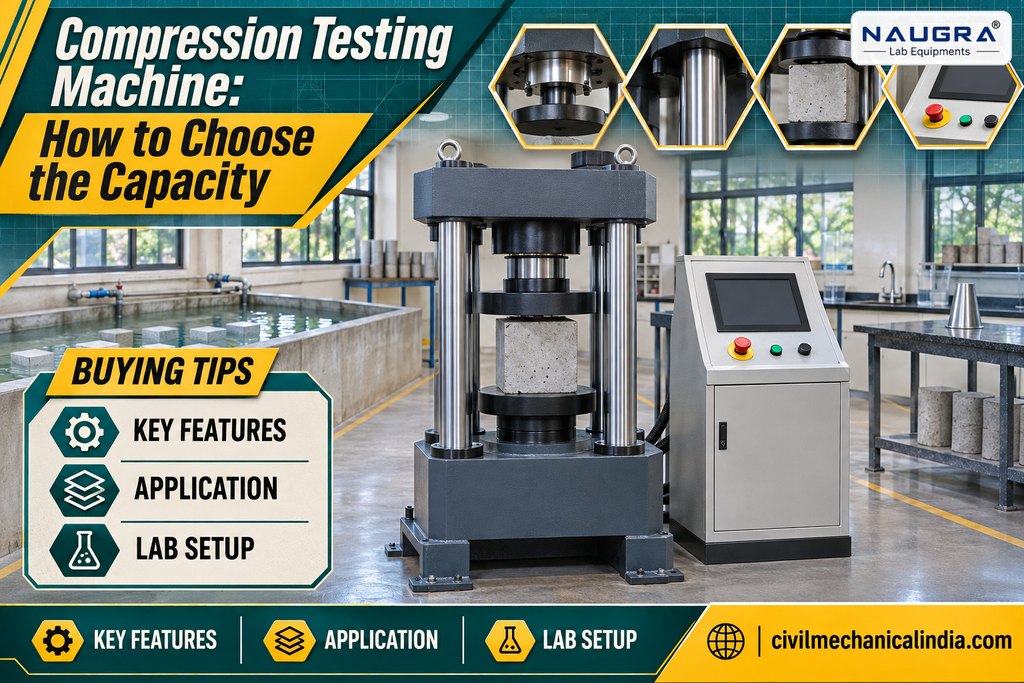
A compression testing machine crushes concrete cubes or cylinders to find their strength, and its capacity must match the strongest concrete you expect to test. We manufacture these machines in India. This guide explains how site labs, universities and road agencies in Côte d'Ivoire, Cameroon, Mozambique, DR Congo and Botswana can choose the right one.
How a compression testing machine is rated
Capacity is given in kilonewtons (kN). The load needed is the concrete strength multiplied by the loaded area. A 150 mm cube has an area of 22,500 mm², so concrete of 60 MPa needs about 1,350 kN. Good practice is to work in the middle part of the machine's range, not at its limit.
| Specimen | Loaded area | Load at 40 MPa | Load at 80 MPa |
|---|---|---|---|
| 100 mm cube | 10,000 mm² | 400 kN | 800 kN |
| 150 mm cube | 22,500 mm² | 900 kN | 1,800 kN |
| 150 x 300 mm cylinder | About 17,670 mm² | About 707 kN | About 1,414 kN |
These figures are simple arithmetic, shown to help you size a machine. Common capacities in the industry are 1,000, 2,000 and 3,000 kN.
Our concrete compression testing machine
Our Compression Testing Machine is listed under code CTE-0001. The product page describes a fully automatic machine with software, a capacity of 3000 kN, and platens for 150 mm cubes, 100 mm cubes and 150 x 300 mm cylinders. It sits in our Concrete Testing Lab Equipment category alongside the moulds and curing equipment a concrete lab needs:
- Different types of Concrete Moulds, including the cube mould 150x150mm size most labs use.
- Accelerated Curing Tank for early strength prediction.
- Flexure Testing Machine Digital for beam tests.
- Vibrating Table for compacting specimens.
Manual, digital or fully automatic
- Manual machines use a hand-operated valve and a gauge. They are simple and suit small site labs.
- Digital machines show load and pace rate on a display, which makes it easier to hold the loading rate the standard requires.
- Fully automatic machines run the test at a set rate and store results, which removes operator influence.
If results go into contract records, automatic control and stored data are worth the extra cost.
What drives the testing machine price
We give a quotation against each specification. The main factors are:
- Capacity and frame stiffness.
- Control type: manual, digital or automatic with software.
- Platens and spacers for different specimen sizes.
- Extra frames, for example a flexure attachment.
- Calibration requirements at site.
- Sea freight, since a compressive strength testing machine is heavy.
Import and site notes by country
Confirm single-phase or three-phase supply in the lab before ordering, and tell us the voltage.
| Country | Nominal mains supply | Usual port of entry | Note for this equipment |
|---|---|---|---|
| Côte d'Ivoire | 220 V, 50 Hz | Abidjan | Infrastructure projects around Abidjan often specify EN methods. State the standard so platens and pace rate match. |
| Cameroon | 220 V, 50 Hz | Douala | Humid conditions near Douala call for covered storage and regular oiling of platens. |
| Mozambique | 220 V, 50 Hz | Maputo, Beira or Nacala | Choose the port closest to site. Moving a heavy frame overland from the wrong port is costly. |
| DR Congo | 220 V, 50 Hz | Matadi (west); Dar es Salaam route for the east and south | Mining sites in the south are reached by long road routes. Ask for a reinforced crate and lifting points. |
| Botswana | 230 V, 50 Hz | Durban or Walvis Bay, then road (landlocked) | Dry, dusty site labs need the hydraulic unit kept covered and the oil checked often. |
Mistakes to avoid
- Choosing capacity for today's mix only, when high-strength concrete is planned.
- Forgetting the foundation. The floor must carry the machine and stay level.
- Testing cubes that are not centred, which gives low results.
- Skipping calibration after transport.
- Ordering the machine without moulds, tamping rods and a curing tank.
Frequently asked questions
Which capacity suits a general concrete lab?
Most labs testing 150 mm cubes choose 2,000 kN. Choose 3,000 kN if you test high-strength concrete or want more reserve.
Can the same machine test cylinders and cubes?
Yes, with the correct platens and distance pieces. List every specimen size in your enquiry.
Do you supply other concrete testing apparatus with the machine?
Yes. Slump cones, moulds, mixers and non-destructive testers are all in our Concrete Testing Lab Equipment range and can ship in the same crate set.
Request a quotation
Send your specimen sizes, highest concrete grade, standard and power supply through our contact page. We will recommend a compressive strength machine and send an itemised offer.