
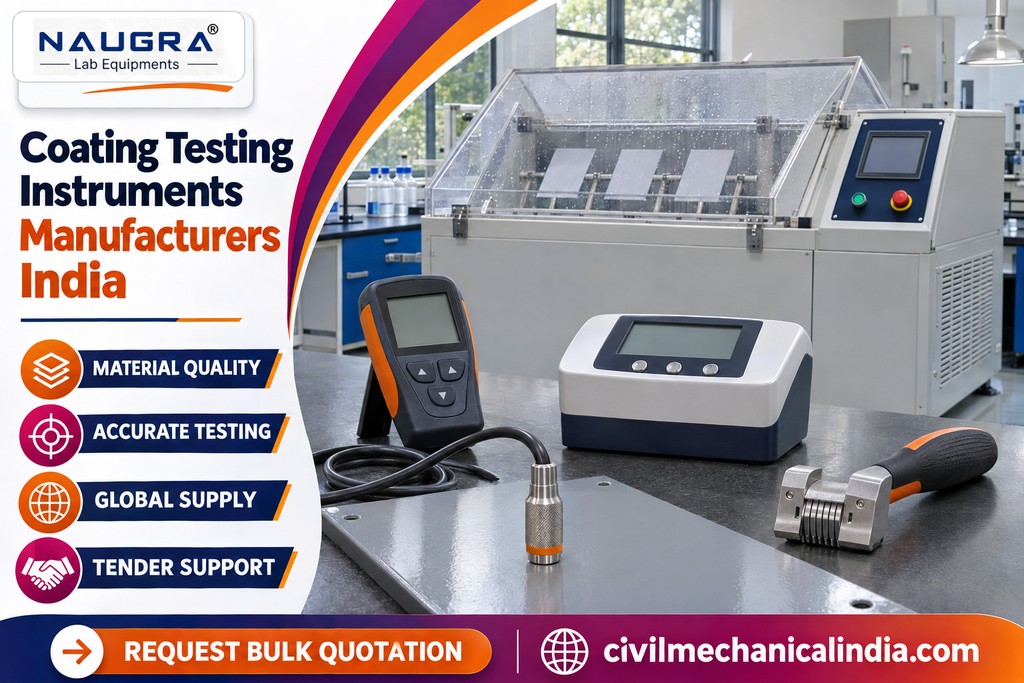
We manufacture coating testing instruments in India for powder coaters, galvanisers, platers, steel fabricators and coating inspectors. A coating protects only if it is thick enough, well bonded and resistant to corrosion, and these instruments measure all three. The model codes below are for tender buyers in Africa and South America.
Our coating testing instruments range
| Product | Model code | Use |
|---|---|---|
| Digital Coating Thickness Gauge for Ferrous and Non-Ferrous Substrates | CMI-IND-0395 | Coating thickness on ferrous and non-ferrous metals |
| Automatic Pull Off Adhesion Tester for Paint and Coatings | CMI-IND-0391 | Adhesion by automatic pull-off |
| Cross Cut Adhesion Test Kit for Paint Films | CMI-IND-0392 | Adhesion by cross cut |
| Gloss Meter Triple Angle for Paint and Coatings | CMI-IND-0396 | Gloss at three angles |
| Cyclic Corrosion Test Chamber for Coated Panels | CMI-IND-0394 | Corrosion resistance under cyclic conditions |
Ten instruments are shown on our Surface Coating Testing Instruments page.
Tests and applications
| Requirement | Test | Used by |
|---|---|---|
| Enough coating | Dry film thickness | Every coater and inspector |
| Good bond | Cross cut, pull-off | Coaters, fabricators |
| Appearance | Gloss, colour | Architectural and appliance coaters |
| Corrosion protection | Salt spray, cyclic corrosion | Qualification of systems |
| Mechanical resistance | Impact, bend, cupping | Coil and powder coaters |
Thickness is measured on every job. Too thin and the coating fails early. Too thick and it wastes material and may crack. Specifications for structural steel, pipelines and tanks state minimum and maximum values, and inspectors verify them before release.
Adhesion tests reveal poor surface preparation, the commonest cause of coating failure. Corrosion chambers compress years of exposure into weeks and are used to qualify a coating system before it is specified.
Coastal and industrial environments are severe. Asset owners in ports, oil and gas, and power increasingly require inspection records for every coated item.
What to specify in a tender
- Coating types: paint, powder, galvanising or plating.
- Substrates: steel, aluminium or others.
- Thickness range and probe types.
- Adhesion method and dolly sizes.
- Chamber volume and test cycles for corrosion testing.
Inspecting coatings on the job
Coating inspection begins before painting. Measure surface profile and cleanliness after blasting, and check air temperature, steel temperature and dew point so that paint is not applied to a damp surface.
Calibrate the thickness gauge on shims over the actual blasted steel, then take readings in the pattern the specification requires. Record every reading, as averages hide thin spots.
Run adhesion tests on test panels or agreed areas, since they are destructive. Corrosion tests belong in the laboratory and run for hundreds of hours, so plan them early when qualifying a new system. Keep a file for each job with conditions, readings and batch numbers of the paint used.
Applicators benefit too. A coater who records thickness and adhesion on every batch can answer a warranty claim with evidence, and can show a new customer exactly how consistent the process is.
Markets we supply in Africa and South America
Steel structures, pipelines, tanks and roofing sheet all depend on coatings, in climates that are often hot, humid or coastal.
| Country | Nominal mains supply | Usual port of entry | Note for buyers |
|---|---|---|---|
| Chad | 220 V, 50 Hz | Douala, then road | Oil field and pipeline facilities require inspected protective coatings. |
| Mauritius | 230 V, 50 Hz | Port Louis | A coastal climate everywhere on the island makes corrosion protection critical. |
| Guinea | 220 V, 50 Hz | Conakry | Mining plant and port structures are exposed to humid, salty air. |
| South Sudan | 230 V, 50 Hz | Mombasa, then road | Oil sector assets depend on coating inspection for long service. |
| Chile | 220 V, 50 Hz | San Antonio or Valparaíso | Mining and port infrastructure on a long coastline need rigorous coating control. |
| Ecuador | 120 V, 60 Hz | Guayaquil | Supply is 120 V at 60 Hz. Chambers are specified to suit. |
Why source from us
- Thickness, adhesion, appearance and corrosion testers from one manufacturer.
- Portable instruments for site inspectors.
- Paint laboratory instruments on the same order.
- Installation and training available.
Frequently asked questions
Do you supply surface profile and dew point instruments?
Ask us in your enquiry. We confirm the inspection kit contents in the offer.
Can one gauge measure on steel and aluminium?
The listed gauge covers ferrous and non-ferrous substrates.
Are paint laboratory testers available?
Yes. Viscometers, grind gauges and film applicators for the paint laboratory are listed in our Paint Testing Equipment India range and can be added to the same offer.
Send us your tender requirements
Coating contractors and asset owners often specify inspection kits and a small laboratory in the same tender. Send us your tender requirements and we will reply to each line with the instrument we offer, its model code and accessories.
We can supply everything from India: coating thickness gauges, pull-off and cross cut adhesion testers, gloss meters, impact and bend testers, salt spray and cyclic corrosion chambers, surface profile and climate instruments, and paint laboratory equipment such as viscometers and grind gauges. Calibration shims and spare dollies are quoted separately.
Tell us the coatings you apply or inspect, the specifications you work to and the destination port. Write to us through the contact page. We reply with an itemised quotation and delivery time.
Kits differ for inspectors, applicators and laboratories, so each tender is quoted on its own scope. Tell us how many inspectors you are equipping and we will price identical kits for each.