
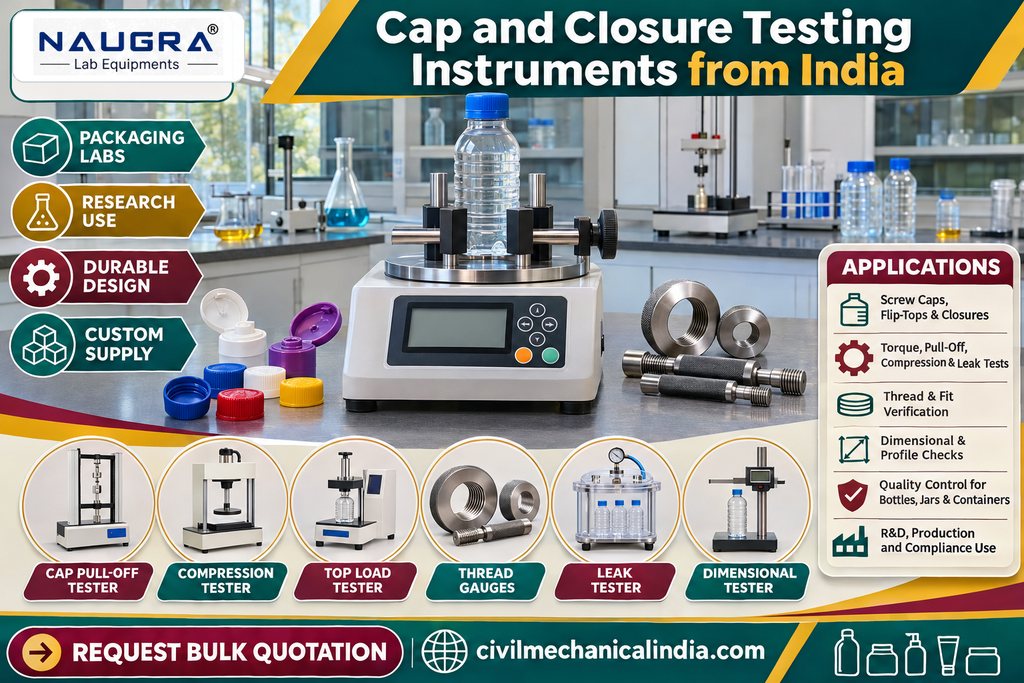
Our closure testing instruments check that a cap seals, opens with the right effort and survives the capping machine. Closure moulders, bottlers of water, soft drinks, edible oil and medicines, and packaging laboratories use them every shift. We manufacture them in India. The model codes below are for tender buyers in Africa and South America.
Our closure testing instruments range
| Product | Model code | Use |
|---|---|---|
| Digital Cap Application and Removal Torque Tester | CMI-IND-0194 | Application and removal torque of caps |
| Axial Top Load Tester for Plastic Closures | CMI-IND-0191 | Axial load a closure withstands during capping |
| Go No-Go Gauge Set for Plastic Cap Threads | CMI-IND-0196 | Thread dimensions with go and no-go gauges |
| Flip Top Hinge Fatigue Tester for Dispensing Closures | CMI-IND-0195 | Life of flip-top hinges under repeated opening |
| Child Resistant Closure Push and Turn Force Tester | CMI-IND-0192 | Push and turn force of child resistant closures |
| Closure Torque Retention Test Chamber with Temperature Cycling | CMI-IND-0193 | Torque retention through temperature cycles |
Ten instruments are shown on our Plastic Caps and Closure Testing Instruments page.
Tests and applications
| Complaint | Property | Test |
|---|---|---|
| Cap too hard to open | Removal torque | Torque tester |
| Leaking bottles | Application torque, seal | Torque tester, leak test |
| Caps crushed on the line | Top load | Axial load tester |
| Caps do not fit | Thread dimensions | Gauges |
| Hinges break | Hinge life | Fatigue tester |
| Unsafe for children | Opening force | Push and turn tester |
Torque is the daily test. If caps are applied too loosely, bottles leak and carbonated drinks go flat. If too tightly, consumers cannot open them and tamper bands break early. Bottlers check removal torque at each capping head at set intervals.
Torque also changes after capping, as the liner relaxes and the bottle cools or warms. Retention tests through temperature cycles show what the consumer will actually experience weeks later.
Closure moulders test dimensions and top load on every cavity, because one faulty cavity in a multi-cavity mould produces a steady stream of defective caps.
What to specify in a tender
- Closure types and diameters.
- Torque range and units required.
- Bottle holding fixtures for each container shape.
- Standards or customer methods for child resistant and tamper-evident closures.
- Data output for statistical process control.
Closure checks at the mould and on the line
At the moulding plant, sample caps from every cavity at start-up and at fixed intervals. Check weight, thread dimensions and top load, and record results by cavity number so that a drifting cavity can be blocked quickly.
On the filling line, test removal torque from each capping head. Head-by-head records reveal a worn chuck long before leaks appear in the warehouse.
Allow caps and bottles to reach a stable temperature before torque tests, and always test at the same time after capping. Agree that timing with the closure supplier, because torque read immediately and torque read a day later are different numbers.
Markets we supply in Africa and South America
Bottled water, soft drinks and edible oil are produced in every country of both regions, and every bottle needs a cap.
| Country | Nominal mains supply | Usual port of entry | Note for buyers |
|---|---|---|---|
| Côte d'Ivoire | 220 V, 50 Hz | Abidjan | A regional centre for beverage and edible oil bottling. |
| Tunisia | 230 V, 50 Hz | Radès (Tunis) | Olive oil and mineral water bottlers export and test to buyers' specifications. |
| Uganda | 240 V, 50 Hz | Mombasa, then road | Local soft drink and water producers are expanding quickly. |
| Mozambique | 220 V, 50 Hz | Maputo, Beira or Nacala | Beverage plants serve a long coastline with warm storage conditions. |
| Brazil | 127 V or 220 V, 60 Hz (varies by state) | Santos | A very large beverage industry with rigorous closure standards. |
| Peru | 220 V, 60 Hz | Callao | Bottlers at altitude watch carbonation and sealing closely. |
Why source from us
- Torque, load, dimensional and fatigue testers from one manufacturer.
- Fixtures made for your bottle and cap sizes.
- Bottle and preform testers on the same order.
- Installation and training available.
Frequently asked questions
Can the torque tester hold odd-shaped bottles?
Adjustable pegs hold most shapes. Send drawings of unusual containers and we will confirm fixtures.
Is a motorised torque tester available?
Ask us in your enquiry. We state the available versions in the offer.
Do you supply seal and leak testers?
Yes. Seal integrity testers are listed in our Filling Line Testing Instruments range.
Send us your tender requirements
Closure quality is specified by the bottler and proved by the moulder, so both sides need the same instruments. Send us your tender requirements and we will answer each line with the instrument we offer, its model code, range and fixtures.
We can supply the whole closure laboratory from India: digital torque testers, top load testers, thread gauge sets, hinge fatigue testers, child resistant closure testers, torque retention chambers, leak testers and weighing equipment. For bottlers we add bottle, preform and filling line testers, so a single order equips the plant.
Tell us the closures and bottles you make or use, the limits your customers set and the destination port. Send the list through our contact page. We reply with an itemised quotation and delivery time. Fixtures and gauges are made for specific sizes, so each tender is quoted on its own list.