
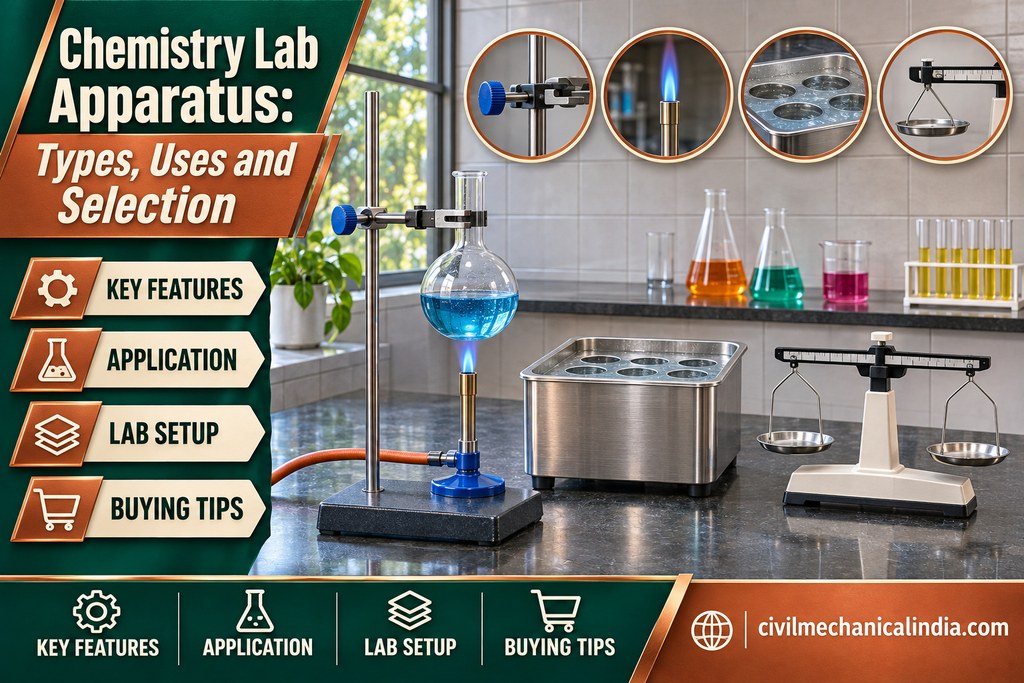
Chemistry lab apparatus covers everything a student or analyst uses to hold, heat, measure and separate substances. We manufacture and supply chemistry apparatus from India for schools, colleges and quality control rooms. This guide sets out the main types, what each one does and how buyers in Tanzania, Uganda, Morocco, Algeria and Angola can choose well.
Types of chemistry lab apparatus and their uses
It helps to group the apparatus used in chemistry lab work by job.
| Job | Apparatus | Use |
|---|---|---|
| Support | Retort stand, clamp, boss head, tripod | Holds flasks, burettes and condensers steady |
| Heating | Lab burner, spirit lamp, hot plate, water bath | Heats samples directly or gently |
| Measuring | Balance, burette, pipette, measuring cylinder | Measures mass and volume |
| Containing | Beakers, flasks, test tubes | Holds liquids during reactions |
| Separating | Funnels, filter stands, distillation sets | Separates solids, liquids and vapours |
A retort stand and clamp is the most used support item in any chemistry room. Check that the base is heavy enough not to tip when a full burette is fitted.
Apparatus from our range
These items are listed in our Laboratory Apparatus category. The descriptions come from our product cards.
| Product | Code | Description on our website |
|---|---|---|
| Laboratory Retort Stand with Clamp and Boss Head | CMI-NP-1249 | Cast iron base, steel rod, boss heads, clamps |
| Laboratory Spirit Lamp and Bunsen Burner Set | CMI-NP-1250 | Glass spirit lamp, gas Bunsen burner, tripod, wire gauze |
| Laboratory Water Bath with Digital Temperature Control | CMI-NP-1251 | Stainless steel chamber, digital controller |
| Physical Balance with Weight Box | CMI-NP-1252 | Beam type, pan pair, fractional weight box |
Glass items sit in a separate category, Laboratory Glassware, and porcelain crucibles and basins are under Porcelain Ware.
How to select the right items
Use the experiment list to decide, then check four points:
- Heat source. If the lab has no piped gas, plan for spirit lamps, hot plates or bottled gas burners.
- Accuracy. Titration needs a proper burette and pipette. Rough volume work only needs a measuring cylinder.
- Material. Stainless steel and cast iron last longer than painted mild steel in a damp room.
- Quantity. One set per group of students, plus spares for items that break or go missing.
For a college or industrial lab, each chemistry lab instrument that gives a reading, such as a balance or a temperature-controlled bath, should be checked against a reference when it arrives.
What drives the price
We prepare a quotation for each enquiry. The price depends on:
- Size and material of stands, clamps and baths.
- Digital or analogue temperature control.
- The number of sets ordered.
- Whether glassware is included, and in which grade.
- Packing and freight to the destination port.
A long chemistry lab equipment list quoted together almost always costs less per item than small repeat orders.
Import and site notes by country
Check the supply voltage before ordering heated apparatus. Unpowered items need no adaptation.
| Country | Nominal mains supply | Usual port of entry | Note for this equipment |
|---|---|---|---|
| Tanzania | 230 V, 50 Hz | Dar es Salaam | Coastal air in Dar es Salaam corrodes steel quickly. Choose plated or stainless clamps and bosses. |
| Uganda | 240 V, 50 Hz | Mombasa, then road (landlocked) | Bottled gas is common in schools without piped supply. Ask for burners matched to the local gas type. |
| Morocco | 220 V, 50 Hz | Casablanca | French is widely used in technical education. Tell us if you need labels or manuals in French. |
| Algeria | 230 V, 50 Hz | Algiers | Customs paperwork is detailed. Send us the exact product descriptions your importer needs on the invoice. |
| Angola | 220 V, 50 Hz | Luanda | Portuguese-language tender documents are normal. Share the original text so descriptions match line by line. |
Mistakes to avoid
- Buying stands with light bases that tip over.
- Ordering burners without checking the gas type.
- Mixing up heating baths and serological baths, which have different temperature ranges.
- Forgetting consumables such as wire gauze, tubing and filter papers.
- Skipping a storage plan, which leads to loss and breakage within a year.
Frequently asked questions
What is the difference between chemistry apparatus and chemistry equipment?
In everyday use the words overlap. Apparatus usually means the simple items used at the bench, while equipment includes powered machines such as ovens, baths and stirrers.
Can you supply a list of chemistry laboratory apparatus and their uses for our tender?
Yes. Send the practicals you teach and we will return a table of items, each with its use and our product code, ready to paste into a specification.
Do you supply chemicals?
Our website lists apparatus and instruments. Chemicals are regulated for transport, so most buyers source them locally. Ask us if you are unsure about a specific item.
Ask for a quotation
Tell us what you teach or test, how many groups you have and where the goods must arrive. We will send an itemised offer. Reach us through the contact page, or browse the wider Educational Lab Equipments range first.