
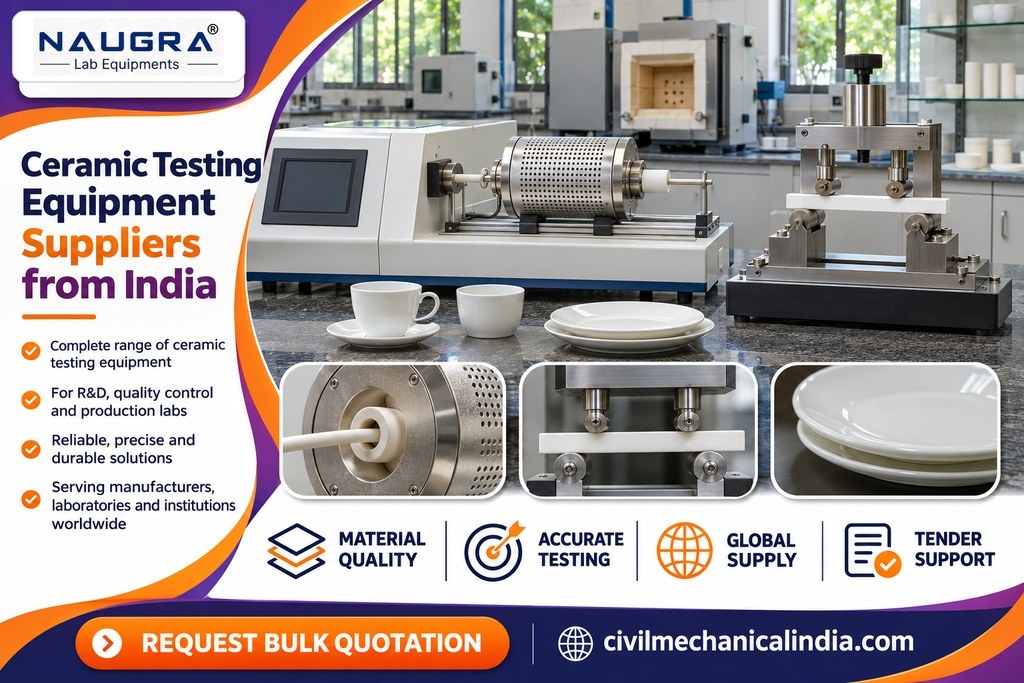
We supply ceramic testing equipment from India to producers of tableware, sanitaryware, insulators, refractories and technical ceramics, and to ceramic institutes. Ceramics are made from natural raw materials that vary, so testing controls each step from slip to fired piece. The model codes below are for tender buyers in Africa and South America.
Our ceramic testing equipment range
| Product | Model code | Use |
|---|---|---|
| Ceramic Dilatometer for Thermal Expansion of Porcelain Bodies | CMI-IND-0451 | Thermal expansion of bodies and glazes |
| Ceramic Four Point Flexural Strength Testing Machine | CMI-IND-0452 | Flexural strength by four-point bending |
| Ceramic Slip Viscosity and Casting Rate Test Apparatus | CMI-IND-0455 | Slip viscosity and casting rate |
| Ceramic Powder Particle Size and Sedimentation Analyser for Slips | CMI-IND-0454 | Particle size of slips by sedimentation |
| Ceramic Glaze Mohs Hardness and Scratch Test Set | CMI-IND-0453 | Scratch hardness of glazes |
| Ceramic Tableware Lead and Cadmium Release Test Set | CMI-IND-0456 | Lead and cadmium release from tableware |
Ten instruments are shown on our Porcelains and Ceramics Testing Instruments page.
Tests and applications
| Stage | Property | Test |
|---|---|---|
| Raw materials | Particle size, moisture | Sedimentation analyser, oven |
| Slip | Viscosity, thixotropy, casting rate | Viscometer, casting test |
| Body and glaze | Thermal expansion match | Dilatometer |
| Fired ware | Strength, absorption, hardness | Flexure tester, absorption test |
| Food contact ware | Lead and cadmium release | Extraction test set |
Glaze fit is the classic ceramic problem. If body and glaze expand differently on heating and cooling, the glaze crazes or peels. A dilatometer measures both, so the ceramist can adjust the recipe before a kiln load is lost.
Slip control decides casting time and defect rate in sanitaryware and tableware. Viscosity and casting rate are checked on every batch.
Tableware that touches food must not release harmful metals. Export markets enforce limits, and many African and South American countries are adopting them. Fired strength and water absorption complete the picture for insulators and technical products.
What to specify in a tender
- Products made: tableware, sanitaryware, insulators or technical ceramics.
- Temperature range for the dilatometer.
- Specimen dimensions and spans for strength tests.
- Slip types and the viscosity range.
- Regulations for metal release and the analysis method used.
Controlling a ceramic process
Raw material checks come first. Clays change from one part of a pit to another, so test each delivery for particle size, moisture and fired colour before it enters production.
Prepare test bars from each body batch and fire them with production ware. Measure shrinkage, absorption and strength, and plot them against kiln position. The results show both recipe drift and uneven firing.
Slip should be tested at the same temperature each time, as viscosity depends strongly on it. Record deflocculant additions with every reading. Keep glaze and body expansion records for each recipe, and repeat the measurement whenever a raw material source changes.
Small potteries and training centres can apply the same ideas with simple tools: a shrinkage bar, a balance for absorption and a consistent test tile for each glaze. Good records of even these basic checks prevent most losses.
Markets we supply in Africa and South America
Local clay resources support ceramic production in many countries of both regions, from sanitaryware plants to craft potteries.
| Country | Nominal mains supply | Usual port of entry | Note for buyers |
|---|---|---|---|
| Ghana | 230 V, 50 Hz | Tema | Clay deposits support brick, tile and emerging sanitaryware production. |
| Morocco | 220 V, 50 Hz | Casablanca | A long ceramic tradition alongside modern tableware and tile factories. |
| Ethiopia | 220 V, 50 Hz | Djibouti, then road or rail | New sanitaryware and tile investments need process control laboratories. |
| Zambia | 230 V, 50 Hz | Dar es Salaam or Durban, then road | Refractories for the copper industry are an important ceramic product. |
| Chile | 220 V, 50 Hz | San Antonio or Valparaíso | Mining uses large volumes of refractory and technical ceramics. |
| Ecuador | 120 V, 60 Hz | Guayaquil | Supply is 120 V at 60 Hz. Furnaces are specified to suit. |
Why source from us
- Raw material, slip, body and fired ware testers from one supplier.
- Food contact safety test apparatus.
- Tile and sanitaryware testers on the same order.
- Installation and training available.
Frequently asked questions
Does the metal release test need an analyser?
The test set prepares the extract. Analysis needs a suitable instrument, which we can discuss.
What temperature does the dilatometer reach?
We state the range in the offer. Tell us your firing temperatures.
Are sanitaryware tests covered?
Yes. See our Bathware Testing Instruments range.
Send us your tender requirements
Ceramic factories and institutes usually equip a laboratory that follows the process from raw clay to finished ware. Send us your tender requirements and we will reply to each line with the instrument we offer, its model code and the accessories included.
We can supply the ceramics laboratory from India: dilatometers, flexural strength testers, viscometers and casting test apparatus, particle size analysers, glaze hardness sets, metal release test sets, absorption apparatus, laboratory kilns, ball mills, ovens and balances.
Tell us the products you make, your firing range, the standards you must meet and the destination port. Write to us through the contact page. We reply with an itemised quotation and delivery time.
Ceramic processes differ widely, so each tender is quoted on its own scope. Craft training centres can ask for a simplified set that covers slip, shrinkage and glaze fit.